
Lucia in London
E. F. (Edward Frederic) Benson
THE CLASSIC COLLECTION · 1905
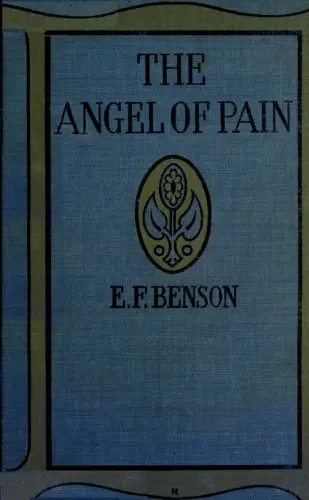
"The Angel of Pain" by E. F. Benson is a novel written in the early 20th century. The story unfolds in a lush summer garden and centers around Philip Home, a successful man often perceived as brusque and unsympathetic, yet who reveals a more intimate side with a close circle of friends and family. The narrative explores themes of love, societal expectations, and the complex dynamics of relationships against a backdrop of nature and beauty. The opening of the novel depicts a serene summer afternoon, where Philip is in his meticulously cultivated garden, reflecting on his prosperous life and the love he feels for Madge Ellington. His interactions with his mother, Mrs. Home, provide insights into his character and hints at his emotional depth. As they discuss their guests, including the enigmatic Hermit and artistic Evelyn Dundas, both characters become evocative representatives of different lifestyles and philosophies. The scene is painted vividly with rich descriptions of flowers, the warm atmosphere, and intellectual banter, setting the stage for the unfolding relationships and tensions among the characters throughout the story.
Introduction adapted from the source catalogue; source summaries may be automatically generated.
Free to read · English · 142,778 words · No account needed
MAKE TIME FOR A GOOD BOOK
On by default. Untick to stop anonymous reading totals. Each page counts after 10 seconds in view. How this works.
Anonymous counting is on unless you have switched it off.
"What a glorious morning, dear Madge," said Lady Dover. "Dr. Inglis has already made me his morning report. He has no further anxiety, I think, at all. I am so glad."
She herself had a pile of letters, of which she had opened only about half, but abandoned them entirely to talk to Madge, and make her tea. But the sight of all those letters, somehow, diverted Madge's attention from her own, and a sudden thought struck her, which was new.
"Lady Dover," she said abruptly, "I believe you have been putting all manner of visitors off because of poor Evelyn."
Lady Dover looked up in gentle, clear-eyed acquiescence.
"Why, my dear, it was most important he should be quite quiet," she
said.
Madge arrested the hand that was pouring out her tea.
"Ah, you dear," she said, "and all these days I never thought of it, or
thanked you."
The spout of the teapot poured a clear amber stream on to the
table-cloth.
"And I have spilt the tea, too," said Madge. "But I do thank you,
and--and I am frightened!"
"There is nothing wrong?"
"No; but they are going to take the bandages off, and what shall I see? Will you be there, too, and help me not to mind if it is dreadful? You see--you see, I suppose I loved his face as well, why not, and if all that is terribly changed.... They have told me it will be. And he must not guess that I mind, that I even see it is different. And when his hands tell him what has happened, as they will, I must still convince him somehow that to me there is no difference. Oh, I want help!" she cried. "Indeed it is not only for me, I want it for him--I must convince him that it does not matter."
But at this point Lady Dover failed a little. She was not, in spite of her obvious kindness and sympathy, quite human enough to go to the depths that Madge's gropings reached blind hands to. The trials and difficulties that came within her ken, the loss of someone loved, the parching of love in what had been a fountain, she could have understood, but the fear of a maimed face affecting love she could not quite grasp. Her idea of love may perhaps have been spiritually finer, it may also perhaps have not been adequately human.
There was a pause, anyhow, and since nothing but immediate and spontaneous reply was conceivable from Madge's point of view, she took up her letter again.
"This, too," she said, "it is from Philip."
But to that Lady Dover responded instantly.
Your reading position is saved on this browser. Take it to another device with a library code. Reading pages adapt to text, rather than matching a printed edition.
E. F. (Edward Frederic) Benson

E. F. (Edward Frederic) Benson

E. F. (Edward Frederic) Benson

E. F. (Edward Frederic) Benson
BEHIND THE BOOK
This eBook is for the use of anyone anywhere in the United States and most other parts of the world at no cost and with almost no restrictions whatsoever. You may copy it, give it away or re-use it under the terms of the Project Gutenberg License included with this eBook or online at www.gutenberg.org. If you are not located in the United States, you will have to check the laws of the country where you are located before using this eBook. Read the source licence.
The original source file, including credits and licence, is retained by this library. Request an original-format copy at no charge. Please include the book title and Project Gutenberg identifier #44210.
KEEP YOUR CURIOSITY GOING
Coulson Kernahan

Maurice Baring
Frances Wright
Cécile Tormay

Frederic Jesup Stimson

W. H. P. (William Henry Pope) Jarvis