
Lucia in London
E. F. (Edward Frederic) Benson
THE CLASSIC COLLECTION · 1905
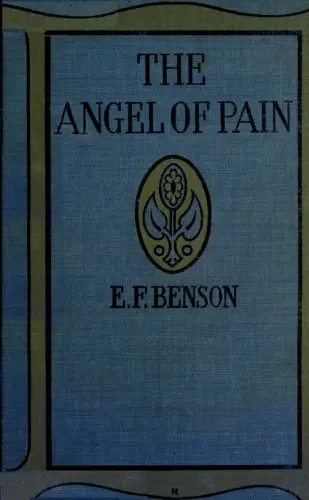
"The Angel of Pain" by E. F. Benson is a novel written in the early 20th century. The story unfolds in a lush summer garden and centers around Philip Home, a successful man often perceived as brusque and unsympathetic, yet who reveals a more intimate side with a close circle of friends and family. The narrative explores themes of love, societal expectations, and the complex dynamics of relationships against a backdrop of nature and beauty. The opening of the novel depicts a serene summer afternoon, where Philip is in his meticulously cultivated garden, reflecting on his prosperous life and the love he feels for Madge Ellington. His interactions with his mother, Mrs. Home, provide insights into his character and hints at his emotional depth. As they discuss their guests, including the enigmatic Hermit and artistic Evelyn Dundas, both characters become evocative representatives of different lifestyles and philosophies. The scene is painted vividly with rich descriptions of flowers, the warm atmosphere, and intellectual banter, setting the stage for the unfolding relationships and tensions among the characters throughout the story.
Introduction adapted from the source catalogue; source summaries may be automatically generated.
Free to read · English · 142,778 words · No account needed
MAKE TIME FOR A GOOD BOOK
On by default. Untick to stop anonymous reading totals. Each page counts after 10 seconds in view. How this works.
Anonymous counting is on unless you have switched it off.
But the courteous Scotsman did not reply; he gazed a moment longer, and then ran down the steep descent to the bridge. And in Madge the faint feeling of alarm grew stronger, though no less indefinable, as she looked at the leaping little grey speck growing every moment larger. At last she saw who it was; it was Mr. Osborne jumping and running for all he was worth. At that she followed her gillie, and hurried after him across the wire bridge. And as if a drum had beat to arms, legions of fears no longer indefinable leaped into her brain in hideous tumult.
A hundred yards ahead her gillie had met the running figure, and in a moment he had slung off the creel and started to run towards her, leaving Mr. Osborne to drop down, as if exhausted, in the heather.
"What is it?" she cried as he approached.
"An accident, ma'am," he said. "I don't know what."
Madge did not delay him, but went on towards Mr. Osborne. As she got near he sprang up from his seat.
"Ah, my dear Mrs. Dundas," he said; "don't go--don't go!"
His panting breath made him pause a moment, but he looked at her face of agony and apprehension, and, clenching his hands, went on.
"No, not killed; there is nobody dead. But there has been an accident, a ricochet off one of those rocks. Someone has been--yes, my poor, dear lady, it is your husband. But don't go; it is terrible."
But before he could say more to stop her she had passed him, and was
running up the hill.
Since the moment when the ice had been broken between Philip and Tom Merivale, and, what was perhaps more vital, since that terrible ice round Philip's heart had begun to thaw, talk between them, till then so scanty and superficial, had taken a plunge into the depths of things, into those cool, wavering obscurities that lie round the springs of life and death. And the import of this was perhaps no less weighty to the Hermit than it was to Philip; never before had he unveiled, not his mystery, but his exceeding simplicity, to another, except in so far as half-laughing paradox and the apparent marvel of the nightingale that sat on his hand and sang could be considered as unveiling. But he was very conscious in himself, with that premonition that birds and beasts, and all the living things, that have not had their natural instincts blunted for generations by indoor and artificial life, possess, that something critical was at hand. What that was he could not guess, and, indeed, refrained from trying to do so. But for months now he had waited for some revelation, as a neophyte waits for a further initiation. As far as he could tell he knew all the secrets of that antechamber in which he waited. Up to a certain point his knowledge was complete and consolidated; the joy of animate nature was utterly his, no thrush or scudding blackbird knew better than he the joy that comes from the mere fact of life and air and food and sleep and drink, of which every moment brings its own reward. To none, too, could he have stated this so easily as to his old friend, and the very fact that Philip was but now just beginning to emerge from black and bitter waters, made his understanding of it more piercing. It was the fresh, vital air to a man who has sunk and nearly been drowned in a pool, from the depths of which he has but just had strength to struggle, and lie with eyes but half open and mouth that could only just drink in the freshness of the day God made. And it was this very sunlight and freshness of air which penetrated to those other depths which were the springs of life and death. From the bitter depth of his own hell Philip had swum up into life, and yet as he went up he was getting down, by the same movement, into other depths; but these were cool, and no blackness mingled with their veiled obscurities.
Your reading position is saved on this browser. Take it to another device with a library code. Reading pages adapt to text, rather than matching a printed edition.
E. F. (Edward Frederic) Benson

E. F. (Edward Frederic) Benson

E. F. (Edward Frederic) Benson

E. F. (Edward Frederic) Benson
BEHIND THE BOOK
This eBook is for the use of anyone anywhere in the United States and most other parts of the world at no cost and with almost no restrictions whatsoever. You may copy it, give it away or re-use it under the terms of the Project Gutenberg License included with this eBook or online at www.gutenberg.org. If you are not located in the United States, you will have to check the laws of the country where you are located before using this eBook. Read the source licence.
The original source file, including credits and licence, is retained by this library. Request an original-format copy at no charge. Please include the book title and Project Gutenberg identifier #44210.
KEEP YOUR CURIOSITY GOING
Coulson Kernahan

Maurice Baring
Frances Wright
Cécile Tormay

Frederic Jesup Stimson

W. H. P. (William Henry Pope) Jarvis