
Lucia in London
E. F. (Edward Frederic) Benson
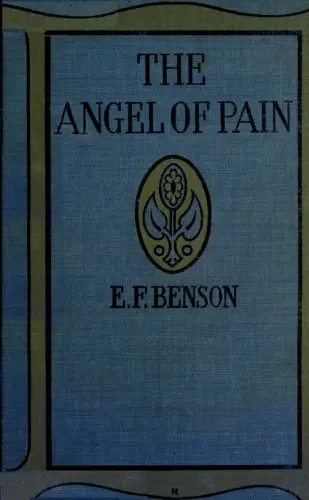
THE CLASSIC COLLECTION · 1905
"The Angel of Pain" by E. F. Benson is a novel written in the early 20th century. The story unfolds in a lush summer garden and centers around Philip Home, a successful man often perceived as brusque and unsympathetic, yet who reveals a more intimate side with a close circle of friends and family. The narrative explores themes of love, societal expectations, and the complex dynamics of relationships against a backdrop of nature and beauty. The opening of the novel depicts a serene summer afternoon, where Philip is in his meticulously cultivated garden, reflecting on his prosperous life and the love he feels for Madge Ellington. His interactions with his mother, Mrs. Home, provide insights into his character and hints at his emotional depth. As they discuss their guests, including the enigmatic Hermit and artistic Evelyn Dundas, both characters become evocative representatives of different lifestyles and philosophies. The scene is painted vividly with rich descriptions of flowers, the warm atmosphere, and intellectual banter, setting the stage for the unfolding relationships and tensions among the characters throughout the story.
Introduction adapted from the source catalogue; source summaries may be automatically generated.
Free to read · English · 142,778 words · No account needed
MAKE TIME FOR A GOOD BOOK
On by default. Untick to stop anonymous reading totals. Each page counts after 10 seconds in view. How this works.
Anonymous counting is on unless you have switched it off.
"I warn you that you will have a good deal of my company, then," said
he.
She laughed again.
"But as you are my host I can't decently object," she said. "Oh, tell me, Mr. Home, what is Mr. Dundas like? You are a great friend of his, are you not? He was at tea, and asked a series of the silliest riddles, which somehow made me giggle. Giggle hopelessly, do you understand; they were so stupid. And he is the Mr. Dundas, who paints everybody as if they were so much more interesting than they are?"
"Yes, evidently the same," said Philip. "And what you say is quite true. Yet, again, as you say, his conversation is futile beyond words."
Madge walked on again in silence a little.
"I think that combination is rather charming," she said. "People don't laugh enough, and certainly he makes one laugh. I wish I laughed more, for instance."
"And has Merivale come?" asked Philip.
"Yes; he was at tea, too. What does he do?"
"He doesn't do anything. He just thinks."
"Good heavens! how frightfully fatiguing. All the time, do you mean?"
"Yes, all the time. Have you never met him before? Yet, how should you? He lives in the New Forest, and communes with birds and animals. People think he is mad, but he is the sanest person I know."
"Why?" asked she.
"Because he has had the wit to find out what he likes, and to do it all
the time."
"And what is that?" asked the girl.
"He sits by a stream and looks at the water. Then he lies on his back and looks at the sky. Then he whistles, chuckles, what you please to call it, and the thrushes come scudding out of the bushes and chuckle back at him."
"Is that not rather uncanny?" asked Madge.
"Most uncanny. Some day, as I tell him, he will see Pan. And I shall then have to attend a funeral."
The girl's eyebrows wrinkled into a frown.
"Pan?" she said.
"Yes; he is the God of 'Go as you please!' And his temple is a lunatic asylum. But don't be alarmed. The Hermit won't go into a lunatic asylum yet awhile."
"The Hermit?"
"Yes, the Hermit is Merivale. Because he lives quite alone in the New Forest. He never reads, he hardly ever sees anybody, he never does anything. He used to write at one time."
Madge shivered slightly.
"How intensely uncomfortable!" she said. "I think I shall like Mr.
Dundas best."
"You are sure to like him."
"Because everybody does? That is the worst of reasons. I always distrust
very popular people."
Your reading position is saved on this browser. Take it to another device with a library code. Reading pages adapt to text, rather than matching a printed edition.
E. F. (Edward Frederic) Benson

E. F. (Edward Frederic) Benson

E. F. (Edward Frederic) Benson

E. F. (Edward Frederic) Benson
BEHIND THE BOOK
This eBook is for the use of anyone anywhere in the United States and most other parts of the world at no cost and with almost no restrictions whatsoever. You may copy it, give it away or re-use it under the terms of the Project Gutenberg License included with this eBook or online at www.gutenberg.org. If you are not located in the United States, you will have to check the laws of the country where you are located before using this eBook. Read the source licence.
The original source file, including credits and licence, is retained by this library. Request an original-format copy at no charge. Please include the book title and Project Gutenberg identifier #44210.
KEEP YOUR CURIOSITY GOING
Coulson Kernahan

Maurice Baring
Frances Wright
Cécile Tormay

Frederic Jesup Stimson

W. H. P. (William Henry Pope) Jarvis