
Last letters from the living dead man
David Patterson (Spirit) Hatch
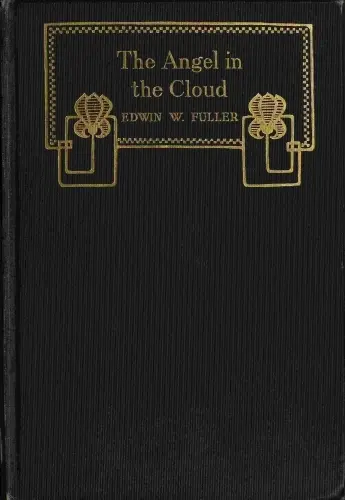
THE CLASSIC COLLECTION · 1907
"The Angel in the Cloud" by Edwin W. Fuller is a poetic work written in the early 20th century. This volume invites readers into a deeply reflective exploration of human existence, intertwining themes of nature, spirituality, and the searching for meaning through powerful imagery and allegorical elements. The opening sets the stage for a journey both outward and inward, where the author contemplates the complexity of life and the divine. At the start of this work, the narrator experiences a day overwhelmed by oppressive heat, prompting an escape into nature. Through the vivid descriptions of the setting—a stifling summer day giving way to an enchanting park—the narrator reflects on nature's beauty and its contrasting injustices, expressing thoughts on providence and fate. A shift occurs as the narrator embarks on a dreamlike vision that takes him on a cosmic journey, encountering an angel and ultimately leading to insights about the divine and the human condition. The opening serves to evoke a sense of wonder while posing profound questions about the balance of joy and suffering in existence.
Introduction adapted from the source catalogue; source summaries may be automatically generated.
Free to read · English · 30,009 words · No account needed
MAKE TIME FOR A GOOD BOOK
On by default. Untick to stop anonymous reading totals. Each page counts after 10 seconds in view. How this works.
Anonymous counting is on unless you have switched it off.
The good lies in the thought of pleasing God: The consciousness that God is pleased with us, A pleasure yields, and good might there be sought For pleasure’s sake, and prove a selfish aim; But moral selfishness a pain imparts, And good, for pleasure sought, defeats the search.
The good is sought, because it pleases God,
Not with the doer, but with what is done.
Good has its origin in th’ idea God,
And what He loves; but to continue good
It must retain approval in the act,
And not transfer it to the agent’s self.
The consciousness that God approves a deed,
Makes Man approve, and thus his mind is brought
In correlation with the Mind Divine.
The man who does an alms, if done to gain
God’s favor for himself, feels selfish pain;
But if because the act, not he, will please,
He finds the pleasure. Man, as time rolls on,
Finds general laws that please or displease God,
And ranging, under these, subordinates
Amenable to them and not to God,
The moral quality of lesser deeds
He reckons by these laws, nor does ascend
To God, that gives their moral quality.
Jouffroy, in Order, placed the Abstract Good,
And paused a step below the real truth,
The idea God, whence Order emanates.
Thus Man, progressing, good withdraws from God
And seems an independent entity,
And man denominates it, Abstract Good.
He can attain the Abstract but in part;
When mind is freed from flesh, he may attain
To its full grandeur. Here, at most, he grasps
A faint outline, and fits it on concrete.
No concept occupies one act of mind,
But opening the lettered label, he
May count the attributes, and by an act
Complex, of memory and cognition, gain
Some idea of his Abstract. Thus of “Man,”
One act can only cognize M-A-N,
But opening, he finds the attributes,
As “mammal,” “biped,” “vertebrate.” This act
Is complex, and he cannot unitize,
Save by the bundle of a word. You’ve said
It answers all the purposes of life,
Then why seek more? lest speculation vain
Point out dim realms, where Man can never tread,
These baffling thoughts are given, as peacocks’ feet,
To Man’s fond pride. The simplest avenue
Of thought, pursued, will reach absurdity,
To comprehension finite.
Even the truth
Of numbers you presume to doubt. Two balls,
You claim, can ne’er be two unless alike.
You mingle quantity and number, foolishly,
As if a ball the size of Earth, and one,
A tiny mustard-seed, would not be two!
You deem all Mathematics wide at fault,
Because Man’s powers to illustrate are weak.
Earth has oft seen a pure right angle drawn,
Because Man’s sight could not detect a flaw;
And if to his discernment perfect made,
He must admit its perfect form. If life,
In every intricate demand, finds truth,
Why seek to overturn by sophistry?
You see and know Achilles far beyond
The tortoise, yet the super-wise must prove
That he can never pass the creeping thing,
Although his speed a hundred times as swift!
When Man commences, he may find a doubt
In everything; his life, his neighbor’s life,
The outside world, may all be but a myth;
Then let him so believe, but let him act
Consistently; but does the skeptic so?
He crams all Nature in his little mind,
Yet how he cringes to her slightest law!
He flees the rain, and wards the cold, or fears
The lightning’s glittering blow. He doubts his frame
Can work by mechanism so absurd,
Yet will not for a day refrain from food!
Your reading position is saved on this browser. Take it to another device with a library code. Reading pages adapt to text, rather than matching a printed edition.
BEHIND THE BOOK
This eBook is for the use of anyone anywhere in the United States and most other parts of the world at no cost and with almost no restrictions whatsoever. You may copy it, give it away or re-use it under the terms of the Project Gutenberg License included with this eBook or online at www.gutenberg.org. If you are not located in the United States, you will have to check the laws of the country where you are located before using this eBook. Read the source licence.
The original source file, including credits and licence, is retained by this library. Request an original-format copy at no charge. Please include the book title and Project Gutenberg identifier #57504.
KEEP YOUR CURIOSITY GOING
David Patterson (Spirit) Hatch

David Patterson (Spirit) Hatch

David Patterson (Spirit) Hatch

Edwin Abbott Abbott

Richard Watson
T. G. (Theophilus Gould) Steward