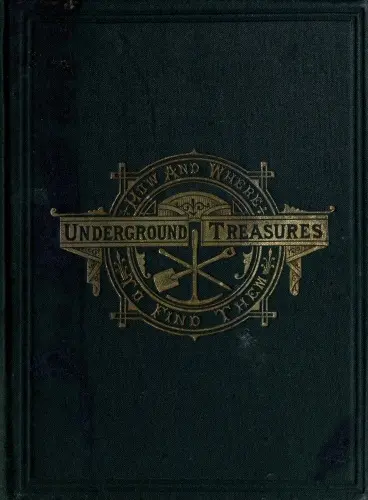
Underground Treasures: How and Where to Find Them A Key for the Ready Determination of All the Useful Minerals Within the United States
James Orton
THE CLASSIC COLLECTION · 1870
"The Andes and the Amazon: Or, Across the Continent of South America" by James Orton is a travel narrative and scientific account written in the late 19th century. This volume emerges from an expedition to the equatorial Andes and the Amazon River, aimed at exploring and documenting the geography, natural history, and cultures of South America. The author, a professor of natural history, undertakes the journey with a group of fellow scientists and adventurers, seeking to shed light on the largely uncharted regions of Ecuador and the Amazon basin. At the start of the book, Orton recounts the arrival of his party in Guayaquil, Ecuador, painting a vivid picture of the city's climate, commerce, and cultural atmosphere. He describes the contrasting perceptions of the city as seen from a distance versus the reality of its structures upon closer inspection. His observations of the local flora, fauna, and the bustling life along the river set the stage for his expedition into the Andes. This opening chapter establishes the backdrop for the journey ahead, highlighting the adventure and challenges that await as Orton and his companions prepare to traverse the exotic and largely uncharted landscapes of South America.
Introduction adapted from the source catalogue; source summaries may be automatically generated.
Free to read · English · 95,479 words · No account needed
MAKE TIME FOR A GOOD BOOK
On by default. Untick to stop anonymous reading totals. Each page counts after 10 seconds in view. How this works.
Anonymous counting is on unless you have switched it off.
Leaving Quito in the afternoon by the old arched gateway at the foot of Panecillo, and crossing a spur of the mountain, we stopped for the night at the Jesuit hacienda, situated in the beautiful valley of Lloa, but nearly ruined by the earthquake of 1859. On the damp walls of this monastery, perched 10,268 feet above the ocean, we found several old paintings, among them a copy of the Visitation by Rubens. The sunset views in this heart of the Andes were surpassingly beautiful. Mounting our horses at break of day, and taking an Indian guide, we ascended rapidly, by a narrow and difficult path, through the forest that belts the volcano, up to the height of 12,000 feet, emerging gradually into a thicket of stunted bushes, and then entered the dreary paramo. Splendid was the view of the Eastern Cordillera. At least six dazzling white volcanoes were in sight just across the Valley of Quito, among them table-topped Cayambi, majestic Antisana, and princely Cotopaxi, whose tapering summit is a mile above the clouds. Toiling upward, we reached the base of the cone, where vegetation ceased entirely; and, tying our horses to some huge rocks that had fallen from the mural cliff above, started off on hands and feet for the crater. The cone is deeply covered with sand and cinders for about two hundred feet, and the sides are inclined at an angle of about 35 deg.. At ten o'clock we reached the brim of the crater, and the great gulf burst suddenly into view. We can never forget the impression made upon us by the sight. We speak of many things here below as awful, but that word has its full meaning when carried to the top of Pichincha. There you see a frightful opening in the earth's crust nearly a mile in width and half a mile deep, and from the dark abyss comes rolling up a cloud of sulphurous vapors. Monte Somma in the time of Strabo was a miniature; but this crater is on the top of a mountain four times the height of the Italian volcano. Imagination finds it difficult to conceive a spectacle of more fearful grandeur or such solemn magnificence. It well accords with Milton's picture of the bottomless pit. The united effect of the silence and solitude of the place, the great depth of the cavity, the dark precipitous sides, and the column of smoke standing over an unseen crevice, was to us more impressive than thundering Cotopaxi or fiery Vesuvius. Humboldt, after standing on this same brink, exclaimed, "I have never beheld a grander or more remarkable picture than that presented by this volcano;" and La Condamine compared it to "the Chaos of the poets." Below us are the smouldering fires which may any moment spring forth into a conflagration; around us are black, ragged cliffs--fit boundary for this gateway to the infernal regions. They look as if they had just been dragged up from the central furnace of the earth. Life seems to have fled in terror from the vicinity; even lichens, the children of the bare rocks, refuse to clothe the scathed and beetling crags. For some moments, made mute by the dreadful sight, we stood like statues on the rim of the mighty caldron, with our eyes riveted on the abyss below, lost in contemplating that which can not be described. The panorama from this lofty summit is more pleasing, but equally sublime. Toward the rising sun is the long range of the Eastern Cordillera, hiding from our view the great valley of the Amazon. To right and left are the peaks of another procession of august mountains from Cotocachi to Chimborazo. We are surrounded by the great patriarchs of the Andes, and their speaker, Cotopaxi, ever and anon sends his muttering voice over the land. The view westward is like looking down from a balloon. Those parallel ridges of the mountain chain, dropping one behind the other, are the gigantic staircase by which the ice-crowned Chimborazo steps down to the sea. A white sea of clouds covers the peaceful Pacific and the lower parts of the coast. But the vapory ocean, curling into the ravines, beautifully represents little coves and bays, leaving islands and promontories like a true ocean on a broken shore. We seem raised above the earth, which lies like an opened map below us; we can look down on the upper surface of the clouds, and, were it night, down too upon the lightnings.
Your reading position is saved on this browser. Take it to another device with a library code. Reading pages adapt to text, rather than matching a printed edition.
BEHIND THE BOOK
This eBook is for the use of anyone anywhere in the United States and most other parts of the world at no cost and with almost no restrictions whatsoever. You may copy it, give it away or re-use it under the terms of the Project Gutenberg License included with this eBook or online at www.gutenberg.org. If you are not located in the United States, you will have to check the laws of the country where you are located before using this eBook. Read the source licence.
The original source file, including credits and licence, is retained by this library. Request an original-format copy at no charge. Please include the book title and Project Gutenberg identifier #19209.
KEEP YOUR CURIOSITY GOING
Wilfrid Scawen Blunt
Wilfrid Scawen Blunt

E. W. (Edgar Watson) Howe
Cécile Tormay

Moritz Busch
John L. Ransom