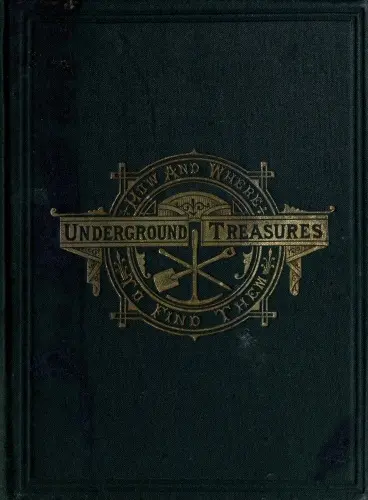
Underground Treasures: How and Where to Find Them A Key for the Ready Determination of All the Useful Minerals Within the United States
James Orton
THE CLASSIC COLLECTION · 1870
"The Andes and the Amazon: Or, Across the Continent of South America" by James Orton is a travel narrative and scientific account written in the late 19th century. This volume emerges from an expedition to the equatorial Andes and the Amazon River, aimed at exploring and documenting the geography, natural history, and cultures of South America. The author, a professor of natural history, undertakes the journey with a group of fellow scientists and adventurers, seeking to shed light on the largely uncharted regions of Ecuador and the Amazon basin. At the start of the book, Orton recounts the arrival of his party in Guayaquil, Ecuador, painting a vivid picture of the city's climate, commerce, and cultural atmosphere. He describes the contrasting perceptions of the city as seen from a distance versus the reality of its structures upon closer inspection. His observations of the local flora, fauna, and the bustling life along the river set the stage for his expedition into the Andes. This opening chapter establishes the backdrop for the journey ahead, highlighting the adventure and challenges that await as Orton and his companions prepare to traverse the exotic and largely uncharted landscapes of South America.
Introduction adapted from the source catalogue; source summaries may be automatically generated.
Free to read · English · 95,479 words · No account needed
MAKE TIME FOR A GOOD BOOK
On by default. Untick to stop anonymous reading totals. Each page counts after 10 seconds in view. How this works.
Anonymous counting is on unless you have switched it off.
The population of Para is thirty-five thousand, or double what it was when Wallace and Bates entered it twenty years ago. It is the largest city on the largest river in the world, and the capital of a province ten times the size of New York State. The enterprising, wealthy class consists of Portuguese and pure Brazilians, with a few English, Germans, French, and North Americans. The multitude is an amalgamation of Portuguese, Indian, and Negro. The diversity of races, and the mingled dialects of the Amazon and Europe, make an attractive street scene. Side by side we see the corpulent Brazilian planter, the swarthy Portuguese trader, the merry Negro porter, and the apathetic Indian boatman. Some of the more recent offspring are dressed a la Adam before the fall; numbers wear only a shirt or skirt; the negro girls who go about the streets with trays of sweetmeats on their heads are loosely yet prettily dressed in pure white, with massive gilded chains and earrings; but the middle and upper classes generally follow Paris fashions. The mechanic arts are in the hands of free Negroes and Indians, mulattoes and mamelucos.[144] Commerce is carried on almost exclusively by Portuguese and other foreigners. Dry-goods come chiefly from England and France; groceries from Portugal; flour and hardware from the United States. The principal exports are rubber, cacao, coffee,[145] sugar, cotton, Brazil nuts, sarsaparilla, vanilla, farina, copaiba, tobacco, rum, hides, fish, parrots, and monkeys.[146] Para exceeds in the number of its indigenous commodities any other port in the world, but the trade at present is insignificant when we consider the vast extent and resources of the country. The city can never have a rival at the mouth of the Amazon, and is destined to become a great emporium. But Brazilian legislation stands in the way. Heavy import duties are charged--from 35 to 45 per cent.; and on the 1st of January, 1868, it was ordered that 15 per cent. must be paid in English gold. The consequence has been that gold has risen from 28 to 30 above par, creating an additional tax. Exportation is equally discouraging. There is a duty of nine per cent. to be paid at the custom-house, and seven per cent. more at the consulado. But this is not the sum total. Those who live outside of the province of Para, say above Obidos, must first pay an import of thirteen per cent. to get their produce into Para. For example: up the river crude rubber can be bought for twenty-five cents a pound; the trader pays twenty-five cents an arroba (thirty-two pounds) for transportation to Para from Santarem, exclusive of canoe hire and shipping; thirteen per cent. duty in entering Para, ten per cent. to the commission merchant, and sixteen per cent. more as export tax; making a total loss on labor of about fifty per cent. Brazil abounds with the most valuable woods in the world, but is prevented from competing with other nations by this system of self-strangulation. In 1867 the import duty on timber was twelve per cent. Though situated on the edge of a boundless forest, Para consumes large quantities of North American pine. There is not a grist-mill on the Amazon, and only two or three saw-mills. A dozen boards of red cedar (a very common timber) costs 60$000 per thousand (about thirty dollars) at Santarem. There is no duty on goods going to Peru. The current money, besides foreign gold, consists of copper coins and imperial treasury notes. The basis of calculation is the imaginary rey, equivalent to half a mill. The coins in use are the vintem (twenty reys), answering to our cent, the half vintem, and double vintem. The currency has so fluctuated in value that many of the pieces have been restamped. Fifty vintems make a milrey, expressed thus: 1$000. This is the smallest paper issue. Unfortunately, the notes may suddenly fall below par. As a great many counterfeits made in Portugal are in circulation, the government recalls the issue which has been counterfeited, notifying holders, by the provincial papers, that all such bills must be exchanged for a new issue within six months. Those not brought in at the end of that period lose ten per cent. of their value, and ten per cent. for each following month, until the value of the note is nil. The result has been that many persons trading up the river have lost heavily, and now demand hard money. Change is very scarce in Para.
Your reading position is saved on this browser. Take it to another device with a library code. Reading pages adapt to text, rather than matching a printed edition.
BEHIND THE BOOK
This eBook is for the use of anyone anywhere in the United States and most other parts of the world at no cost and with almost no restrictions whatsoever. You may copy it, give it away or re-use it under the terms of the Project Gutenberg License included with this eBook or online at www.gutenberg.org. If you are not located in the United States, you will have to check the laws of the country where you are located before using this eBook. Read the source licence.
The original source file, including credits and licence, is retained by this library. Request an original-format copy at no charge. Please include the book title and Project Gutenberg identifier #19209.
KEEP YOUR CURIOSITY GOING
Wilfrid Scawen Blunt
Wilfrid Scawen Blunt

E. W. (Edgar Watson) Howe
Cécile Tormay

Moritz Busch
John L. Ransom