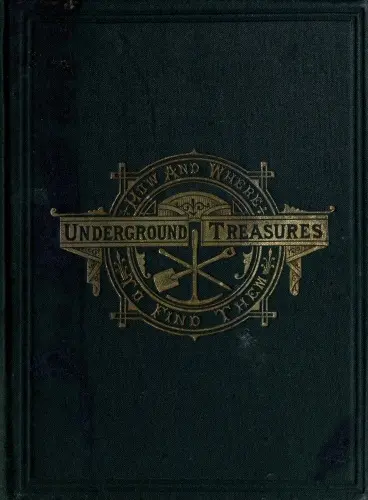
Underground Treasures: How and Where to Find Them A Key for the Ready Determination of All the Useful Minerals Within the United States
James Orton
THE CLASSIC COLLECTION · 1870
"The Andes and the Amazon: Or, Across the Continent of South America" by James Orton is a travel narrative and scientific account written in the late 19th century. This volume emerges from an expedition to the equatorial Andes and the Amazon River, aimed at exploring and documenting the geography, natural history, and cultures of South America. The author, a professor of natural history, undertakes the journey with a group of fellow scientists and adventurers, seeking to shed light on the largely uncharted regions of Ecuador and the Amazon basin. At the start of the book, Orton recounts the arrival of his party in Guayaquil, Ecuador, painting a vivid picture of the city's climate, commerce, and cultural atmosphere. He describes the contrasting perceptions of the city as seen from a distance versus the reality of its structures upon closer inspection. His observations of the local flora, fauna, and the bustling life along the river set the stage for his expedition into the Andes. This opening chapter establishes the backdrop for the journey ahead, highlighting the adventure and challenges that await as Orton and his companions prepare to traverse the exotic and largely uncharted landscapes of South America.
Introduction adapted from the source catalogue; source summaries may be automatically generated.
Free to read · English · 95,479 words · No account needed
MAKE TIME FOR A GOOD BOOK
On by default. Untick to stop anonymous reading totals. Each page counts after 10 seconds in view. How this works.
Anonymous counting is on unless you have switched it off.
At Napo we took possession of the governor's house. Each village in the Napo province was obliged to build an edifice of split bamboo for that dignitary; and, as he no longer exists, they are left unoccupied. They generally stand on the highest and best site in the town, and are a god-send to travelers. Immediately on our arrival, the Indian governor and his staff of justices called to see what we wanted, and during our stay supplied us with chickens, eggs, plantains, yucas, and fuel. His excellency would always come, silver-headed cane in hand, though the justices had only six eggs or a single fowl to bring us. The alcalde also paid us his respects. He is an old blanco (as the whites are called), doing a little traffic in gold dust, lienzo, and pita, but is the highest representative of Ecuador in the Napo country. Here, too, we met, to our great delight, Mr. George Edwards, a native of Connecticut, who has settled himself, probably for life, in the depths of this wilderness. He was equally rejoiced to see the face and hear the speech of a countryman. His industry and upright character have won for him the respect and good-will of the Indians, and he is favorably known in Quito. The government has given him a tract of land on the Yusupino, two miles west of Napo village. Here he is cultivating vanilla, of which he has now three thousand plants, and also his patience, for six years elapse after transplanting before a pod appears. He has been so long in the country (thirteen years) his English would now and then run off into Spanish or Quichua.
Napo is prettily situated on the left bank of the Rio Napo, a dense forest inclosing it on every side. The maximum number of inhabitants is eighty families; but many of these are in town only in festival seasons. It was well for us that we reached the Napo during the feasts; otherwise we might not have found men enough to man our canoes down the river. There are three or four blancos, petty merchants, who follow the old Spanish practice of compulsory sales, forcing the Indians to take lienzo, knives, beads, etc., at exorbitant prices, and making them pay in gold dust and pita. This kind of commerce is known under the name of repartos. It is hard to find an Indian whose gold or whose labor is not claimed by the blancos. The present and possible productions of this region are: bananas, plantains, yucas,[116] yams, sweet potatoes, rice, beans, corn, lemons, oranges, chirimoyas, anonas (a similar fruit to the preceding), pine-apples, palm cabbages, guavas, guayavas, castor-oil beans, coffee, cacao, cinnamon, India-rubber, vanilla (two kinds),[117] chonta-palm nuts, sarsaparilla, contrayerva (a mint), tobacco (of superior quality), and guayusa; of woods, balsam, red wood, Brazil wood, palo de cruz, palo de sangre, ramo caspi, quilla caspi, guayacan (or "holy wood," being much used for images), ivory palm, a kind of ebony, cedar, and aguana (the last two used for making canoes); of dyewoods, sarne (dark red), tinta (blue), terriri, and quito (black); of gums, estoraque (a balsam) and copal, besides a black beeswax, the production of a small (Trigona) bee, that builds its comb in the ground; of manufactures, pita, hammocks, twine, calabashes, aguardiente (from the plantain), chicha (from the yuca),[118] sugar and molasses (from the cane, which grows luxuriantly), and manati-lard; of minerals, gold dust. The gold, in minute spangles, is washed down by the rivers at flood time, chiefly from the Llanganati Mountains. The articles desired in exchange are lienzo, thread, needles, axes, hoes, knives, fish-hooks, rings, medals, crosses, beads, mirrors, salt, and poison. Quito nearly monopolizes the trade; though a few canoes go down the Napo to the Maranon after salt and poison. The salt comes from near Chasuta, on the Huallaga;[119] the urari from the Ticuna Indians. It takes about twenty days to paddle down to the Maranon, and three months to pole up. The Napo is navigable for a flat-bottomed steamer as far as Santa Rosa,[120] and it is a wonder that Anglo-Saxon enterprise has not put one upon these waters. The profits would be great, as soon as commercial relations with the various tribes were established.[121] Four yards of coarse cotton cloth, for example, will exchange for one hundred pounds of sarsaparilla. Urari is sold at Napo for its weight in silver. By a decree of the Ecuadorian Congress, there will be no duty on foreign goods entering the Napo for twenty years. The Napo region, under proper cultivation, would yield the most valuable productions of either hemisphere in profusion. But agriculture is unknown; there is no word for plow. The natives spend most of their time in idleness, or feasting and hunting. Their weapons are blow-guns and wooden spears; our guns they call by a word which signifies "thunder and lightning." Laying up for the future or for commerce is foreign to their ideas. The houses are all built of bamboo tied together with lianas, and shingled with leaves of the sunipanga palm. The Indians are peaceful, good-natured, and idle. They seldom steal any thing but food. Their only stimulants are chicha, guayusa, and tobacco. This last they roll up in plantain leaves and smoke, or snuff an infusion of it through the nose from the upper bill of a toucan. "The Peruvians (says Prescott, quoting Garcilasso) differ from every other Indian nation to whom tobacco was known by using it only for medicinal purposes in the form of snuff." There is no bread on the Napo; the nearest approach to flour is yuca starch. There are no clocks or watches; time is measured by the position of the sun. The mean temperature at Napo village is about one degree warmer than that of Archidona. Its altitude above the sea is 1450 feet. The nights are cool, and there are no musquitoes; but sand-flies are innumerable. Jiggers also have been seen. There are no well-defined wet and dry seasons; but the most rain falls in May, June, and July. The lightning, Edwards informed us, seldom strikes. Dysentery, fevers, and rheumatism are the prevailing diseases; and we saw one case of goitre. But the climate is considered salubrious. Few twins are born; and there are fewer children than in Archidona--a difference ascribed by some to the exposure of the Napo people in gold washing; by others to the greater quantity of guayusa drunk by the Archidonians.
Your reading position is saved on this browser. Take it to another device with a library code. Reading pages adapt to text, rather than matching a printed edition.
BEHIND THE BOOK
This eBook is for the use of anyone anywhere in the United States and most other parts of the world at no cost and with almost no restrictions whatsoever. You may copy it, give it away or re-use it under the terms of the Project Gutenberg License included with this eBook or online at www.gutenberg.org. If you are not located in the United States, you will have to check the laws of the country where you are located before using this eBook. Read the source licence.
The original source file, including credits and licence, is retained by this library. Request an original-format copy at no charge. Please include the book title and Project Gutenberg identifier #19209.
KEEP YOUR CURIOSITY GOING
Wilfrid Scawen Blunt
Wilfrid Scawen Blunt

E. W. (Edgar Watson) Howe
Cécile Tormay

Moritz Busch
John L. Ransom