
Last letters from the living dead man
David Patterson (Spirit) Hatch
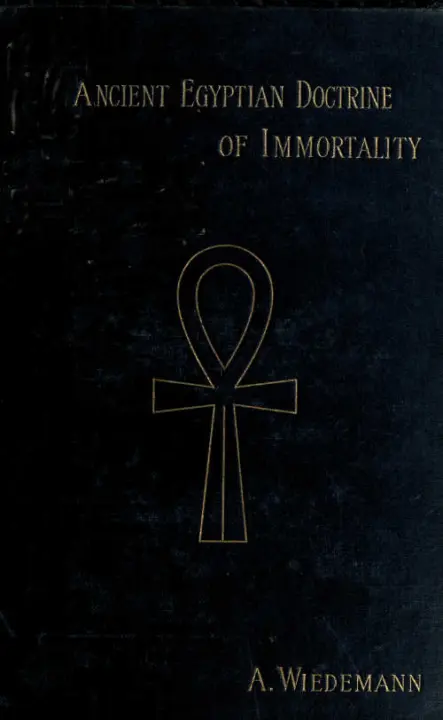
THE CLASSIC COLLECTION · 1895
"The Ancient Egyptian Doctrine of the Immortality of the Soul" by Alfred Wiedemann is a historical account published in the late 19th century. The book delves into the complex beliefs of ancient Egyptians regarding the immortality of the soul, focusing on their religious and cultural practices surrounding death and the afterlife. Wiedemann aims to provide a comprehensive understanding of the doctrines of immortality that were widely held across all strata of Egyptian society over a vast historical timeline. In the book, Wiedemann explores the multifaceted concepts related to the ancient Egyptian belief in the soul and its immortality. He delineates the various aspects of the soul, including components like the KA (spirit double), BA (soul), heart, and others, and examines their significance in the afterlife. The author describes the practices surrounding embalming, funerary rituals, and the journey of the Osiris, illustrating how these beliefs provided comfort and cultural continuity for Egyptians through the promise of eternal life. Through rich descriptions and references to ancient texts, Wiedemann illustrates the enduring influence of these doctrines on subsequent religious thought, notably Christianity.
Introduction adapted from the source catalogue; source summaries may be automatically generated.
Free to read · English · 13,607 words · No account needed
MAKE TIME FOR A GOOD BOOK
On by default. Untick to stop anonymous reading totals. Each page counts after 10 seconds in view. How this works.
Anonymous counting is on unless you have switched it off.
[24] The illustration is taken from photographs of a scarab in the Edwards collection at University College, London.
[25] For the translation of chap, xxx b. of The Book of the Dead, which formed the usual inscriptions on heart scarabs, see p. 53.
[26] The possession of the formula in chap, cxlviii. of The Book of
the Dead, from line 8, ensured abundance (of food) to the BA of the
dead.
[27] Illustrations 7 and 8 are taken from photographs of objects in the Edwards Museum at University College.
[28] See The Book of the Dead, NAVILLE’S edition, pls. 4, 97, 101, 104; LEPSIUS’ edition, pls. 33, etc., etc.
[29] See, e.g., illustration and Orcagna’s fresco of the Triumph of Death, in the Campo Santo of Pisa.
[30] See p. 10.
[31] VON BERGMANN, Sarkophag des Panehemisis, I., pp. 11, 15, 24; PIERRET, Insc. du Louvre, II., p. 23; MARIETTE, Dendérah, iv., 62a.
[32] The Book of the Dead, lxxxix. 6.
[33] VON BERGMANN, Sarkophag des Panehemisis, I., p. 37, where the translation is not quite accurately given.
[34] In Transactions of the Society of Biblical Archæology, VIII., p. 386 et seq., Birch has collected passages bearing on this point.
[35] On primitive beliefs as to a man’s shadow being a vital part of himself, see FRAZER, The Golden Bough, Vol. I., pp. 141-44.
[36] See MASPERO, Recueil de Travaux relatifs à Égypt, III., p. 105 et seq.; and Histoire Ancienne des Peuples de l’Orient, Vol. I., p. 114. In The Book of the Dead, chap. lxxxix., 3, the KHÛ is mentioned in connection with the BA; in chap. cxlix., 40, with the KHAÏB; and in chap. xcii., 5, with both.
[37] See p. 30.
[38] A certain part in the religious life of our own time has been played by a similar “Hypocephalus,” viz., the Mormon Scriptures (cf.: Joseph Smith, A Pearl of Great Price, 1851, p. 7). For particulars of the Hypocephalus of the illustration see Proceedings of the Society of Biblical Archæology, Vol. VI., p. 52, and plate.
[39] See Ebers, Æg. Zeitschr., 1867, p. 108; 1871, p. 48; WIEDEMANN, Proceedings of the Orientalist Congress at St. Etienne, II., p. 155.
Your reading position is saved on this browser. Take it to another device with a library code. Reading pages adapt to text, rather than matching a printed edition.
BEHIND THE BOOK
This eBook is for the use of anyone anywhere in the United States and most other parts of the world at no cost and with almost no restrictions whatsoever. You may copy it, give it away or re-use it under the terms of the Project Gutenberg License included with this eBook or online at www.gutenberg.org. If you are not located in the United States, you will have to check the laws of the country where you are located before using this eBook. Read the source licence.
The original source file, including credits and licence, is retained by this library. Request an original-format copy at no charge. Please include the book title and Project Gutenberg identifier #48875.
KEEP YOUR CURIOSITY GOING
David Patterson (Spirit) Hatch

David Patterson (Spirit) Hatch

David Patterson (Spirit) Hatch
Cécile Tormay

Moritz Busch
John L. Ransom