
Last letters from the living dead man
David Patterson (Spirit) Hatch
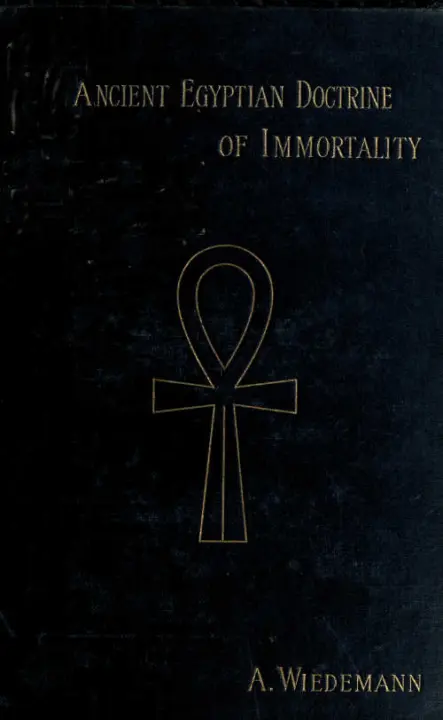
THE CLASSIC COLLECTION · 1895
"The Ancient Egyptian Doctrine of the Immortality of the Soul" by Alfred Wiedemann is a historical account published in the late 19th century. The book delves into the complex beliefs of ancient Egyptians regarding the immortality of the soul, focusing on their religious and cultural practices surrounding death and the afterlife. Wiedemann aims to provide a comprehensive understanding of the doctrines of immortality that were widely held across all strata of Egyptian society over a vast historical timeline. In the book, Wiedemann explores the multifaceted concepts related to the ancient Egyptian belief in the soul and its immortality. He delineates the various aspects of the soul, including components like the KA (spirit double), BA (soul), heart, and others, and examines their significance in the afterlife. The author describes the practices surrounding embalming, funerary rituals, and the journey of the Osiris, illustrating how these beliefs provided comfort and cultural continuity for Egyptians through the promise of eternal life. Through rich descriptions and references to ancient texts, Wiedemann illustrates the enduring influence of these doctrines on subsequent religious thought, notably Christianity.
Introduction adapted from the source catalogue; source summaries may be automatically generated.
Free to read · English · 13,607 words · No account needed
MAKE TIME FOR A GOOD BOOK
On by default. Untick to stop anonymous reading totals. Each page counts after 10 seconds in view. How this works.
Anonymous counting is on unless you have switched it off.
[6] We have a crude representation of this KA sign, dating from the reign of Amenemhat I., of the Twelfth Dynasty; see PETRIE, Tanis I. (Second Memoir of the Egypt Exploration Fund), pl. I., No. 3.
[7] LEPSIUS, Denkmäler, III. 186. The hands of the KA-staff have
doubtless a common origin with those of the KA-sign—[Illustration:
{H}].
[8] LEPSIUS, Denkmäler, III. 87.
[9] In the course of his excavations at Dêr el Bahri, for the Egypt Exploration Fund, M. Naville discovered the originals of these scenes in a series of bas-reliefs representing the birth of Queen Hatshepsû which were plagiarised by Amenophis III.
[10] LEPSIUS, Denkmäler, III. 21, 129.
[11] LEPSIUS, Denkmäler, III., pl. 75.
[12] Such prayers were also inscribed on funerary stelæ in order that passers-by might repeat them for the benefit of the dead. These inscriptions vary but little. The prayer on the funerary tablet of Khemnekht (now in the Agram Museum) dates from the Thirteenth Dynasty, and runs as follows: “O every scribe, every Kherheb (lector, priestly reciter), all ye who pass by this stele, who love and honour your gods, and would have your offices to flourish (shine) for your children, say ye: ‘Let royal offerings be brought unto Osiris for the Ka of the priest Khemnekht’”: For an account of the development of the formulæ on funerary stelæ, see WIEDEMANN, Observations sur quelques stèles funéraires égyptiennes, Le Muséon X., 42, 199 et seq.
[13] The particulars above summarised may be verified from contracts which a prince (erpā-hā) of Siût concluded with the priests of Anubis under the Tenth or Eleventh Dynasty (discussed by MASPERO, Transactions of the Society of Biblical Archæology VII., p. 6 et seq., Études de Mythologie, I., p. 62 et seq., and ERMAN, Æg. Zeitschr., 1882, p. 159 ff., the best publication of these inscriptions being that by GRIFFITH, Inscriptions of Siût and Dêr Rîfeh, London, 1889. Similar contracts were made even in the times of the pyramid-building kings: cf. e.g. LEPSIUS, Denkmäler, II. 3-7; DE ROUGÉ, Inscriptions hiéroglyphiques, pl. I.; MARIETTE, Les Mastabahs, p. 316 et seq.)
[14] As in the case of statues found in the temple of Ptah at Memphis (MARIETTE, Mon. div., pl. 27 b), and in that of Amon at Karnak (MARIETTE, Karnak, pl. 8 f; cf. LEPSIUS, Auswahl, pl. 11).
[15] This striking theory was first broached by MASPERO, Rec. de Trav., I., p. 154; Études de Mythologie, I., p. 80.
[16] We find occasional mention of the Ka of the East and the Ka of the West (Wilkinson, Manners and Customs, 2nd ed., III., pp. 200, 201), which are to be considered as being the Kas of the deities of the East and of the West, and not as Kas of the abstract conceptions of East and West.
Your reading position is saved on this browser. Take it to another device with a library code. Reading pages adapt to text, rather than matching a printed edition.
BEHIND THE BOOK
This eBook is for the use of anyone anywhere in the United States and most other parts of the world at no cost and with almost no restrictions whatsoever. You may copy it, give it away or re-use it under the terms of the Project Gutenberg License included with this eBook or online at www.gutenberg.org. If you are not located in the United States, you will have to check the laws of the country where you are located before using this eBook. Read the source licence.
The original source file, including credits and licence, is retained by this library. Request an original-format copy at no charge. Please include the book title and Project Gutenberg identifier #48875.
KEEP YOUR CURIOSITY GOING
David Patterson (Spirit) Hatch

David Patterson (Spirit) Hatch

David Patterson (Spirit) Hatch
Cécile Tormay

Moritz Busch
John L. Ransom