THE CLASSIC COLLECTION✦The anatomy of plantsCLASSIC FREE BOOKS
The anatomy of plants
Nehemiah Grew
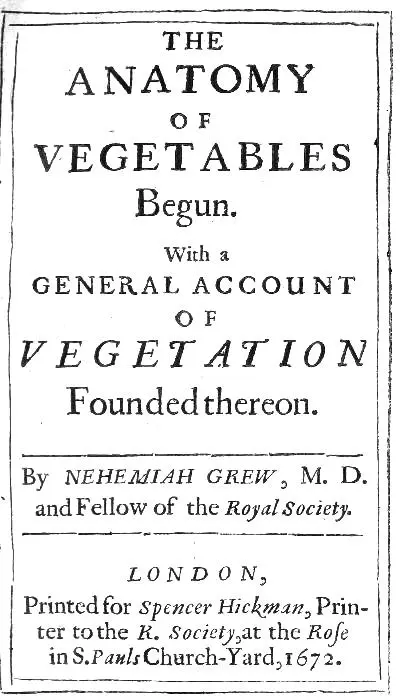
THE CLASSIC COLLECTION · 1672
"The Anatomy of Vegetables Begun" by Nehemiah Grew is a scientific publication written in the late 17th century. The work delves into the anatomical structure and functions of plants, particularly focusing on the process of vegetation from seed to plant. Grew presents detailed observations and dissections of various vegetable parts, emphasizing the underlying principles of plant growth. At the start of this treatise, Grew outlines his methodology and intentions, emphasizing the lack of prior comprehensive work on vegetable anatomy compared to animal anatomy. He introduces the garden bean as a primary subject for dissection, detailing its layers and internal structures. The opening chapters describe the anatomy of the seed, including its coats, main structures, and the roles of the radicle and plume in the growth of the plant. Grew encourages a systematic examination of vegetable anatomy to enhance understanding of the natural processes governing plant life.
Introduction adapted from the source catalogue; source summaries may be automatically generated.
Free to read · English · 29,010 words · No account needed
MAKE TIME FOR A GOOD BOOK
On by default. Untick to stop anonymous reading totals. Each page counts after 10 seconds in view. How this works.
Anonymous counting is on unless you have switched it off.
The other Part of the purest sap embosom’d in the Ramulets of the seed-Branch, runs a Circle, or some progress therein; and so becomes, as the Semen Masculinum, yet more elaborate.
Wherein also, lest its Current should be too copious or precipitate, by their co-arcture and divarication where they are inosculated, it is retarded; the noblest portion only obtaining a pass.
With this purest sap, the said Ramulets being supplied, from thence at last, the Navel-Fibres shoot (as the privitive Artery into the Colliquamentum) through the Secondine into the aforesaid Liquor deposited therein.
Into which Liquor, being now shot, and its own proper Sap or Tinctures mixed therewith, it strikes it thus into a Coagulum; or, of a Liquor, it becomes a Body consistent and truly Parenchymous; and the supply of the said Liquor still continu’d, and the shooting of the Navel-Fibres, as is above described, still carried on, and therewith the said Coagulation or Fixation likewise.
And in the Interim of the Coagulation, a gentle Fermentation being also made, the said Parenchyma or Coagulum becometh such, not of any Constitution indifferently, but is thus raised (as we see Bread in Baking) into a Congeries of Fixed Bubbles: For such is the Parenchyma of the whole Seed.
Fig. 1.
Sheweth a ~Bean~ with the two ~Lobes~ laid open somewhat wider than the Parts, without a Rupture, will well bear, for the better sight of that Part which lieth between them.
aaaa The two Lobes.
AA Their contiguous Flats.
b The Radicle.
c The Plume.
dd One of the Cavities wherein the Plume lieth.
Fig. 2.
aaaa The Parenchyma.
eeee The seminal Root distributed throughout the
Parenchyma of either Lobe.
b The Radicle, with the seminal Root running through it in one Trunk to the Point thereof.
c The Plume, with the Distributions of its Inner Body continued from the seminal Root of either Lobe.
xx The oblique Insertion of the two grand Branches of the Lobes into the Trunk of the Radicle.
Fig. 3.
The ~Lobe~ of a ~Bean~ cut athwart.
aaa The convex or external part thereof.
bbb The concave side out of sight.
cccc The Extremities of the Branches of the seminal Root, as they appear like so many small Specks in the traverse Cut.
Fig. 4.
The Plume cut athwart.
The black Specks represent the Branches of the seminal Body thereinto inserted, or therein distributed.
Fig. 5.
aaaa A Lobe of a Gourd-seed.
cccc The greater Branches.
ee The Sub-divisions and Inosculations of the lesser.
Fig. 5. 00.
AA A great white Lupine.
aa The Navel-Fibres which strike from the Ramulets of the Seed-Branch, into the Lobes.
Your reading position is saved on this browser. Take it to another device with a library code. Reading pages adapt to text, rather than matching a printed edition.
BEHIND THE BOOK
This eBook is for the use of anyone anywhere in the United States and most other parts of the world at no cost and with almost no restrictions whatsoever. You may copy it, give it away or re-use it under the terms of the Project Gutenberg License included with this eBook or online at www.gutenberg.org. If you are not located in the United States, you will have to check the laws of the country where you are located before using this eBook. Read the source licence.
The original source file, including credits and licence, is retained by this library. Request an original-format copy at no charge. Please include the book title and Project Gutenberg identifier #58138.
KEEP YOUR CURIOSITY GOING

John Muir

Asa Gray
Asa Gray

Florence Nightingale
Elizabeth Robins Pennell
Denison Olmsted