THE CLASSIC COLLECTION✦The anatomy of plantsCLASSIC FREE BOOKS
The anatomy of plants
Nehemiah Grew
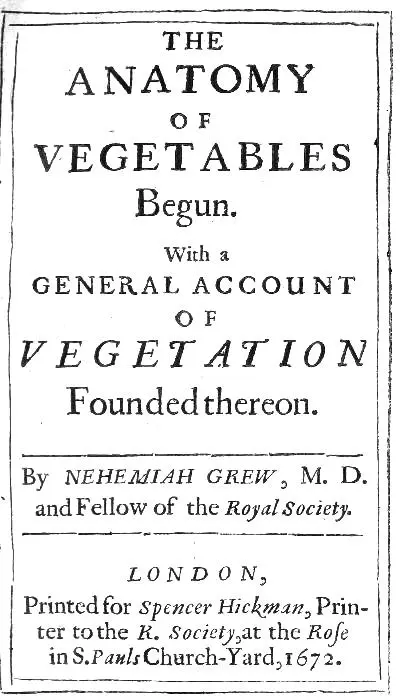
THE CLASSIC COLLECTION · 1672
"The Anatomy of Vegetables Begun" by Nehemiah Grew is a scientific publication written in the late 17th century. The work delves into the anatomical structure and functions of plants, particularly focusing on the process of vegetation from seed to plant. Grew presents detailed observations and dissections of various vegetable parts, emphasizing the underlying principles of plant growth. At the start of this treatise, Grew outlines his methodology and intentions, emphasizing the lack of prior comprehensive work on vegetable anatomy compared to animal anatomy. He introduces the garden bean as a primary subject for dissection, detailing its layers and internal structures. The opening chapters describe the anatomy of the seed, including its coats, main structures, and the roles of the radicle and plume in the growth of the plant. Grew encourages a systematic examination of vegetable anatomy to enhance understanding of the natural processes governing plant life.
Introduction adapted from the source catalogue; source summaries may be automatically generated.
Free to read · English · 29,010 words · No account needed
MAKE TIME FOR A GOOD BOOK
On by default. Untick to stop anonymous reading totals. Each page counts after 10 seconds in view. How this works.
Anonymous counting is on unless you have switched it off.
The Proportions of the Pith, are various; in Trees, but small; in Plants generally, very fair; in some making by far the greatest part of the Root; as in a Turnep: By reason of the wide circumference whereof, and so the finer Concoction and Assimilation of its Sap; that part which in most old Trunks is a dry and harsh Pith, here proves a tender pleasant meat. The parts of a Turnep in the travers cut see in Fig. 8.
In the Roots of very many Plants, as Turneps, Carrots, &c. the Lignous Body, besides its main utmost Ring, hath divers of its osculated Fibres dispersed throughout the Body of the Pith; sometimes all alike, and sometimes more especially in, or near, its Center; which Fibres, as they run towards the top of the Root, still declining the Center, at last collaterally strike into its Circumference; either all of them, or some few, keeping the Center still; of these principally the Lignous Body of the Trunk is often originated.
These Fibres, although they are so exceeding slender, yet in some Roots, as in that of Flower-de-liz, they are visibly concave, each of them, in their several Cavities also embosoming a very small Pith; the sight whereof, the Root being cut traverse, and laid in a Window for a day or two to dry, may without Glasses be obtained. And this is the general account of the Root; the declaration of the manner of its growth, with the use and service of its several parts, we shall next endeavour.
We say then, that the Radicle being impregnate, and shot into the Moulds, the contiguous moisture, by the Cortical Body, being a Body laxe and Spongy, is easily admitted: Yet not all indiscriminately, but that which is more adapt to pass through the surrounding Cuticle. Which transient Sap, though it thus becomes fine, yet is not simple; but a mixture of Particles, both in respect of those originally in the Root, and amongst themselves, somewhat heterogeneous. And being lodg’d in the Cortical Body moderately laxe, and of a Circular form; the effect will be an easie Fermentation. The Sap fermenting, a separation of Parts will follow; some whereof will be impacted to the Circumference of the Cortical Body, whence the Cuticle becomes a Skin; as we see in the growing of the Coats of Cheeses, of the Skin over divers Liquors, and the like. Whereupon the Sap passing into the Cortical Body, through this, as through a Manica Hippocratis, is still more finely filtred. With which Sap, the Cortical Body being dilated as far as its Tone, without a solution of Continuity will bear; and the supply of the Sap still renew’d; and the purest part, as most apt and ready, recedes, with its due Tinctures, from the said Cortical Body, to the Lignous. Which Lignous Body likewise super-inducing its own proper Tinctures into the said Sap; ’tis now to its highest preparation wrought up, and becomes (as they speak of that of an Animal) the Vegetative Ros or Cambium: the noblest part whereof is at last coagulated in, and assimilated to the like substance with the said Lignous Body. The remainder, though not united to it, yet tinctur’d therein, thus retreats, that is, by the continual appulse of the Sap, is in part carried off into the Cortical Body back again, the Sap whereof it now tinctures into good Aliment: So that whereas before the Cortical Body was only relaxed in its Parts, and so dilated; ’tis now increas’d in real quantity or number of parts, and so is truly nourish’d. And the Cortical Body being saturate with so much of this Vital Sap as serves it self; and the second Remainders discharged thence to the Skin; this also is nourish’d and augmented therewith. So that as in an Animal Body there is no instauration or growth of Parts made by the Bloud only, but the Nervous Liquor is also thereunto assistant; so is it here: the Sap prepared in the Cortical Body, is as the Arterious; and that part thereof prepared by the Lignous, is as the Nervous Liquor; which partly becoming Nutriment to it self, and partly being discharged back into the Cortical Body, and diffusing its Tincture through the Sap there, that to the said Cortical Body and Skin, becomes also true Nutriment, and so they all now grow.
Your reading position is saved on this browser. Take it to another device with a library code. Reading pages adapt to text, rather than matching a printed edition.
BEHIND THE BOOK
This eBook is for the use of anyone anywhere in the United States and most other parts of the world at no cost and with almost no restrictions whatsoever. You may copy it, give it away or re-use it under the terms of the Project Gutenberg License included with this eBook or online at www.gutenberg.org. If you are not located in the United States, you will have to check the laws of the country where you are located before using this eBook. Read the source licence.
The original source file, including credits and licence, is retained by this library. Request an original-format copy at no charge. Please include the book title and Project Gutenberg identifier #58138.
KEEP YOUR CURIOSITY GOING

John Muir

Asa Gray
Asa Gray

Florence Nightingale
Elizabeth Robins Pennell
Denison Olmsted