
Last letters from the living dead man
David Patterson (Spirit) Hatch
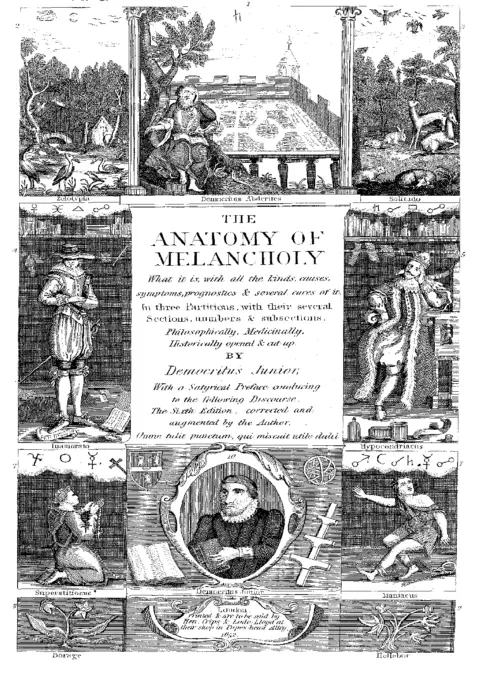
THE CLASSIC COLLECTION · 1617
"The Anatomy of Melancholy" by Robert Burton is a medical treatise first published in 1621. This massive work explores depression and its causes, symptoms, and cures, but ranges far beyond medicine into history, astronomy, geography, and literature. Written under the pseudonym Democritus Junior, Burton blends scientific analysis with humor and satire across over 500,000 words. Drawing from ancient authorities and medieval sources, he examines melancholy as both a passing mood and a serious ailment, creating a unique work that inspired generations of writers.
Introduction adapted from the source catalogue; source summaries may be automatically generated.
Free to read · English · 529,097 words · No account needed
MAKE TIME FOR A GOOD BOOK
On by default. Untick to stop anonymous reading totals. Each page counts after 10 seconds in view. How this works.
Anonymous counting is on unless you have switched it off.
SUBSECT. VI.—Parents a cause by Propagation.
That other inward inbred cause of Melancholy is our temperature, in whole or part, which we receive from our parents, which [1312]Fernelius calls Praeter naturam, or unnatural, it being an hereditary disease; for as he justifies [1313]Quale parentum maxime patris semen obtigerit, tales evadunt similares spermaticaeque paries, quocunque etiam morbo Pater quum generat tenetur, cum semine transfert, in Prolem; such as the temperature of the father is, such is the son's, and look what disease the father had when he begot him, his son will have after him; [1314]and is as well inheritor of his infirmities, as of his lands. And where the complexion and constitution of the father is corrupt, there ([1315]saith Roger Bacon) the complexion and constitution of the son must needs be corrupt, and so the corruption is derived from the father to the son. Now this doth not so much appear in the composition of the body, according to that of Hippocrates, [1316]in habit, proportion, scars, and other lineaments; but in manners and conditions of the mind, Et patrum in natos abeunt cum semine mores. Seleucus had an anchor on his thigh, so had his posterity, as Trogus records, lib. 15. Lepidus, in Pliny l. 7. c. 17, was purblind, so was his son. That famous family of Aenobarbi were known of old, and so surnamed from their red beards; the Austrian lip, and those Indian flat noses are propagated, the Bavarian chin, and goggle eyes amongst the Jews, as [1317] Buxtorfius observes; their voice, pace, gesture, looks, are likewise derived with all the rest of their conditions and infirmities; such a mother, such a daughter; their very [1318]affections Lemnius contends to follow their seed, and the malice and bad conditions of children are many times wholly to be imputed to their parents; I need not therefore make any doubt of Melancholy, but that it is an hereditary disease. [1319] Paracelsus in express words affirms it, lib. de morb. amentium to. 4. tr. 1; so doth [1320]Crato in an Epistle of his to Monavius. So doth Bruno Seidelius in his book de morbo incurab. Montaltus proves, cap. 11, out of Hippocrates and Plutarch, that such hereditary dispositions are frequent, et hanc (inquit) fieri reor ob participatam melancholicam intemperantiam (speaking of a patient) I think he became so by participation of Melancholy. Daniel Sennertus, lib. 1. part 2. cap. 9, will have his melancholy constitution derived not only from the father to the son, but to the whole family sometimes; Quandoque totis familiis hereditativam, [1321]Forestus, in his medicinal observations, illustrates this point, with an example of a merchant, his patient, that had this infirmity by inheritance; so doth Rodericus a Fonseca, tom. 1. consul. 69, by an instance of a young man that was so affected ex matre melancholica, had a melancholy mother, et victu melancholico, and bad diet together. Ludovicus Mercatus, a Spanish physician, in that excellent Tract which he hath lately written of hereditary diseases, tom. 2. oper. lib. 5, reckons up leprosy, as those [1322]Galbots in Gascony, hereditary lepers, pox, stone, gout, epilepsy, &c. Amongst the rest, this and madness after a set time comes to many, which he calls a miraculous thing in nature, and sticks for ever to them as an incurable habit. And that which is more to be wondered at, it skips in some families the father, and goes to the son, [1323]or takes every other, and sometimes every third in a lineal descent, and doth not always produce the same, but some like, and a symbolizing disease. These secondary causes hence derived, are commonly so powerful, that (as [1324]Wolfius holds) saepe mutant decreta siderum, they do often alter the primary causes, and decrees of the heavens. For these reasons, belike, the Church and commonwealth, human and Divine laws, have conspired to avoid hereditary diseases, forbidding such marriages as are any whit allied; and as Mercatus adviseth all families to take such, si fieri possit quae maxime distant natura, and to make choice of those that are most differing in complexion from them; if they love their own, and respect the common good. And sure, I think, it hath been ordered by God's especial providence, that in all ages there should be (as usually there is) once in [1325]600 years, a transmigration of nations, to amend and purify their blood, as we alter seed upon our land, and that there should be as it were an inundation of those northern Goths and Vandals, and many such like people which came out of that continent of Scandia and Sarmatia (as some suppose) and overran, as a deluge, most part of Europe and Africa, to alter for our good, our complexions, which were much defaced with hereditary infirmities, which by our lust and intemperance we had contracted. A sound generation of strong and able men were sent amongst us, as those northern men usually are, innocuous, free from riot, and free from diseases; to qualify and make us as those poor naked Indians are generally at this day; and those about Brazil (as a late [1326]writer observes), in the Isle of Maragnan, free from all hereditary diseases, or other contagion, whereas without help of physic they live commonly 120 years or more, as in the Orcades and many other places. Such are the common effects of temperance and intemperance, but I will descend to particular, and show by what means, and by whom especially, this infirmity is derived unto us. Filii ex senibus nati, raro sunt firmi temperamenti, old men's children are seldom of a good temperament, as Scoltzius supposeth, consult. 177, and therefore most apt to this disease; and as [1327]Levinus Lemnius farther adds, old men beget most part wayward, peevish, sad, melancholy sons, and seldom merry. He that begets a child on a full stomach, will either have a sick child, or a crazed son (as [1328]Cardan thinks), contradict. med. lib. 1. contradict. 18, or if the parents be sick, or have any great pain of the head, or megrim, headache, (Hieronymus Wolfius [1329]doth instance in a child of Sebastian Castalio's); if a drunken man get a child, it will never likely have a good brain, as Gellius argues, lib. 12. cap. 1. Ebrii gignunt Ebrios, one drunkard begets another, saith [1330]Plutarch, symp. lib. 1. quest. 5, whose sentence [1331]Lemnius approves, l. 1. c. 4. Alsarius Crutius, Gen. de qui sit med. cent. 3. fol. 182. Macrobius, lib. 1. Avicenna, lib. 3. Fen. 21. Tract 1. cap. 8, and Aristotle himself, sect. 2. prob. 4, foolish, drunken, or hair-brain women, most part bring forth children like unto themselves, morosos et languidos, and so likewise he that lies with a menstruous woman. Intemperantia veneris, quam in nautis praesertim insectatur [1332] Lemnius, qui uxores ineunt, nulla menstrui decursus ratione habita nec observato interlunio, praecipua causa est, noxia, pernitiosa, concubitum hunc exitialem ideo, et pestiferum vocat. [1333]Rodoricus a Castro Lucitanus, detestantur ad unum omnes medici, tum et quarta luna concepti, infelices plerumque et amentes, deliri, stolidi, morbosi, impuri, invalidi, tetra lue sordidi minime vitales, omnibus bonis corporis atque animi destituti: ad laborem nati, si seniores, inquit Eustathius, ut Hercules, et alii. [1334]Judaei maxime insectantur foedum hunc, et immundum apud Christianas Concubitum, ut illicitum abhorrent, et apud suos prohibent; et quod Christiani toties leprosi, amentes, tot morbili, impetigines, alphi, psorae, cutis et faciei decolorationes, tam multi morbi epidemici, acerbi, et venenosi sint, in hunc immundum concubitum rejiciunt, et crudeles in pignora vocant, qui quarta, luna profluente hac mensium illuvie concubitum hunc non perhorrescunt. Damnavit olim divina Lex et morte mulctavit hujusmodi homines, Lev. 18, 20, et inde nati, siqui deformes aut mutili, pater dilapidatus, quod non contineret ab [1335] immunda muliere. Gregorius Magnus, petenti Augustino nunquid apud [1336]Britannos hujusmodi concubitum toleraret, severe prohibuit viris suis tum misceri foeminas in consuetis suis menstruis, &c. I spare to English this which I have said. Another cause some give, inordinate diet, as if a man eat garlic, onions, fast overmuch, study too hard, be over-sorrowful, dull, heavy, dejected in mind, perplexed in his thoughts, fearful, &c., their children (saith [1337]Cardan subtil. lib. 18) will be much subject to madness and melancholy; for if the spirits of the brain be fuzzled, or misaffected by such means, at such a time, their children will be fuzzled in the brain: they will be dull, heavy, timorous, discontented all their lives. Some are of opinion, and maintain that paradox or problem, that wise men beget commonly fools; Suidas gives instance in Aristarchus the Grammarian, duos reliquit Filios Aristarchum et Aristachorum, ambos stultos; and which [1338]Erasmus urgeth in his Moria, fools beget wise men. Card. subt. l. 12, gives this cause, Quoniam spiritus sapientum ob studium resolvuntur, et in cerebrum feruntur a corde: because their natural spirits are resolved by study, and turned into animal; drawn from the heart, and those other parts to the brain. Lemnius subscribes to that of Cardan, and assigns this reason, Quod persolvant debitum languide, et obscitanter, unde foetus a parentum generositate desciscit: they pay their debt (as Paul calls it) to their wives remissly, by which means their children are weaklings, and many times idiots and fools. Some other causes are given, which properly pertain, and do proceed from the mother: if she be over-dull, heavy, angry, peevish, discontented, and melancholy, not only at the time of conception, but even all the while she carries the child in her womb (saith Fernelius, path. l. 1, 11) her son will be so likewise affected, and worse, as [1339]Lemnius adds, l. 4. c. 7, if she grieve overmuch, be disquieted, or by any casualty be affrighted and terrified by some fearful object, heard or seen, she endangers her child, and spoils the temperature of it; for the strange imagination of a woman works effectually upon her infant, that as Baptista Porta proves, Physiog. caelestis l. 5. c. 2, she leaves a mark upon it, which is most especially seen in such as prodigiously long for such and such meats, the child will love those meats, saith Fernelius, and be addicted to like humours: [1340]if a great-bellied woman see a hare, her child will often have a harelip, as we call it. Garcaeus, de Judiciis geniturarum, cap. 33, hath a memorable example of one Thomas Nickell, born in the city of Brandeburg, 1551, [1341]that went reeling and staggering all the days of his life, as if he would fall to the ground, because his mother being great with child saw a drunken man reeling in the street. Such another I find in Martin Wenrichius, com. de ortu monstrorum, c. 17, I saw (saith he) at Wittenberg, in Germany, a citizen that looked like a carcass; I asked him the cause, he replied, [1342]His mother, when she bore him in her womb, saw a carcass by chance, and was so sore affrighted with it, that ex eo foetus ei assimilatus, from a ghastly impression the child was like it. So many several ways are we plagued and punished for our father's defaults; insomuch that as Fernelius truly saith, [1343]It is the greatest part of our felicity to be well born, and it were happy for human kind, if only such parents as are sound of body and mind should be suffered to marry. An husbandman will sow none but the best and choicest seed upon his land, he will not rear a bull or a horse, except he be right shapen in all parts, or permit him to cover a mare, except he be well assured of his breed; we make choice of the best rams for our sheep, rear the neatest kine, and keep the best dogs, Quanto id diligentius in procreandis liberis observandum? And how careful then should we be in begetting of our children? In former times some [1344]countries have been so chary in this behalf, so stern, that if a child were crooked or deformed in body or mind, they made him away; so did the Indians of old by the relation of Curtius, and many other well-governed commonwealths, according to the discipline of those times. Heretofore in Scotland, saith [1345]Hect. Boethius, if any were visited with the falling sickness, madness, gout, leprosy, or any such dangerous disease, which was likely to be propagated from the father to the son, he was instantly gelded; a woman kept from all company of men; and if by chance having some such disease, she were found to be with child, she with her brood were buried alive: and this was done for the common good, lest the whole nation should be injured or corrupted. A severe doom you will say, and not to be used amongst Christians, yet more to be looked into than it is. For now by our too much facility in this kind, in giving way for all to marry that will, too much liberty and indulgence in tolerating all sorts, there is a vast confusion of hereditary diseases, no family secure, no man almost free from some grievous infirmity or other, when no choice is had, but still the eldest must marry, as so many stallions of the race; or if rich, be they fools or dizzards, lame or maimed, unable, intemperate, dissolute, exhaust through riot, as he said, [1346]jura haereditario sapere jubentur; they must be wise and able by inheritance: it comes to pass that our generation is corrupt, we have many weak persons, both in body and mind, many feral diseases raging amongst us, crazed families, parentes, peremptores; our fathers bad, and we are like to be worse.
Your reading position is saved on this browser. Take it to another device with a library code. Reading pages adapt to text, rather than matching a printed edition.
BEHIND THE BOOK
This eBook is for the use of anyone anywhere in the United States and most other parts of the world at no cost and with almost no restrictions whatsoever. You may copy it, give it away or re-use it under the terms of the Project Gutenberg License included with this eBook or online at www.gutenberg.org. If you are not located in the United States, you will have to check the laws of the country where you are located before using this eBook. Read the source licence.
The original source file, including credits and licence, is retained by this library. Request an original-format copy at no charge. Please include the book title and Project Gutenberg identifier #10800.
KEEP YOUR CURIOSITY GOING
David Patterson (Spirit) Hatch
Coulson Kernahan

Ralph Waldo Emerson
Frances Wright

Edwin Abbott Abbott

Joseph Droz