
Last letters from the living dead man
David Patterson (Spirit) Hatch
THE CLASSIC COLLECTION · 1617
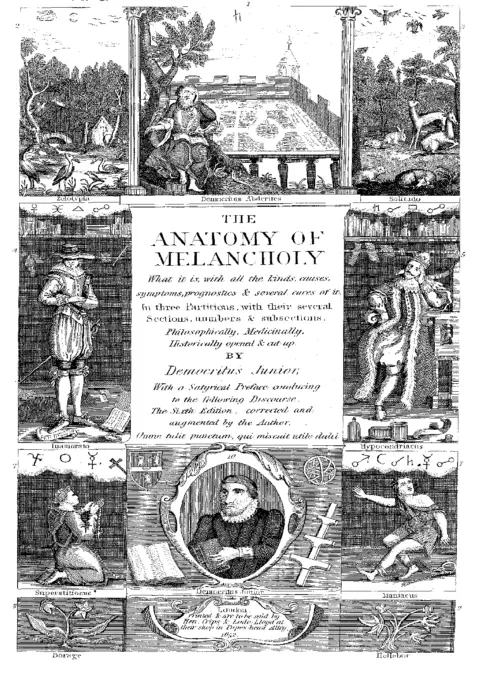
"The Anatomy of Melancholy" by Robert Burton is a medical treatise first published in 1621. This massive work explores depression and its causes, symptoms, and cures, but ranges far beyond medicine into history, astronomy, geography, and literature. Written under the pseudonym Democritus Junior, Burton blends scientific analysis with humor and satire across over 500,000 words. Drawing from ancient authorities and medieval sources, he examines melancholy as both a passing mood and a serious ailment, creating a unique work that inspired generations of writers.
Introduction adapted from the source catalogue; source summaries may be automatically generated.
Free to read · English · 529,097 words · No account needed
MAKE TIME FOR A GOOD BOOK
On by default. Untick to stop anonymous reading totals. Each page counts after 10 seconds in view. How this works.
Anonymous counting is on unless you have switched it off.
My angry ghost arising from the deep,
Shall haunt thee waking, and disturb thy sleep;
At least my shade thy punishment shall know,
And Fame shall spread the pleasing news below.
They are (as others suppose) appointed by those higher powers to keep men from their nativity, and to protect or punish them as they see cause: and are called boni et mali Genii by the Romans. Heroes, lares, if good, lemures or larvae if bad, by the stoics, governors of countries, men, cities, saith [1124]Apuleius, Deos appellant qui ex hominum numero juste ac prudenter vitae curriculo gubernato, pro numine, postea ab hominibus praediti fanis et ceremoniis vulgo admittuntur, ut in Aegypto Osyris, &c. Praestites, Capella calls them, which protected particular men as well as princes, Socrates had his Daemonium Saturninum et ignium, which of all spirits is best, ad sublimes cogitationes animum erigentem, as the Platonists supposed; Plotinus his, and we Christians our assisting angel, as Andreas Victorellus, a copious writer of this subject, Lodovicus de La-Cerda, the Jesuit, in his voluminous tract de Angelo Custode, Zanchius, and some divines think. But this absurd tenet of Tyreus, Proclus confutes at large in his book de Anima et daemone. Psellus [1125], a Christian, and sometimes tutor (saith Cuspinian) to Michael Parapinatius, Emperor of Greece, a great observer of the nature of devils, holds they are corporeal [1126], and have aerial bodies, that they are mortal, live and die, (which Martianus Capella likewise maintains, but our Christian philosophers explode) that they [1127]are nourished and have excrements, they feel pain if they be hurt (which Cardan confirms, and Scaliger justly laughs him to scorn for; Si pascantur aere, cur non pugnant ob puriorem aera? &c.) or stroken: and if their bodies be cut, with admirable celerity they come together again. Austin, in Gen. lib. iii. lib. arbit., approves as much, mutata casu corpora in deteriorem qualitatem aeris spissioris, so doth Hierome. Comment. in epist. ad Ephes. cap. 3, Origen, Tertullian, Lactantius, and many ancient Fathers of the Church: that in their fall their bodies were changed into a more aerial and gross substance. Bodine, lib. 4, Theatri Naturae and David Crusius, Hermeticae Philosophiae, lib. 1. cap. 4, by several arguments proves angels and spirits to be corporeal: quicquid continetur in loco corporeum est; At spiritus continetur in loco, ergo. [1128]Si spiritus sunt quanti, erunt corporei: At sunt quanti, ergo. sunt finiti, ergo. quanti, &c. Bodine [1129]goes farther yet, and will have these, Animae separatae genii, spirits, angels, devils, and so likewise souls of men departed, if corporeal (which he most eagerly contends) to be of some shape, and that absolutely round, like Sun and Moon, because that is the most perfect form, quae nihil habet asperitatis, nihil angulis incisum, nihil anfractibus involutem, nihil eminens, sed inter corpora perfecta est perfectissimum; [1130]therefore all spirits are corporeal he concludes, and in their proper shapes round. That they can assume other aerial bodies, all manner of shapes at their pleasures, appear in what likeness they will themselves, that they are most swift in motion, can pass many miles in an instant, and so likewise [1131]transform bodies of others into what shape they please, and with admirable celerity remove them from place to place; (as the Angel did Habakkuk to Daniel, and as Philip the deacon was carried away by the Spirit, when he had baptised the eunuch; so did Pythagoras and Apollonius remove themselves and others, with many such feats) that they can represent castles in the air, palaces, armies, spectrums, prodigies, and such strange objects to mortal men's eyes, [1132]cause smells, savours, &c., deceive all the senses; most writers of this subject credibly believe; and that they can foretell future events, and do many strange miracles. Juno's image spake to Camillus, and Fortune's statue to the Roman matrons, with many such. Zanchius, Bodine, Spondanus, and others, are of opinion that they cause a true metamorphosis, as Nebuchadnezzar was really translated into a beast, Lot's wife into a pillar of salt; Ulysses' companions into hogs and dogs, by Circe's charms; turn themselves and others, as they do witches into cats, dogs, hares, crows, &c. Strozzius Cicogna hath many examples, lib. iii. omnif. mag. cap. 4 and 5, which he there confutes, as Austin likewise doth, de civ. Dei lib. xviii. That they can be seen when and in what shape, and to whom they will, saith Psellus, Tametsi nil tale viderim, nec optem videre, though he himself never saw them nor desired it; and use sometimes carnal copulation (as elsewhere I shall [1133]prove more at large) with women and men. Many will not believe they can be seen, and if any man shall say, swear, and stiffly maintain, though he be discreet and wise, judicious and learned, that he hath seen them, they account him a timorous fool, a melancholy dizzard, a weak fellow, a dreamer, a sick or a mad man, they contemn him, laugh him to scorn, and yet Marcus of his credit told Psellus that he had often seen them. And Leo Suavius, a Frenchman, c. 8, in Commentar. l. 1. Paracelsi de vita longa, out of some Platonists, will have the air to be as full of them as snow falling in the skies, and that they may be seen, and withal sets down the means how men may see them; Si irreverberatus oculis sole splendente versus caelum continuaverint obtutus, &c., [1134]and saith moreover he tried it, praemissorum feci experimentum, and it was true, that the Platonists said. Paracelsus confesseth that he saw them divers times, and conferred with them, and so doth Alexander ab [1135]Alexandro, that he so found it by experience, when as before he doubted of it. Many deny it, saith Lavater, de spectris, part 1. c. 2, and part 2. c. 11, because they never saw them themselves; but as he reports at large all over his book, especially c. 19. part 1, they are often seen and heard, and familiarly converse with men, as Lod. Vives assureth us, innumerable records, histories, and testimonies evince in all ages, times, places, and [1136]all travellers besides; in the West Indies and our northern climes, Nihil familiarius quam in agris et urbibus spiritus videre, audire qui vetent, jubeant, &c. Hieronymus vita Pauli, Basil ser. 40, Nicephorus, Eusebius, Socrates, Sozomenus, [1137]Jacobus Boissardus in his tract de spirituum apparitionibus, Petrus Loyerus l. de spectris, Wierus l. 1. have infinite variety of such examples of apparitions of spirits, for him to read that farther doubts, to his ample satisfaction. One alone I will briefly insert. A nobleman in Germany was sent ambassador to the King of Sweden (for his name, the time, and such circumstances, I refer you to Boissardus, mine [1138]Author). After he had done his business, he sailed to Livonia, on set purpose to see those familiar spirits, which are there said to be conversant with men, and do their drudgery works. Amongst other matters, one of them told him where his wife was, in what room, in what clothes, what doing, and brought him a ring from her, which at his return, non sine omnium admiratione, he found to be true; and so believed that ever after, which before he doubted of. Cardan, l. 19. de subtil, relates of his father, Facius Cardan, that after the accustomed solemnities, An. 1491, 13 August, he conjured up seven devils, in Greek apparel, about forty years of age, some ruddy of complexion, and some pale, as he thought; he asked them many questions, and they made ready answer, that they were aerial devils, that they lived and died as men did, save that they were far longer lived (700 or 800 [1139]years); they did as much excel men in dignity as we do juments, and were as far excelled again of those that were above them; our [1140]governors and keepers they are moreover, which [1141]Plato in Critias delivered of old, and subordinate to one another, Ut enim homo homini sic daemon daemoni dominatur, they rule themselves as well as us, and the spirits of the meaner sort had commonly such offices, as we make horse-keepers, neat-herds, and the basest of us, overseers of our cattle; and that we can no more apprehend their natures and functions, than a horse a man's. They knew all things, but might not reveal them to men; and ruled and domineered over us, as we do over our horses; the best kings amongst us, and the most generous spirits, were not comparable to the basest of them. Sometimes they did instruct men, and communicate their skill, reward and cherish, and sometimes, again, terrify and punish, to keep them in awe, as they thought fit, Nihil magis cupientes (saith Lysius, Phis. Stoicorum) quam adorationem hominum. [1142]The same Author, Cardan, in his Hyperchen, out of the doctrine of Stoics, will have some of these genii (for so he calls them) to be [1143]desirous of men's company, very affable and familiar with them, as dogs are; others, again, to abhor as serpents, and care not for them. The same belike Tritemius calls Ignios et sublunares, qui nunquam demergunt ad inferiora, aut vix ullum habent in terris commercium: [1144]Generally they far excel men in worth, as a man the meanest worm; though some of them are inferior to those of their own rank in worth, as the blackguard in a prince's court, and to men again, as some degenerate, base, rational creatures, are excelled of brute beasts. That they are mortal, besides these testimonies of Cardan, Martianus, &c., many other divines and philosophers hold, post prolixum tempus moriuntur omnes; The [1145]Platonists, and some Rabbins, Porphyrius and Plutarch, as appears by that relation of Thamus: [1146]The great God Pan is dead; Apollo Pythius ceased; and so the rest. St. Hierome, in the life of Paul the Hermit, tells a story how one of them appeared to St. Anthony in the wilderness, and told him as much. [1147]Paracelsus of our late writers stiffly maintains that they are mortal, live and die as other creatures do. Zozimus, l. 2, farther adds, that religion and policy dies and alters with them. The [1148]Gentiles' gods, he saith, were expelled by Constantine, and together with them. Imperii Romani majestas, et fortuna interiit, et profligata est; The fortune and majesty of the Roman Empire decayed and vanished, as that heathen in [1149]Minutius formerly bragged, when the Jews were overcome by the Romans, the Jew's God was likewise captivated by that of Rome; and Rabsakeh to the Israelites, no God should deliver them out of the hands of the Assyrians. But these paradoxes of their power, corporeity, mortality, taking of shapes, transposing bodies, and carnal copulations, are sufficiently confuted by Zanch. c. 10, l. 4. Pererius in his comment, and Tostatus questions on the 6th of Gen. Th. Aquin., St. Austin, Wierus, Th. Erastus, Delrio, tom. 2, l. 2, quaest. 29; Sebastian Michaelis, c. 2, de spiritibus, D. Reinolds Lect. 47. They may deceive the eyes of men, yet not take true bodies, or make a real metamorphosis; but as Cicogna proves at large, they are [1150]Illusoriae, et praestigiatrices transformationes, omnif. mag. lib. 4. cap. 4, mere illusions and cozenings, like that tale of Pasetis obulus in Suidas, or that of Autolicus, Mercury's son, that dwelt in Parnassus, who got so much treasure by cozenage and stealth. His father Mercury, because he could leave him no wealth, taught him many fine tricks to get means, [1151]for he could drive away men's cattle, and if any pursued him, turn them into what shapes he would, and so did mightily enrich himself, hoc astu maximam praedam est adsecutus. This, no doubt, is as true as the rest; yet thus much in general. Thomas, Durand, and others, grant that they have understanding far beyond men, can probably conjecture and [1152]foretell many things; they can cause and cure most diseases, deceive our senses; they have excellent skill in all Arts and Sciences; and that the most illiterate devil is Quovis homine scientior (more knowing than any man), as [1153]Cicogna maintains out of others. They know the virtues of herbs, plants, stones, minerals, &c.; of all creatures, birds, beasts, the four elements, stars, planets, can aptly apply and make use of them as they see good; perceiving the causes of all meteors, and the like: Dant se coloribus (as [1154] Austin hath it) accommodant se figuris, adhaerent sonis, subjiciunt se odoribus, infundunt se saporibus, omnes sensus etiam ipsam intelligentiam daemones fallunt, they deceive all our senses, even our understanding itself at once. [1155]They can produce miraculous alterations in the air, and most wonderful effects, conquer armies, give victories, help, further, hurt, cross and alter human attempts and projects (Dei permissu) as they see good themselves. [1156]When Charles the Great intended to make a channel betwixt the Rhine and the Danube, look what his workmen did in the day, these spirits flung down in the night, Ut conatu Rex desisteret, pervicere. Such feats can they do. But that which Bodine, l. 4, Theat. nat. thinks (following Tyrius belike, and the Platonists,) they can tell the secrets of a man's heart, aut cogitationes hominum, is most false; his reasons are weak, and sufficiently confuted by Zanch. lib. 4, cap. 9. Hierom. lib. 2, com. in Mat. ad cap. 15, Athanasius quaest. 27, ad Antiochum Principem, and others. Orders.] As for those orders of good and bad devils, which the Platonists hold, is altogether erroneous, and those Ethnics boni et mali Genii, are to be exploded: these heathen writers agree not in this point among themselves, as Dandinus notes, An sint [1157]mali non conveniunt, some will have all spirits good or bad to us by a mistake, as if an Ox or Horse could discourse, he would say the Butcher was his enemy because he killed him, the grazier his friend because he fed him; a hunter preserves and yet kills his game, and is hated nevertheless of his game; nec piscatorem piscis amare potest, &c. But Jamblichus, Psellus, Plutarch, and most Platonists acknowledge bad, et ab eorum maleficiis cavendum, and we should beware of their wickedness, for they are enemies of mankind, and this Plato learned in Egypt, that they quarrelled with Jupiter, and were driven by him down to hell. [1158]That which [1159]Apuleius, Xenophon, and Plato contend of Socrates Daemonium, is most absurd: That which Plotinus of his, that he had likewise Deum pro Daemonio; and that which Porphyry concludes of them all in general, if they be neglected in their sacrifice they are angry; nay more, as Cardan in his Hipperchen will, they feed on men's souls, Elementa sunt plantis elementum, animalibus plantae, hominibus animalia, erunt et homines aliis, non autem diis, nimis enim remota est eorum natura a nostra, quapropter daemonibus: and so belike that we have so many battles fought in all ages, countries, is to make them a feast, and their sole delight: but to return to that I said before, if displeased they fret and chafe, (for they feed belike on the souls of beasts, as we do on their bodies) and send many plagues amongst us; but if pleased, then they do much good; is as vain as the rest and confuted by Austin, l. 9. c. 8. de Civ. Dei. Euseb. l. 4. praepar. Evang. c. 6. and others. Yet thus much I find, that our schoolmen and other [1160]divines make nine kinds of bad spirits, as Dionysius hath done of angels. In the first rank are those false gods of the gentiles, which were adored heretofore in several idols, and gave oracles at Delphos, and elsewhere; whose prince is Beelzebub. The second rank is of liars and equivocators, as Apollo, Pythius, and the like. The third are those vessels of anger, inventors of all mischief; as that Theutus in Plato; Esay calls them [1161]vessels of fury; their prince is Belial. The fourth are malicious revenging devils; and their prince is Asmodaeus. The fifth kind are cozeners, such as belong to magicians and witches; their prince is Satan. The sixth are those aerial devils that [1162]corrupt the air and cause plagues, thunders, fires, &c.; spoken of in the Apocalypse, and Paul to the Ephesians names them the princes of the air; Meresin is their prince. The seventh is a destroyer, captain of the furies, causing wars, tumults, combustions, uproars, mentioned in the Apocalypse; and called Abaddon. The eighth is that accusing or calumniating devil, whom the Greeks call Διαβολος, that drives men to despair. The ninth are those tempters in several kinds, and their prince is Mammon. Psellus makes six kinds, yet none above the Moon: Wierus in his Pseudo-monarchia Daemonis, out of an old book, makes many more divisions and subordinations, with their several names, numbers, offices, &c., but Gazaeus cited by [1163]Lipsius will have all places full of angels, spirits, and devils, above and beneath the Moon,[1164]ethereal and aerial, which Austin cites out of Varro l. 7. de Civ. Dei, c. 6. The celestial devils above, and aerial beneath, or, as some will, gods above, Semi-dei or half gods beneath, Lares, Heroes, Genii, which climb higher, if they lived well, as the Stoics held; but grovel on the ground as they were baser in their lives, nearer to the earth: and are Manes, Lemures, Lamiae, &c. [1165]They will have no place but all full of spirits, devils, or some other inhabitants; Plenum Caelum, aer, aqua terra, et omnia sub terra, saith [1166]Gazaeus; though Anthony Rusca in his book de Inferno, lib. v. cap. 7. would confine them to the middle region, yet they will have them everywhere. Not so much as a hair-breadth empty in heaven, earth, or waters, above or under the earth. The air is not so full of flies in summer, as it is at all times of invisible devils: this [1167]Paracelsus stiffly maintains, and that they have every one their several chaos, others will have infinite worlds, and each world his peculiar spirits, gods, angels, and devils to govern and punish it. Singula [1168]nonnulli credunt quoque sidera posse Dici orbes, terramque appellant sidus opacum, Cui minimus divum praesit.———
Your reading position is saved on this browser. Take it to another device with a library code. Reading pages adapt to text, rather than matching a printed edition.
BEHIND THE BOOK
This eBook is for the use of anyone anywhere in the United States and most other parts of the world at no cost and with almost no restrictions whatsoever. You may copy it, give it away or re-use it under the terms of the Project Gutenberg License included with this eBook or online at www.gutenberg.org. If you are not located in the United States, you will have to check the laws of the country where you are located before using this eBook. Read the source licence.
The original source file, including credits and licence, is retained by this library. Request an original-format copy at no charge. Please include the book title and Project Gutenberg identifier #10800.
KEEP YOUR CURIOSITY GOING
David Patterson (Spirit) Hatch
Coulson Kernahan

Ralph Waldo Emerson
Frances Wright

Edwin Abbott Abbott

Joseph Droz