
Last letters from the living dead man
David Patterson (Spirit) Hatch
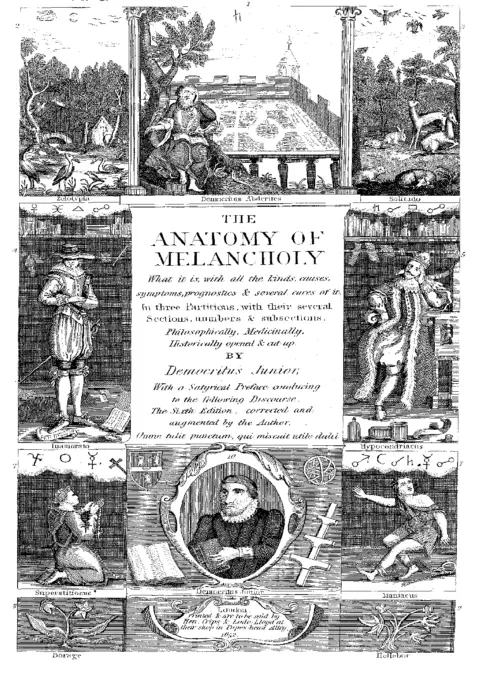
THE CLASSIC COLLECTION · 1617
"The Anatomy of Melancholy" by Robert Burton is a medical treatise first published in 1621. This massive work explores depression and its causes, symptoms, and cures, but ranges far beyond medicine into history, astronomy, geography, and literature. Written under the pseudonym Democritus Junior, Burton blends scientific analysis with humor and satire across over 500,000 words. Drawing from ancient authorities and medieval sources, he examines melancholy as both a passing mood and a serious ailment, creating a unique work that inspired generations of writers.
Introduction adapted from the source catalogue; source summaries may be automatically generated.
Free to read · English · 529,097 words · No account needed
MAKE TIME FOR A GOOD BOOK
On by default. Untick to stop anonymous reading totals. Each page counts after 10 seconds in view. How this works.
Anonymous counting is on unless you have switched it off.
[6709]Aeternitas est illa vox,
Vox illa fulminatrix,
Tonitruis minacior,
Fragoribusque coeli,
Aeternitas est illa vox,
—meta carens et orta, &c.
Tormenta nulla territant,
Quae finiuntur annis;
Aeternitas, aeternitas
Versat coquilque pectus.
Auget haec poenas indies,
Centuplicatque flammas, &c.
This meditation terrifies these poor distressed souls, especially if their bodies be predisposed by melancholy, they religiously given, and have tender consciences, every small object affrights them, the very inconsiderate reading of Scripture itself, and misinterpretation of some places of it; as, Many are called, few are chosen. Not every one that saith Lord. Fear not little flock. He that stands, let him take heed lest he fall. Work out your salvation with fear and trembling, That night two shall be in a bed, one received, the other left. Strait is the way that leads to heaven, and few there are that enter therein. The parable of the seed and of the sower, some fell on barren ground, some was choked. Whom he hath predestinated he hath chosen. He will have mercy on whom he will have mercy. Non est volentis nec currentis, sed miserentis Dei. These and the like places terrify the souls of many; election, predestination, reprobation, preposterously conceived, offend divers, with a deal of foolish presumption, curiosity, needless speculation, contemplation, solicitude, wherein they trouble and puzzle themselves about those questions of grace, free will, perseverance, God's secrets; they will know more than is revealed of God in his word, human capacity, or ignorance can apprehend, and too importunate inquiry after that which is revealed; mysteries, ceremonies, observation of Sabbaths, laws, duties, &c., with many such which the casuists discuss, and schoolmen broach, which divers mistake, misconstrue, misapply to themselves, to their own undoing, and so fall into this gulf. They doubt of their election, how they shall know, it, by what signs. And so far forth, saith Luther, with such nice points, torture and crucify themselves, that they are almost mad, and all they get by it is this, they lay open a gap to the devil by desperation to carry them to hell; but the greatest harm of all proceeds from those thundering ministers, a most frequent cause they are of this malady: [6710]and do more harm in the church (saith Erasmus) than they that flatter; great danger on both sides, the one lulls them asleep in carnal security, the other drives them to despair. Whereas, [6711]St. Bernard well adviseth, We should not meddle with the one without the other, nor speak of judgment without mercy; the one alone brings desperation, the other security. But these men are wholly for judgment; of a rigid disposition themselves, there is no mercy with them, no salvation, no balsam for their diseased souls, they can speak of nothing but reprobation, hell-fire, and damnation; as they did Luke xi. 46. lade men with burdens grievous to be borne, which they themselves touch not with a finger. 'Tis familiar with our papists to terrify men's souls with purgatory, tales, visions, apparitions, to daunt even the most generous spirits, to [6712]require charity, as Brentius observes, of others, bounty, meekness, love, patience, when they themselves breathe nought but lust, envy, covetousness. They teach others to fast, give alms, do penance, and crucify their mind with superstitious observations, bread and water, hair clothes, whips, and the like, when they themselves have all the dainties the world can afford, lie on a down-bed with a courtesan in their arms: Heu quantum patimur pro Christo, as [6713]he said, what a cruel tyranny is this, so to insult over and terrify men's souls! Our indiscreet pastors many of them come not far behind, whilst in their ordinary sermons they speak so much of election, predestination, reprobation, ab aeterno, subtraction of grace, preterition, voluntary permission, &c., by what signs and tokens they shall discern and try themselves, whether they be God's true children elect, an sint reprobi, praedestinati, &c., with such scrupulous points, they still aggravate sin, thunder out God's judgments without respect, intempestively rail at and pronounce them damned in all auditories, for giving so much to sports and honest recreations, making every small fault and thing indifferent an irremissible offence, they so rent, tear and wound men's consciences, that they are almost mad, and at their wits' end. These bitter potions (saith [6714]Erasmus) are still in their mouths, nothing but gall and horror, and a mad noise, they make all their auditors desperate: many are wounded by this means, and they commonly that are most devout and precise, have been formerly presumptuous, and certain of their salvation; they that have tender consciences, that follow sermons, frequent lectures, that have indeed least cause, they are most apt to mistake, and fall into these miseries. I have heard some complain of Parson's Resolution, and other books of like nature (good otherwise), they are too tragical, too much dejecting men, aggravating offences: great care and choice, much discretion is required in this kind. The last and greatest cause of this malady, is our own conscience, sense of our sins, and God's anger justly deserved, a guilty conscience for some foul offence formerly committed,—[6715]O miser Oreste, quid morbi te perdit? Or: Conscientia, Sum enim mihi conscius de malis perpetratis.[6716] A good conscience is a continual feast, but a galled conscience is as great a torment as can possibly happen, a still baking oven, (so Pierius in his Hieroglyph, compares it) another hell. Our conscience, which is a great ledger book, wherein are written all our offences, a register to lay them up, (which those [6717]Egyptians in their hieroglyphics expressed by a mill, as well for the continuance, as for the torture of it) grinds our souls with the remembrance of some precedent sins, makes us reflect upon, accuse and condemn our own selves. [6718]Sin lies at door, &c. I know there be many other causes assigned by Zanchius, [6719]Musculus, and the rest; as incredulity, infidelity, presumption, ignorance, blindness, ingratitude, discontent, those five grand miseries in Aristotle, ignominy, need, sickness, enmity, death, &c.; but this of conscience is the greatest, [6720]Instar ulceris corpus jugiter percellens: The scrupulous conscience (as [6721]Peter Forestus calls it) which tortures so many, that either out of a deep apprehension of their unworthiness, and consideration of their own dissolute life, accuse themselves and aggravate every small offence, when there is no such cause, misdoubting in the meantime God's mercies, they fall into these inconveniences. The poet calls them [6722]furies dire, but it is the conscience alone which is a thousand witnesses to accuse us, [6723] Nocte dieque suum gestant in pectore testem. A continual tester to give in evidence, to empanel a jury to examine us, to cry guilty, a persecutor with hue and cry to follow, an apparitor to summon us, a bailiff to carry us, a serjeant to arrest, an attorney to plead against us, a gaoler to torment, a judge to condemn, still accusing, denouncing, torturing and molesting. And as the statue of Juno in that holy city near Euphrates in [6724]Assyria will look still towards you, sit where you will in her temple, she stares full upon you, if you go by, she follows with her eye, in all sites, places, conventicles, actions, our conscience will be still ready to accuse us. After many pleasant days, and fortunate adventures, merry tides, this conscience at last doth arrest us. Well he may escape temporal punishment, [6725]bribe a corrupt judge, and avoid the censure of law, and flourish for a time; for [6726]who ever saw (saith Chrysostom) a covetous man troubled in mind when he is telling of his money, an adulterer mourn with his mistress in his arms? we are then drunk with pleasure, and perceive nothing: yet as the prodigal son had dainty fare, sweet music at first, merry company, jovial entertainment, but a cruel reckoning in the end, as bitter as wormwood, a fearful visitation commonly follows. And the devil that then told thee that it was a light sin, or no sin at all, now aggravates on the other side, and telleth thee, that it is a most irremissible offence, as he did by Cain and Judas, to bring them to despair; every small circumstance before neglected and contemned, will now amplify itself, rise up in judgment, and accuse the dust of their shoes, dumb creatures, as to Lucian's tyrant, lectus et candela, the bed and candle did bear witness, to torment their souls for their sins past. Tragical examples in this kind are too familiar and common: Adrian, Galba, Nero, Otho, Vitellius, Caracalla, were in such horror of conscience for their offences committed, murders, rapes, extortions, injuries, that they were weary of their lives, and could get nobody to kill them. [6727]Kennetus, King of Scotland, when he had murdered his nephew Malcom, King Duffe's son, Prince of Cumberland, and with counterfeit tears and protestations dissembled the matter a long time, [6728]at last his conscience accused him, his unquiet soul could not rest day or night, he was terrified with fearful dreams, visions, and so miserably tormented all his life. It is strange to read what [6729]Cominaeus hath written of Louis XI. that French King; of Charles VIII.; of Alphonsus, King of Naples; in the fury of his passion how he came into Sicily, and what pranks he played. Guicciardini, a man most unapt to believe lies, relates how that Ferdinand his father's ghost who before had died for grief, came and told him, that he could not resist the French King, he thought every man cried France, France; the reason of it (saith Cominseus) was because he was a vile tyrant, a murderer, an oppressor of his subjects, he bought up all commodities, and sold them at his own price, sold abbeys to Jews and Falkoners; both Ferdinand his father, and he himself never made conscience of any committed sin; and to conclude, saith he, it was impossible to do worse than they did. Why was Pausanias the Spartan tyrant, Nero, Otho, Galba, so persecuted with spirits in every house they came, but for their murders which they had committed? [6730]Why doth the devil haunt many men's houses after their deaths, appear to them living, and take possession of their habitations, as it were, of their palaces, but because of their several villainies? Why had Richard the Third such fearful dreams, saith Polydore, but for his frequent murders? Why was Herod so tortured in his mind? because he had made away Mariamne his wife. Why was Theodoric, the King of the Goths, so suspicious, and so affrighted with a fish head alone, but that he had murdered Symmachus, and Boethius his son-in-law, those worthy Romans? Caelius, lib. 27. cap. 22. See more in Plutarch, in his tract De his qui sero a Numine puniuntur, and in his book De tranquillitate animi, &c. Yea, and sometimes GOD himself hath a hand in it, to show his power, humiliate, exercise, and to try their faith, (divine temptation, Perkins calls it, Cas. cons. lib. 1. cap. 8. sect. 1.) to punish them for their sins. God the avenger, as [6731]David terms him, ultor a tergo Deus, his wrath is apprehended of a guilty, soul, as by Saul and Judas, which the poets expressed by Adrastia, or Nemesis: [6732]Assequitur Nemesique virum vestigia servat, Ne male quid facias.———
Your reading position is saved on this browser. Take it to another device with a library code. Reading pages adapt to text, rather than matching a printed edition.
BEHIND THE BOOK
This eBook is for the use of anyone anywhere in the United States and most other parts of the world at no cost and with almost no restrictions whatsoever. You may copy it, give it away or re-use it under the terms of the Project Gutenberg License included with this eBook or online at www.gutenberg.org. If you are not located in the United States, you will have to check the laws of the country where you are located before using this eBook. Read the source licence.
The original source file, including credits and licence, is retained by this library. Request an original-format copy at no charge. Please include the book title and Project Gutenberg identifier #10800.
KEEP YOUR CURIOSITY GOING
David Patterson (Spirit) Hatch
Coulson Kernahan

Ralph Waldo Emerson
Frances Wright

Edwin Abbott Abbott

Joseph Droz