
Last letters from the living dead man
David Patterson (Spirit) Hatch
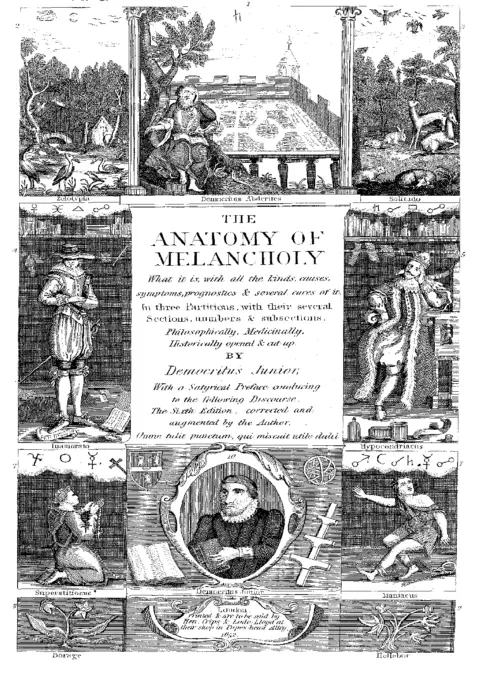
THE CLASSIC COLLECTION · 1617
"The Anatomy of Melancholy" by Robert Burton is a medical treatise first published in 1621. This massive work explores depression and its causes, symptoms, and cures, but ranges far beyond medicine into history, astronomy, geography, and literature. Written under the pseudonym Democritus Junior, Burton blends scientific analysis with humor and satire across over 500,000 words. Drawing from ancient authorities and medieval sources, he examines melancholy as both a passing mood and a serious ailment, creating a unique work that inspired generations of writers.
Introduction adapted from the source catalogue; source summaries may be automatically generated.
Free to read · English · 529,097 words · No account needed
MAKE TIME FOR A GOOD BOOK
On by default. Untick to stop anonymous reading totals. Each page counts after 10 seconds in view. How this works.
Anonymous counting is on unless you have switched it off.
saith Prudentius. Cuna for cradles, Diverra for sweeping houses, Nodina knots, Prema, Pramunda, Hymen, Hymeneus, for weddings; Comus the god of good fellows, gods of silence, of comfort, Hebe goddess of youth, Mena menstruarum, &c. male and female gods, of all ages, sexes and dimensions, with beards, without beards, married, unmarried, begot, not born at all, but, as Minerva, start out of Jupiter's head. Hesiod reckons up at least 30,000 gods, Varro 300 Jupiters. As Jeremy told them, their gods were to the multitude of cities; Quicquid humus, pelagus, coelum miserabile gignit Id dixere deos, colles, freta, flumina, flammas.
Whatever heavens, sea, and land begat,
Hills, seas, and rivers, God was this and that.
And which was most absurd, they made gods upon such ridiculous occasions; As children make babies (so saith [6510]Morneus), their poets make gods, et quos adorant in templis, ludunt in Theatris, as Lactantius scoffs. Saturn, a man, gelded himself, did eat his own children, a cruel tyrant driven out of his kingdom by his son Jupiter, as good a god as himself, a wicked lascivious paltry king of Crete, of whose rapes, lusts, murders, villainies, a whole volume is too little to relate. Venus, a notorious strumpet, as common as a barber's chair, Mars, Adonis, Anchises' whore, is a great she-goddess, as well as the rest, as much renowned by their poets, with many such; and these gods so fabulously and foolishly made, ceremoniis, hymnis, et canticis celebrunt; their errors, luctus et gaudia, amores, iras, nuptias et liberorum procreationes ([6511]as Eusebius well taxeth), weddings, mirth and mournings, loves, angers, and quarrelling they did celebrate in hymns, and sing of in their ordinary songs, as it were publishing their villainies. But see more of their originals. When Romulus was made away by the sedition of the senators, to pacify the people, [6512]Julius Proculus gave out that Romulus was taken up by Jupiter into heaven, and therefore to be ever after adored for a god amongst the Romans. Syrophanes of Egypt had one only son, whom he dearly loved; he erected his statue in his house, which his servants did adorn with garlands, to pacify their master's wrath when he was angry, so by little and little he was adored for a god. This did Semiramis for her husband Belus, and Adrian the emperor by his minion Antinous. Flora was a rich harlot in Rome, and for that she made the commonwealth her heir, her birthday was solemnised long after; and to make it a more plausible holiday, they made her goddess of flowers, and sacrificed to her amongst the rest. The matrons of Rome, as Dionysius Halicarnassaeus relates, because at their entreaty Coriolanus desisted from his wars, consecrated a church Fortunes muliebri; and [6513]Venus Barbata had a temple erected, for that somewhat was amiss about hair, and so the rest. The citizens [6514]of Alabanda, a small town in Asia Minor, to curry favour with the Romans (who then warred in Greece with Perseus of Macedon, and were formidable to these parts), consecrated a temple to the City of Rome, and made her a goddess, with annual games and sacrifices; so a town of houses was deified, with shameful flattery of the one side to give, and intolerable arrogance on the other to accept, upon so vile and absurd an occasion. Tully writes to Atticus, that his daughter Tulliola might be made a goddess, and adored as Juno and Minerva, and as well she deserved it. Their holy days and adorations were all out as ridiculous; those Lupercals of Pan, Florales of Flora, Bona dea, Anna Perenna, Saturnals, &c., as how they were celebrated, with what lascivious and wanton gestures, bald ceremonies, [6515]by what bawdy priests, how they hang their noses over the smoke of sacrifices, saith [6516]Lucian, and lick blood like flies that was spilled about the altars. Their carved idols, gilt images of wood, iron, ivory, silver, brass, stone, olim truncus eram, &c., were most absurd, as being their own workmanship; for as Seneca notes, adorant ligneos deos, et fabros interim qui fecerunt, contemnunt, they adore work, contemn the workman; and as Tertullian follows it, Si homines non essent diis propitii, non essent dii, had it not been for men, they had never been gods, but blocks, and stupid statues in which mice, swallows, birds make their nests, spiders their webs, and in their very mouths laid their excrements. Those images, I say, were all out as gross as the shapes in which they did represent them: Jupiter with a ram's head, Mercury a dog's, Pan like a goat, Heccate with three heads, one with a beard, another without; see more in Carterius and [6517]Verdurius of their monstrous forms and ugly pictures: and, which was absurder yet, they told them these images came from heaven, as that of Minerva in her temple at Athens, quod e coelo cecidisse credebant accolae, saith Pausanias. They formed some like storks, apes, bulls, and yet seriously believed: and that which was impious and abominable, they made their gods notorious whoremasters, incestuous Sodomites (as commonly they were all, as well as Jupiter, Mars, Apollo, Mercury, Neptune, &c.), thieves, slaves, drudges (for Apollo and Neptune made tiles in Phrygia), kept sheep, Hercules emptied stables, Vulcan a blacksmith, unfit to dwell upon the earth for their villainies, much less in heaven, as [6518]Mornay well saith, and yet they gave them out to be such; so weak and brutish, some to whine, lament, and roar, as Isis for her son and Cenocephalus, as also all her weeping priests; Mars in Homer to be wounded, vexed; Venus ran away crying, and the like; than which what can be more ridiculous? Nonne ridiculum lugere quod colas, vel colere quod lugeas? (which [6519]Minutius objects) Si dii, cur plangitis? si mortui, cur adoratis? that it is no marvel if [6520]Lucian, that adamantine persecutor of superstition, and Pliny could so scoff at them and their horrible idolatry as they did; if Diagoras took Hercules' image, and put it under his pot to seethe his pottage, which was, as he said, his 13th labour. But see more of their fopperies in Cypr. 4. tract, de Idol. varietat. Chrysostom advers. Gentil. Arnobius adv. Gentes. Austin, de civ. dei. Theodoret. de curat. Graec. affect. Clemens Alexandrinus, Minutius Felix, Eusebius, Lactantius, Stuckius, &c. Lamentable, tragical, and fearful those symptoms are, that they should be so far forth affrighted with their fictitious gods, as to spend the goods, lives, fortunes, precious time, best days in their honour, to [6521]sacrifice unto them, to their inestimable loss, such hecatombs, so many thousand sheep, oxen with gilded horns, goats, as [6522]Croesus, king of Lydia, [6523] Marcus Julianus, surnamed ob crebras hostias Victimarius, et Tauricremus, and the rest of the Roman emperors usually did with such labour and cost; and not emperors only and great ones, pro communi bono, were at this charge, but private men for their ordinary occasions. Pythagoras offered a hundred oxen for the invention of a geometrical problem, and it was an ordinary thing to sacrifice in [6524]Lucian's time, a heifer for their good health, four oxen for wealth, a hundred for a kingdom, nine bulls for their safe return from Troja to Pylus, &c. Every god almost had a peculiar sacrifice—the Sun horses, Vulcan fire, Diana a white hart, Venus a turtle, Ceres a hog, Proserpine a black lamb, Neptune a bull (read more in [6525] Stuckius at large), besides sheep, cocks, corals, frankincense, to their undoings, as if their gods were affected with blood or smoke. And surely ([6526]saith he) if one should but repeat the fopperies of mortal men, in their sacrifices, feasts, worshipping their gods, their rites and ceremonies, what they think of them, of their diet, houses, orders, &c., what prayers and vows they make; if one should but observe their absurdity and madness, he would burst out a laughing, and pity their folly. For what can be more absurd than their ordinary prayers, petitions, [6527]requests, sacrifices, oracles, devotions? of which we have a taste in Maximus Tyrius, serm. 1. Plato's Alcibiades Secundus, Persius Sat. 2. Juvenal. Sat. 10. there likewise exploded, Mactant opimas et pingues hostias deo quasi esurienti, profundunt vina tanquam sitienti, lumina accendunt velut in tenebris agenti (Lactantius, lib. 2. cap. 6). As if their gods were hungry, athirst, in the dark, they light candles, offer meat and drink. And what so base as to reveal their counsels and give oracles, e viscerum sterquiliniis, out of the bowels and excremental parts of beasts? sordidos deos Varro truly calls them therefore, and well he might. I say nothing of their magnificent and sumptuous temples, those majestical structures: to the roof of Apollo Didymeus' temple, ad branchidas, as [6528]Strabo writes, a thousand oaks did not suffice. Who can relate the glorious splendour, and stupend magnificence, the sumptuous building of Diana at Ephesus, Jupiter Ammon's temple in Africa, the Pantheon at Rome, the Capitol, the Sarapium at Alexandria, Apollo's temple at Daphne in the suburbs of Antioch. The great temple at Mexico so richly adorned, and so capacious (for 10,000 men might stand in it at once), that fair Pantheon of Cusco, described by Acosta in his Indian History, which eclipses both Jews and Christians. There were in old Jerusalem, as some write, 408 synagogues; but new Cairo reckons up (if [6529]Radzivilus may be believed) 6800 mosques; Fez 400, whereof 50 are most magnificent, like St. Paul's in London. Helena built 300 fair churches in the Holy Land, but one Bassa hath built 400 mosques. The Mahometans have 1000 monks in a monastery; the like saith Acosta of Americans; Riccius of the Chinese, for men and women, fairly built; and more richly endowed some of them, than Arras in Artois, Fulda in Germany, or St. Edmund's-Bury in England with us: who can describe those curious and costly statues, idols, images, so frequently mentioned in Pausanias? I conceal their donaries, pendants, other offerings, presents, to these their fictitious gods daily consecrated. [6530]Alexander, the son of Amyntas, king of Macedonia, sent two statues of pure gold to Apollo at Delphos. [6531]Croesus, king of Lydia dedicated a hundred golden tiles in the same place with a golden altar: no man came empty-handed to their shrines. But these are base offerings in respect; they offered men themselves alive. The Leucadians, as Strabo writes, sacrificed every year a man, averruncandae, deorum irae, causa, to pacify their gods, de montis praecipitio dejecerent, &c. and they did voluntarily undergo it. The Decii did so sacrifice, Diis manibus; Curtius did leap into the gulf. Were they not all strangely deluded to go so far to their oracles, to be so gulled by them, both in war and peace, as Polybius relates (which their argurs, priests, vestal virgins can witness), to be so superstitious, that they would rather lose goods and lives than omit any ceremonies, or offend their heathen gods? Nicias, that generous and valiant captain of the Greeks, overthrew the Athenian navy, by reason of his too much superstition, [6532] because the augurs told him it was ominous to set sail from the haven of Syracuse whilst the moon was eclipsed; he tarried so long till his enemies besieged him, he and all his army were overthrown. The [6533]Parthians of old were so sottish in this kind, they would rather lose a victory, nay lose their own lives, than fight in the night, 'twas against their religion. The Jews would make no resistance on the Sabbath, when Pompeius besieged Jerusalem; and some Jewish Christians in Africa, set upon by the Goths, suffered themselves upon the same occasion to be utterly vanquished. The superstition of the Dibrenses, a bordering town in Epirus, besieged by the Turks, is miraculous almost to report. Because a dead dog was flung into the only fountain which the city had, they would die of thirst all, rather than drink of that [6534]unclean water, and yield up the city upon any conditions. Though the praetor and chief citizens began to drink first, using all good persuasions, their superstition was such, no saying would serve, they must all forthwith die or yield up the city. Vix ausum ipse credere (saith [6535]Barletius) tantam superstitionem, vel affirmare levissimam hanc causam tantae rei vel magis ridiculam, quum non dubitem risum potius quum admirationem posteris excitaturam. The story was too ridiculous, he was ashamed to report it, because he thought nobody would believe it. It is stupend to relate what strange effects this idolatry and superstition hath brought forth of the latter years in the Indies and those bordering parts: [6536]in what feral shapes the [6537]devil is adored, ne quid mali intentent, as they say; for in the mountains betwixt Scanderoon and Aleppo, at this day, there are dwelling a certain kind of people called Coords, coming of the race of the ancient Parthians, who worship the devil, and allege this reason in so doing: God is a good man and will do no harm, but the devil is bad and must be pleased, lest he hurt them. It is wonderful to tell how the devil deludes them, how he terrifies them, how they offer men and women sacrifices unto him, a hundred at once, as they did infants in Crete to Saturn of old, the finest children, like Agamemnon's Iphigenia, &c. At [6538]Mexico, when the Spaniards first overcame them, they daily sacrificed viva hominum corda e viventium corporibus extracta, the hearts of men yet living, 20,000 in a year (Acosta lib. 5. cap. 20) to their idols made of flour and men's blood, and every year 6000 infants of both sexes: and as prodigious to relate, [6539]how they bury their wives with husbands deceased, 'tis fearful to report, and harder to believe, [6540]Nam certamen habent laethi quae viva sequatur Conjugium, pudor, est non licuisse mori,
Your reading position is saved on this browser. Take it to another device with a library code. Reading pages adapt to text, rather than matching a printed edition.
BEHIND THE BOOK
This eBook is for the use of anyone anywhere in the United States and most other parts of the world at no cost and with almost no restrictions whatsoever. You may copy it, give it away or re-use it under the terms of the Project Gutenberg License included with this eBook or online at www.gutenberg.org. If you are not located in the United States, you will have to check the laws of the country where you are located before using this eBook. Read the source licence.
The original source file, including credits and licence, is retained by this library. Request an original-format copy at no charge. Please include the book title and Project Gutenberg identifier #10800.
KEEP YOUR CURIOSITY GOING
David Patterson (Spirit) Hatch
Coulson Kernahan

Ralph Waldo Emerson
Frances Wright

Edwin Abbott Abbott

Joseph Droz