
Last letters from the living dead man
David Patterson (Spirit) Hatch
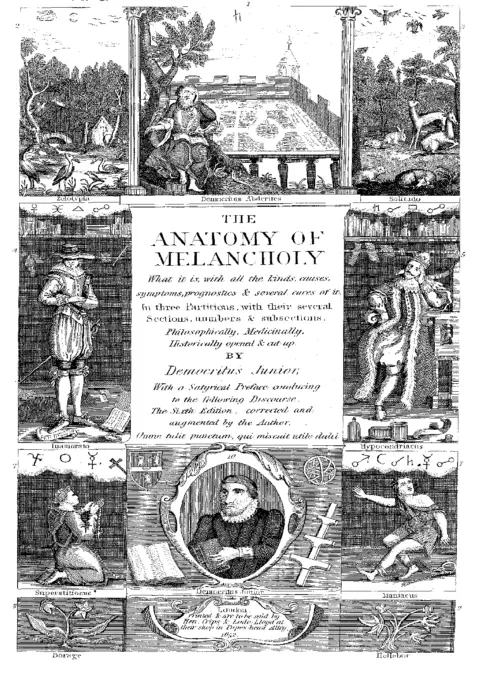
THE CLASSIC COLLECTION · 1617
"The Anatomy of Melancholy" by Robert Burton is a medical treatise first published in 1621. This massive work explores depression and its causes, symptoms, and cures, but ranges far beyond medicine into history, astronomy, geography, and literature. Written under the pseudonym Democritus Junior, Burton blends scientific analysis with humor and satire across over 500,000 words. Drawing from ancient authorities and medieval sources, he examines melancholy as both a passing mood and a serious ailment, creating a unique work that inspired generations of writers.
Introduction adapted from the source catalogue; source summaries may be automatically generated.
Free to read · English · 529,097 words · No account needed
MAKE TIME FOR A GOOD BOOK
On by default. Untick to stop anonymous reading totals. Each page counts after 10 seconds in view. How this works.
Anonymous counting is on unless you have switched it off.
SUBSECT. I.—Religious Melancholy. Its object God; what his beauty is; How it allures. The parts and parties affected.
That there is such a distinct species of love melancholy, no man hath ever yet doubted: but whether this subdivision of [6302]Religious Melancholy be warrantable, it may be controverted. [6303]Pergite Pieridies, medio nec calle vagantem Linquite me, qua nulla pedum vestigia ducunt, Nulla rotae currus testantur signa priores.
I have no pattern to follow as in some of the rest, no man to imitate. No physician hath as yet distinctly written of it as of the other; all acknowledge it a most notable symptom, some a cause, but few a species or kind. [6304]Areteus, Alexander, Rhasis, Avicenna, and most of our late writers, as Gordonius, Fuchsius, Plater, Bruel, Montaltus, &c. repeat it as a symptom. [6305]Some seem to be inspired of the Holy Ghost, some take upon them to be prophets, some are addicted to new opinions, some foretell strange things, de statu mundi et Antichristi, saith Gordonius. Some will prophesy of the end of the world to a day almost, and the fall of the Antichrist, as they have been addicted or brought up; for so melancholy works with them, as [6306]Laurentius holds. If they have been precisely given, all their meditations tend that way, and in conclusion produce strange effects, the humour imprints symptoms according to their several inclinations and conditions, which makes [6307]Guianerius and [6308]Felix Plater put too much devotion, blind zeal, fear of eternal punishment, and that last judgment for a cause of those enthusiastics and desperate persons: but some do not obscurely make a distinct species of it, dividing love melancholy into that whose object is women; and into the other whose object is God. Plato, in Convivio, makes mention of two distinct furies; and amongst our neoterics, Hercules de Saxonia lib. 1. pract. med. cap. 16. cap. de Melanch. doth expressly treat of it in a distinct species. [6309] Love melancholy (saith he) is twofold; the first is that (to which peradventure some will not vouchsafe this name or species of melancholy) affection of those which put God for their object, and are altogether about prayer, fasting, &c., the other about women. Peter Forestus in his observations delivereth as much in the same words: and Felix Platerus de mentis alienat. cap. 3. frequentissima est ejus species, in qua curanda saepissime multum fui impeditus; 'tis a frequent disease; and they have a ground of what they say, forth of Areteus and Plato. [6310]Areteus, an old author, in his third book cap. 6. doth so divide love melancholy, and derives this second from the first, which comes by inspiration or otherwise. [6311]Plato in his Phaedrus hath these words, Apollo's priests in Delphos, and at Dodona, in their fury do many pretty feats, and benefit the Greeks, but never in their right wits. He makes them all mad, as well he might; and he that shall but consider that superstition of old, those prodigious effects of it (as in its place I will shew the several furies of our fatidici dii, pythonissas, sibyls, enthusiasts, pseudoprophets, heretics, and schismatics in these our latter ages) shall instantly confess, that all the world again cannot afford so much matter of madness, so many stupendous symptoms, as superstition, heresy, schism have brought out: that this species alone may be paralleled to all the former, has a greater latitude, and more miraculous effects; that it more besots and infatuates men, than any other above named whatsoever, does more harm, works more disquietness to mankind, and has more crucified the souls of mortal men (such hath been the devil's craft) than wars, plagues, sicknesses, dearth, famine, and all the rest. Give me but a little leave, and I will set before your eyes in brief a stupendous, vast, infinite ocean of incredible madness and folly: a sea full of shelves and rocks, sands, gulfs, euripes and contrary tides, full of fearful monsters, uncouth shapes, roaring waves, tempests, and siren calms, halcyonian seas, unspeakable misery, such comedies and tragedies, such absurd and ridiculous, feral and lamentable fits, that I know not whether they are more to be pitied or derided, or may be believed, but that we daily see the same still practised in our days, fresh examples, nova novitia, fresh objects of misery and madness, in this kind that are still represented unto us, abroad, at home, in the midst of us, in our bosoms. But before I can come to treat of these several errors and obliquities, their causes, symptoms, affections, &c., I must say something necessarily of the object of this love, God himself, what this love is, how it allureth, whence it proceeds, and (which is the cause of all our miseries) how we mistake, wander and swerve from it. Amongst all those divine attributes that God doth vindicate to himself, eternity, omnipotency, immutability, wisdom, majesty, justice, mercy, &c., his [6312]beauty is not the least, one thing, saith David, have I desired of the Lord, and that I will still desire, to behold the beauty of the Lord, Psal. xxvii. 4. And out of Sion, which is the perfection of beauty, hath God shined, Psal. 1. 2. All other creatures are fair, I confess, and many other objects do much enamour us, a fair house, a fair horse, a comely person. [6313]I am amazed, saith Austin, when 1 look up to heaven and behold the beauty of the stars, the beauty of angels, principalities, powers, who can express it? who can sufficiently commend, or set out this beauty which appears in us? so fair a body, so fair a face, eyes, nose, cheeks, chin, brows, all fair and lovely to behold; besides the beauty of the soul which cannot be discerned. If we so labour and be so much affected with the comeliness of creatures, how should we be ravished with that admirable lustre of God himself? If ordinary beauty have such a prerogative and power, and what is amiable and fair, to draw the eyes and ears, hearts and affections of all spectators unto it, to move, win, entice, allure: how shall this divine form ravish our souls, which is the fountain and quintessence of all beauty? Coelum pulchrum, sed pulchrior coeli fabricator; if heaven be so fair, the sun so fair, how much fairer shall he be, that made them fair? For by the greatness and beauty of the creatures, proportionally, the maker of them is seen, Wisd. xiii. 5. If there be such pleasure in beholding a beautiful person alone, and as a plausible sermon, he so much affect us, what shall this beauty of God himself, that is infinitely fairer than all creatures, men, angels, &c. [6314] Omnis pulchritudo florem, hominum, angelorum, et rerum omnium pulcherrimarum ad Dei pulchritudinem collata, nox est et tenebrae, all other beauties are night itself, mere darkness to this our inexplicable, incomprehensible, unspeakable, eternal, infinite, admirable and divine beauty. This lustre, pulchritudo omnium pulcherrima. This beauty and [6315] splendour of the divine Majesty, is it that draws all creatures to it, to seek it, love, admire, and adore it; and those heathens, pagans, philosophers, out of those relics they have yet left of God's image, are so far forth incensed, as not only to acknowledge a God; but, though after their own inventions, to stand in admiration of his bounty, goodness, to adore and seek him; the magnificence and structure of the world itself, and beauty of all his creatures, his goodness, providence, protection, enforceth them to love him, seek him, fear him, though a wrong way to adore him: but for us that are Christians, regenerate, that are his adopted sons, illuminated by his word, having the eyes of our hearts and understandings opened; how fairly doth he offer and expose himself? Ambit nos Deus (Austin saith) donis et forma sua, he woos us by his beauty, gifts, promises, to come unto him; [6316]the whole Scripture is a message, an exhortation, a love letter to this purpose; to incite us, and invite us, [6317]God's epistle, as Gregory calls it, to his creatures. He sets out his son and his church in that epithalamium or mystical song of Solomon, to enamour us the more, comparing his head to fine gold, his locks curled and black as a raven, Cant. iv. 5. his eyes like doves on rivers of waters, washed with milk, his lips as lilies, drooping down pure juice, his hands as rings of gold set with chrysolite: and his church to a vineyard, a garden enclosed, a fountain of living waters, an orchard of pomegranates, with sweet scents of saffron, spike, calamus and cinnamon, and all the trees of incense, as the chief spices, the fairest amongst women, no spot in her, [6318]his sister, his spouse, undefiled, the only daughter of her mother, dear unto her, fair as the moon, pure as the sun, looking out as the morning; that by these figures, that glass, these spiritual eyes of contemplation, we might perceive some resemblance of his beauty, the love between his church and him. And so in the xlv. Psalm this beauty of his church is compared to a queen in a vesture of gold of Ophir, embroidered raiment of needlework, that the king might take pleasure in her beauty. To incense us further yet, [6319]John, in his apocalypse, makes a description of that heavenly Jerusalem, the beauty, of it, and in it the maker of it; Likening it to a city of pure gold, like unto clear glass, shining and garnished with all manner of precious stones, having no need of sun or moon: for the lamb is the light of it, the glory of God doth illuminate it: to give us to understand the infinite glory, beauty and happiness of it. Not that it is no fairer than these creatures to which it is compared, but that this vision of his, this lustre of his divine majesty, cannot otherwise be expressed to our apprehensions, no tongue can tell, no heart can conceive it, as Paul saith. Moses himself, Exod. xxxiii. 18. when he desired to see God in his glory, was answered that he might not endure it, no man could see his face and live. Sensibile forte destruit sensum, a strong object overcometh the sight, according to that axiom in philosophy: fulgorem solis ferre non potes, multo magis creatoris; if thou canst not endure the sunbeams, how canst thou endure that fulgor and brightness of him that made the sun? The sun itself and all that we can imagine, are but shadows of it, 'tis visio praecellens, as [6320]Austin calls it, the quintessence of beauty this, which far exceeds the beauty of heavens, sun and moon, stars, angels, gold and silver, woods, fair fields, and whatsoever is pleasant to behold. All those other beauties fail, vary, are subject to corruption, to loathing; [6321]But this is an immortal vision, a divine beauty, an immortal love, an indefatigable love and beauty, with sight of which we shall never be tired nor wearied, but still the more we see the more we shall covet him. [6322]For as one saith, where this vision is, there is absolute beauty; and where is that beauty, from the same fountain comes all pleasure and happiness; neither can beauty, pleasure, happiness, be separated from his vision or sight, or his vision, from beauty, pleasure, happiness. In this life we have but a glimpse of this beauty and happiness: we shall hereafter, as John saith, see him as he is: thine eyes, as Isaiah promiseth, xxxiii. 17. shall behold the king in his glory, then shall we be perfectly enamoured, have a full fruition of it, desire, [6323]behold and love him alone as the most amiable and fairest object, or summum bonum, or chiefest good. This likewise should we now have done, had not our will been corrupted; and as we are enjoined to love God with all our heart, and all our soul: for to that end were we born, to love this object, as [6324]Melancthon discourseth, and to enjoy it. And him our will would have loved and sought alone as our summum bonum, or principal good, and all other good things for God's sake: and nature, as she proceeded from it, would have sought this fountain; but in this infirmity of human nature this order is disturbed, our love is corrupt: and a man is like that monster in [6325]Plato, composed of a Scylla, a lion and a man; we are carried away headlong with the torrent of our affections: the world, and that infinite variety of pleasing objects in it, do so allure and enamour us, that we cannot so much as look towards God, seek him, or think on him as we should: we cannot, saith Austin, Rempub. coelestem cogitare, we cannot contain ourselves from them, their sweetness is so pleasing to us. Marriage, saith [6326] Gualter, detains many; a thing in itself laudable, good and necessary, but many, deceived and carried away with the blind love of it, have quite laid aside the love of God, and desire of his glory. Meat and drink hath overcome as many, whilst they rather strive to please, satisfy their guts and belly, than to serve God and nature. Some are so busied about merchandise to get money, they lose their own souls, whilst covetously carried, and with an insatiable desire of gain, they forget God; as much we may say of honour, leagues, friendships, health, wealth, and all other profits or pleasures in this life whatsoever. [6327]In this world there be so many beautiful objects, splendours and brightness of gold, majesty of glory, assistance of friends, fair promises, smooth words, victories, triumphs, and such an infinite company of pleasing beauties to allure us, and draw us from God, that we cannot look after him. And this is it which Christ himself, those prophets and apostles so much thundered against, 1 John, xvii. 15, dehort us from; love not the world, nor the things that are in the world: if any man love the world, the love of the Father is not in him, 16. For all that is in the world, as lust of the flesh, the lust of the eyes, and pride of life, is not of the Father, but of the world: and the world passeth away and the lust thereof; but he that fulfilleth the will of God abideth for ever. No man, saith our Saviour, can serve two masters, but he must love the one and hate the other, &c., bonos vel malos mores, boni vel mali faciunt amores, Austin well infers: and this is that which all the fathers inculcate. He cannot ([6328]Austin admonisheth) be God's friend, that is delighted with the pleasures of the world: make clean thine heart, purify thine heart; if thou wilt see this beauty, prepare thyself for it. It is the eye of contemplation by which we must behold it, the wing of meditation which lifts us up and rears our souls with the motion of our hearts, and sweetness of contemplation: so saith Gregory cited by [6329]Bonaventure. And as [6330]Philo Judeus seconds him, he that loves God, will soar aloft and take him wings; and leaving the earth fly up to heaven, wander with sun and moon, stars, and that heavenly troop, God himself being his guide. If we desire to see him, we must lay aside all vain objects, which detain us and dazzle our eyes, and as [6331]Ficinus adviseth us, get us solar eyes, spectacles as they that look on the sun: to see this divine beauty, lay aside all material objects, all sense, and then thou shalt see him as he is. Thou covetous wretch, as [6332]Austin expostulates, why dost thou stand gaping on this dross, muck-hills, filthy excrements? behold a far fairer object, God himself woos thee; behold him, enjoy him, he is sick for love. Cant. v. he invites thee to his sight, to come into his fair garden, to eat and drink with him, to be merry with him, to enjoy his presence for ever. [6333]Wisdom cries out in the streets besides the gates, in the top of high places, before the city, at the entry of the door, and bids them give ear to her instruction, which is better than gold or precious stones; no pleasures can be compared to it: leave all then and follow her, vos exhortor o amici et obsecro. In. [6334]Ficinus's words, I exhort and beseech you, that you would embrace and follow this divine love with all your hearts and abilities, by all offices and endeavours make this so loving God propitious unto you. For whom alone, saith [6335]Plotinus, we must forsake the kingdoms and empires of the whole earth, sea, land, and air, if we desire to be engrafted into him, leave all and follow him. Now, forasmuch as this love of God is a habit infused of God, as [6336] Thomas holds, l. 2. quaest. 23. by which a man is inclined to love God above all, and his neighbour as himself, we must pray to God that he will open our eyes, make clear our hearts, that we may be capable of his glorious rays, and perform those duties that he requires of us, Deut. vi. and Josh. xxiii. to love God above all, and our neighbour as ourself, to keep his commandments. In this we know, saith John, c. v. 2, we love the children of God, when we love God and keep his commandments. This is the love of God, that we keep his commandments; he that loveth not, knoweth not God, for God is love, cap. iv. 8, and he that dwelleth in love, dwelleth in God, and God in him; for love pre-supposeth knowledge, faith, hope, and unites us to God himself, as [6337]Leon Hebreus delivereth unto us, and is accompanied with the fear of God, humility, meekness, patience, all those virtues, and charity itself. For if we love God, we shall love our neighbour, and perform the duties which are required at our hands, to which we are exhorted, 1 Cor. xv. 4, 5; Ephes. iv.; Colos. iii.; Rom. xii. We shall not be envious or puffed up, or boast, disdain, think evil, or be provoked to anger, but suffer all things; endeavour to keep the unity of the spirit in the bond of peace. Forbear one another, forgive one another, clothe the naked, visit the sick, and perform all those works of mercy, which [6338]Clemens Alexandrinus calls amoris et amicitiae, impletionem et extentionem, the extent and complement of love; and that not for fear or worldly respects, but ordine ad Deum, for the love of God himself. This we shall do if we be truly enamoured; but we come short in both, we neither love God nor our neighbour as we should. Our love in spiritual things is too [6339]defective, in worldly things too excessive, there is a jar in both. We love the world too much; God too little; our neighbour not at all, or for our own ends. Vulgus amicitias utilitate probat. The chief thing we respect is our commodity; and what we do is for fear of worldly punishment, for vainglory, praise of men, fashion, and such by respects, not for God's sake. We neither know God aright, nor seek, love or worship him as we should. And for these defects, we involve ourselves into a multitude of errors, we swerve from this true love and worship of God: which is a cause unto us of unspeakable miseries; running into both extremes, we become fools, madmen, without sense, as now in the next place 1 will show you. The parties affected are innumerable almost, and scattered over the face of the earth, far and near, and so have been in all precedent ages, from the beginning of the world to these times, of all sorts and conditions. For method's sake I will reduce them to a twofold division, according to those two extremes of excess and defect, impiety and superstition, idolatry and atheism. Not that there is any excess of divine worship or love of God; that cannot be, we cannot love God too much, or do our duty as we ought, as Papists hold, or have any perfection in this life, much less supererogate: when we have all done, we are unprofitable servants. But because we do aliud agere, zealous without knowledge, and too solicitous about that which is not necessary, busying ourselves about impertinent, needless, idle, and vain ceremonies, populo ut placerent, as the Jews did about sacrifices, oblations, offerings, incense, new moons, feasts, &c., but Isaiah taxeth them, i. 12, who required this at your hands? We have too great opinion of our own worth, that we can satisfy the law: and do more than is required at our hands, by performing those evangelical counsels, and such works of supererogation, merit for others, which Bellarmine, Gregory de Valentia, all their Jesuits and champions defend, that if God should deal in rigour with them, some of their Franciscans and Dominicans are so pure, that nothing could be objected to them. Some of us again are too dear, as we think, more divine and sanctified than others, of a better mettle, greater gifts, and with that proud Pharisee, contemn others in respect of ourselves, we are better Christians, better learned, choice spirits, inspired, know more, have special revelation, perceive God's secrets, and thereupon presume, say and do that many times which is not befitting to be said or done. Of this number are all superstitious idolaters, ethnics, Mahometans, Jews, heretics, [6340]enthusiasts, divinators, prophets, sectaries, and schismatics. Zanchius reduceth such infidels to four chief sects; but I will insist and follow mine own intended method: all which with many other curious persons, monks, hermits, &c., may be ranged in this extreme, and fight under this superstitious banner, with those rude idiots, and infinite swarms of people that are seduced by them. In the other extreme or in defect, march those impious epicures, libertines, atheists, hypocrites, infidels, worldly, secure, impenitent, unthankful, and carnal-minded men, that attribute all to natural causes, that will acknowledge no supreme power; that have cauterised consciences, or live in a reprobate sense; or such desperate persons as are too distrustful of his mercies. Of these there be many subdivisions, diverse degrees of madness and folly, some more than other, as shall be shown in the symptoms: and yet all miserably out, perplexed, doting, and beside themselves for religion's sake. For as [6341]Zanchy well distinguished, and all the world knows religion is twofold, true or false; false is that vain superstition of idolaters, such as were of old, Greeks, Romans, present Mahometans, &c. Timorem deorum inanem, [6342]Tully could term it; or as Zanchy defines it, Ubi falsi dii, aut falso cullu colitur Deus, when false gods, or that God is falsely worshipped. And 'tis a miserable plague, a torture of the soul, a mere madness, Religiosa insania, [6343]Meteran calls it, or insanus error, as [6344]Seneca, a frantic error; or as Austin, Insanus animi morbus, a furious disease of the soul; insania omnium insanissima, a quintessence of madness; [6345]for he that is superstitious can never be quiet. 'Tis proper to man alone, uni superbia, avaritia, superstitio, saith Plin. lib. 7. cap. 1. atque etiam post saevit de futuro, which wrings his soul for the present, and to come: the greatest misery belongs to mankind, a perpetual servitude, a slavery, [6346]Ex timore timor, a heavy yoke, the seal of damnation, an intolerable burden. They that are superstitious are still fearing, suspecting, vexing themselves with auguries, prodigies, false tales, dreams, idle, vain works, unprofitable labours, as [6347]Boterus observes, cura mentis ancipite versantur: enemies to God and to themselves. In a word, as Seneca concludes, Religio Deum colit, superstitio destruit, superstition destroys, but true religion honours God. True religion, ubi verus Deus vere colitur, where the true God is truly worshipped, is the way to heaven, the mother of virtues, love, fear, devotion, obedience, knowledge, &c. It rears the dejected soul of man, and amidst so many cares, miseries, persecutions, which this world affords, it is a sole ease, an unspeakable comfort, a sweet reposal, Jugum suave, et leve, a light yoke, an anchor, and a haven. It adds courage, boldness, and begets generous spirits: although tyrants rage, persecute, and that bloody Lictor or sergeant be ready to martyr them, aut lita, aut morere, (as in those persecutions of the primitive Church, it was put in practice, as you may read in Eusebius and others) though enemies be now ready to invade, and all in an uproar, [6348]Si fractus illabatur orbis, impavidos ferient ruinae, though heaven should fall on his head, he would not be dismayed. But as a good Christian prince once made answer to a menacing Turk, facile scelerata hominum arma contemnit, qui del praesidio tutus est: or as [6349] Phalaris writ to Alexander in a wrong cause, he nor any other enemy could terrify him, for that he trusted in God. Si Deus nobiscum, quis contra nos? In all calamities, persecutions whatsoever, as David did, 2 Sam. ii. 22, he will sing with him, the Lord is my rock, my fortress, my strength, my refuge, the tower and horn of my salvation, &c. In all troubles and adversities, Psal. xlvi. 1. God is my hope and help, still ready to be found, I will not therefore fear, &c., 'tis a fear expelling fear; he hath peace of conscience, and is full of hope, which is (saith [6350]Austin) vita vitae mortalis, the life of this our mortal life, hope of immortality, the sole comfort of our misery: otherwise, as Paul saith, we of all others were most wretched, but this makes us happy, counterpoising our hearts in all miseries; superstition torments, and is from the devil, the author of lies; but this is from God himself, as Lucian, that Antiochian priest, made his divine confession in [6351]Eusebius, Auctor nobis de Deo Deus est, God is the author of our religion himself, his word is our rule, a lantern to us, dictated by the Holy Ghost, he plays upon our hearts as many harpstrings, and we are his temples, he dwelleth in us, and we in him. The part affected of superstition, is the brain, heart, will, understanding, soul itself, and all the faculties of it, totum compositum, all is mad and dotes: now for the extent, as I say, the world itself is the subject of it, (to omit that grand sin of atheism,) all times have been misaffected, past, present, there is not one that doth good, no not one, from the prophet to the priest, &c. A lamentable thing it is to consider, how many myriads of men this idolatry and superstition (for that comprehends all) hath infatuated in all ages, besotted by this blind zeal, which is religion's ape, religion's bastard, religion's shadow, false glass. For where God hath a temple, the devil will have a chapel: where God hath sacrifices, the devil will have his oblations: where God hath ceremonies, the devil will have his traditions: where there is any religion, the devil will plant superstition; and 'tis a pitiful sight to behold and read, what tortures, miseries, it hath procured, what slaughter of souls it hath made, how it rageth amongst those old Persians, Syrians, Egyptians, Greeks, Romans, Tuscans, Gauls, Germans, Britons, &c. Britannia jam hodie celebrat tam attonite, saith [6352]Pliny, tantis ceremoniis (speaking of superstition) ut dedisse Persis videri possit. The Britons are so stupendly superstitious in their ceremonies, that they go beyond those Persians. He that shall but read in Pausanias alone, those gods, temples, altars, idols, statues, so curiously made with such infinite cost and charge, amongst those old Greeks, such multitudes of them and frequent varieties, as [6353]Gerbelius truly observes, may stand amazed, and never enough wonder at it; and thank God withal, that by the light of the Gospel, we are so happily freed from that slavish idolatry in these our days. But heretofore, almost in all countries, in all places, superstition hath blinded the hearts of men; in all ages what a small portion hath the true church ever been! Divisum imperium cum Jove Daemon habet. [6354]The patriarchs and their families, the Israelites a handful in respect, Christ and his apostles, and not all of them, neither. Into what straits hath it been compinged, a little flock! how hath superstition on the other side dilated herself, error, ignorance, barbarism, folly, madness, deceived, triumphed, and insulted over the most wise discreet, and understanding man, philosophers, dynasts, monarchs, all were involved and overshadowed in this mist, in more than Cimmerian darkness. [6355]Adeo ignara superstitio mentes hominum depravat, et nonnunquam sapientum animos transversos agit. At this present, quota pars! How small a part is truly religious! How little in respect! Divide the world into six parts, and one, or not so much, as Christians; idolaters and Mahometans possess almost Asia, Africa, America, Magellanica. The kings of China, great Cham, Siam, and Borneo, Pegu, Deccan, Narsinga, Japan, &c., are gentiles, idolaters, and many other petty princes in Asia, Monomotopa, Congo, and I know not how many Negro princes in Africa, all Terra Australis incognita most of America pagans, differing all in their several superstitions; and yet all idolaters. The Mahometans extend themselves over the great Turk's dominions in Europe, Africa, Asia, to the Xeriffes in Barbary, and its territories in Fez, Sus, Morocco, &c. The Tartar, the great Mogor, the Sophy of Persia, with most of their dominions and subjects, are at this day Mahometans. See how the devil rageth: those at odds, or differing among themselves, some for [6356]Ali, some Enbocar, for Acmor, and Ozimen, those four doctors, Mahomet's successors, and are subdivided into seventy-two inferior sects, as [6357]Leo Afer reports. The Jews, as a company of vagabonds, are scattered over all parts; whose story, present estate, progress from time to time, is fully set down by [6358]Mr. Thomas Jackson, Doctor of Divinity, in his comment on the creed. A fifth part of the world, and hardly that, now professeth CHRIST, but so inlarded and interlaced with several superstitions, that there is scarce a sound part to be found, or any agreement amongst them. Presbyter John, in Africa, lord of those Abyssinians, or Ethiopians, is by his profession a Christian, but so different from us, with such new absurdities and ceremonies, such liberty, such a mixture of idolatry and paganism, [6359]that they keep little more than a bare title of Christianity. They suffer polygamy, circumcision, stupend fastings, divorce as they will themselves, &c., and as the papists call on the Virgin Mary, so do they on Thomas Didymus before Christ. [6360]The Greek or Eastern Church is rent from this of the West, and as they have four chief patriarchs, so have they four subdivisions, besides those Nestorians, Jacobins, Syrians, Armenians, Georgians, &c., scattered over Asia Minor, Syria, Egypt, &c., Greece, Walachia, Circassia, Bulgaria, Bosnia, Albania, Illyricum, Sclavonia, Croatia, Thrace, Servia, Rascia, and a sprinkling amongst the Tartars, the Russians, Muscovites, and most of that great duke's (czar's) subjects, are part of the Greek Church, and still Christians: but as [6361]one saith, temporis successu multas illi addiderunt superstitiones. In process of time they have added so many superstitions, they be rather semi-Christians than otherwise. That which remains is the Western Church with us in Europe, but so eclipsed with several schisms, heresies and superstitions, that one knows not where to find it. The papists have Italy, Spain, Savoy, part of Germany, France, Poland, and a sprinkling in the rest of Europe. In America, they hold all that which Spaniards inhabit, Hispania Nova, Castella Aurea, Peru, &c. In the East Indies, the Philippines, some small holds about Goa, Malacca, Zelan, Ormus, &c., which the Portuguese got not long since, and those land-leaping Jesuits have essayed in China, Japan, as appears by their yearly letters; in Africa they have Melinda, Quiloa, Mombaze, &c., and some few towns, they drive out one superstition with another. Poland is a receptacle of all religions, where Samosetans, Socinians, Photinians (now protected in Transylvania and Poland), Arians, Anabaptists are to be found, as well as in some German cities. Scandia is Christian, but [6362]Damianus A-Goes, the Portugal knight, complains, so mixed with magic, pagan rites and ceremonies, they may be as well counted idolaters: what Tacitus formerly said of a like nation, is verified in them, [6363]A people subject to superstition, contrary to religion. And some of them as about Lapland and the Pilapians, the devil's possession to this day, Misera haec gens (saith mine [6364]author) Satanae hactenus possessio,—et quod maxime mirandum et dolendum, and which is to be admired and pitied; if any of them be baptised, which the kings of Sweden much labour, they die within seven or nine days after, and for that cause they will hardly be brought to Christianity, but worship still the devil, who daily appears to them. In their idolatrous courses, Gandentibus diis patriis, quos religiose colunt, &c. Yet are they very superstitious, like our wild Irish: though they of the better note, the kings of Denmark and Sweden themselves, that govern them, be Lutherans; the remnant are Calvinists, Lutherans, in Germany equally mixed. And yet the emperor himself, dukes of Lorraine, Bavaria, and the princes, electors, are most part professed papists. And though some part of France and Ireland, Great Britain, half the cantons in Switzerland, and the Low Countries, be Calvinists, more defecate than the rest, yet at odds amongst themselves, not free from superstition. And which [6365]Brochard, the monk, in his description of the Holy Land, after he had censured the Greek church, and showed their errors, concluded at last, Faxit Deus ne Latinis multa irrepserint stultifies, I say God grant there be no fopperies in our church. As a dam of water stopped in one place breaks out into another, so doth superstition. I say nothing of Anabaptists, Socinians, Brownists, Familists, &c. There is superstition in our prayers, often in our hearing of sermons, bitter contentions, invectives, persecutions, strange conceits, besides diversity of opinions, schisms, factions, &c. But as the Lord (Job xlii. cap. 7. v.) said to Eliphaz, the Temanite, and his two friends, his wrath was kindled against them, for they had not spoken of him things that were right: we may justly of these schismatics and heretics, how wise soever in their own conceits, non recte loquuntur de Deo, they speak not, they think not, they write not well of God, and as they ought. And therefore, Quid quaeso mi Dorpi, as Erasmus concludes to Dorpius, hisce Theologis faciamus, aut quid preceris, nisi forte fidelem medicum, qui cerebro medeatur? What shall we wish them, but sanam mentem, and a good physician? But more of their differences, paradoxes, opinions, mad pranks, in the symptoms: I now hasten to the causes.
Your reading position is saved on this browser. Take it to another device with a library code. Reading pages adapt to text, rather than matching a printed edition.
BEHIND THE BOOK
This eBook is for the use of anyone anywhere in the United States and most other parts of the world at no cost and with almost no restrictions whatsoever. You may copy it, give it away or re-use it under the terms of the Project Gutenberg License included with this eBook or online at www.gutenberg.org. If you are not located in the United States, you will have to check the laws of the country where you are located before using this eBook. Read the source licence.
The original source file, including credits and licence, is retained by this library. Request an original-format copy at no charge. Please include the book title and Project Gutenberg identifier #10800.
KEEP YOUR CURIOSITY GOING
David Patterson (Spirit) Hatch
Coulson Kernahan

Ralph Waldo Emerson
Frances Wright

Edwin Abbott Abbott

Joseph Droz