
Last letters from the living dead man
David Patterson (Spirit) Hatch
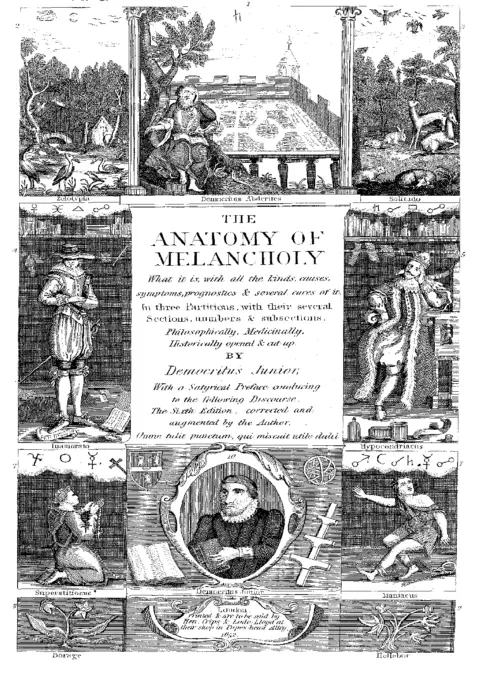
THE CLASSIC COLLECTION · 1617
"The Anatomy of Melancholy" by Robert Burton is a medical treatise first published in 1621. This massive work explores depression and its causes, symptoms, and cures, but ranges far beyond medicine into history, astronomy, geography, and literature. Written under the pseudonym Democritus Junior, Burton blends scientific analysis with humor and satire across over 500,000 words. Drawing from ancient authorities and medieval sources, he examines melancholy as both a passing mood and a serious ailment, creating a unique work that inspired generations of writers.
Introduction adapted from the source catalogue; source summaries may be automatically generated.
Free to read · English · 529,097 words · No account needed
MAKE TIME FOR A GOOD BOOK
On by default. Untick to stop anonymous reading totals. Each page counts after 10 seconds in view. How this works.
Anonymous counting is on unless you have switched it off.
To avoid such nets is no such mastery,
But ta'en escape is all the victory.
But, forasmuch as few men are free, so discreet lovers, or that can contain themselves, and moderate their passions, to curb their senses, as not to see them, not to look lasciviously, not to confer with them, such is the fury of this headstrong passion of raging lust, and their weakness, ferox ille ardor a natura insitus, [5663]as he terms it such a furious desire nature hath inscribed, such unspeakable delight. Sic Divae Veneris furor, Insanis adeo mentibus incubat,
which neither reason, counsel, poverty, pain, misery, drudgery, partus dolor, &c., can deter them from; we must use some speedy means to correct and prevent that, and all other inconveniences, which come by conference and the like. The best, readiest, surest way, and which all approve, is Loci mutatio, to send them several ways, that they may neither hear of, see, nor have an opportunity to send to one another again, or live together, soli cum sola, as so many Gilbertines. Elongatio a patria, 'tis Savanarola's fourth rule, and Gordonius' precept, distrahatur ad longinquas regiones, send him to travel. 'Tis that which most run upon, as so many hounds, with full cry, poets, divines, philosophers, physicians, all, mutet patriam: Valesius: [5664]as a sick man he must be cured with change of air, Tully 4 Tuscul. The best remedy is to get thee gone, Jason Pratensis: change air and soil, Laurentius. [5665]Fuge littus amatum. Virg. Utile finitimis abstinuisse locis. [5666]Ovid. I procul, et longas carpere perge vias. ———sed fuge tutus eris.
Travelling is an antidote of love,
[5667]Magnum iter ad doctas proficisci cogor Athenas,
Ut me longa gravi solvat amore via.
For this purpose, saith [5668]Propertius, my parents sent me to Athens; time and patience wear away pain and grief, as fire goes out for want of fuel. Quantum oculis, animo tam procul ibit amor. But so as they tarry out long enough: a whole year [5669]Xenophon prescribes Critobulus, vix enim intra hoc tempus ab amore sanari poteris: some will hardly be weaned under. All this [5670]Heinsius merrily inculcates in an epistle to his friend Primierus; first fast, then tarry, thirdly, change thy place, fourthly, think of a halter. If change of place, continuance of time, absence, will not wear it out with those precedent remedies, it will hardly be removed: but these commonly are of force. Felix Plater, observ. lib. 1. had a baker to his patient, almost mad for the love of his maid, and desperate; by removing her from him, he was in a short space cured. Isaeus, a philosopher of Assyria, was a most dissolute liver in his youth, palam lasciviens, in love with all he met; but after he betook himself, by his friends' advice, to his study, and left women's company, he was so changed that he cared no more for plays, nor feasts, nor masks, nor songs, nor verses, fine clothes, nor no such love toys: he became a new man upon a sudden, tanquam si priores oculos amisisset, (saith mine [5671]author) as if he had lost his former eyes. Peter Godefridus, in the last chapter of his third book, hath a story out of St. Ambrose, of a young man that meeting his old love after long absence, on whom he had extremely doted, would scarce take notice of her; she wondered at it, that he should so lightly esteem her, called him again, lenibat dictis animum, and told him who she was, Ego sum, inquit: At ego non sum ego; but he replied, he was not the same man: proripuit sese tandem, as [5672]Aeneas fled from Dido, not vouchsafing her any farther parley, loathing his folly, and ashamed of that which formerly he had done. [5673]Non sum stultus ut ante jam Neaera. O Neaera, put your tricks, and practise hereafter upon somebody else, you shall befool me no longer. Petrarch hath such another tale of a young gallant, that loved a wench with one eye, and for that cause by his parents was sent to travel into far countries, after some years he returned, and meeting the maid for whose sake he was sent abroad, asked her how, and by what chance she lost her eye? no, said she, I have lost none, but you have found yours: signifying thereby, that all lovers were blind, as Fabius saith, Amantes de forma judicare non possunt, lovers cannot judge of beauty, nor scarce of anything else, as they will easily confess after they return unto themselves, by some discontinuance or better advice, wonder at their own folly, madness, stupidity, blindness, be much abashed, and laugh at love, and call it an idle thing, condemn themselves that ever they should be so besotted or misled: and be heartily glad they have so happily escaped. If so be (which is seldom) that change of place will not effect this alteration, then other remedies are to be annexed, fair and foul means, as to persuade, promise, threaten, terrify, or to divert by some contrary passion, rumour, tales, news, or some witty invention to alter his affection, [5674]by some greater sorrow to drive out the less, saith Gordonius, as that his house is on fire, his best friends dead, his money stolen. [5675]That he is made some great governor, or hath some honour, office, some inheritance is befallen him. He shall be a knight, a baron; or by some false accusation, as they do to such as have the hiccup, to make them forget it. St. Hierome, lib. 2. epist. 16. to Rusticus the monk, hath an instance of a young man of Greece, that lived in a monastery in Egypt, [5676]that by no labour, no continence, no persuasion, could be diverted, but at last by this trick he was delivered. The abbot sets one of his convent to quarrel with him, and with some scandalous reproach or other to defame him before company, and then to come and complain first, the witnesses were likewise suborned for the plaintiff. The young man wept, and when all were against him, the abbot cunningly took his part, lest he should be overcome with immoderate grief: but what need many words? by this invention he was cured, and alienated from his pristine love-thoughts—Injuries, slanders, contempts, disgraces—spretaeque injuria formae, the insult of her slighted beauty, are very forcible means to withdraw men's affections, contumelia affecti amatores amare desinunt, as [5677]Lucian saith, lovers reviled or neglected, contemned or misused, turn love to hate; [5678]redeam? Non si me obsecret, I'll never love thee more. Egone illam, quae illum, quae me, quae non? So Zephyrus hated Hyacinthus because he scorned him, and preferred his co-rival Apollo (Palephaetus fab. Nar.), he will not come again though he be invited. Tell him but how he was scoffed at behind his back, ('tis the counsel of Avicenna), that his love is false, and entertains another, rejects him, cares not for him, or that she is a fool; a nasty quean, a slut, a vixen, a scold, a devil, or, which Italians commonly do, that he or she hath some loathsome filthy disease, gout, stone, strangury, falling sickness, and that they are hereditary, not to be avoided, he is subject to a consumption, hath the pox, that he hath three or four incurable tetters, issues; that she is bald, her breath stinks, she is mad by inheritance, and so are all the kindred, a hair-brain, with many other secret infirmities, which I will not so much as name, belonging to women. That he is a hermaphrodite, an eunuch, imperfect, impotent, a spendthrift, a gamester, a fool, a gull, a beggar, a whoremaster, far in debt, and not able to maintain her, a common drunkard, his mother was a witch, his father hanged, that he hath a wolf in his bosom, a sore leg, he is a leper, hath some incurable disease, that he will surely beat her, he cannot hold his water, that he cries out or walks in the night, will stab his bedfellow, tell all his secrets in his sleep, and that nobody dare lie with him, his house is haunted with spirits, with such fearful and tragical things, able to avert and terrify any man or woman living, Gordonius, cap. 20. part. 2. hunc in modo consulit; Paretur aliqua vetula turpissima aspectu, cum turpi et vili habitu: et portet subtus gremium pannum menstrualem, et dicat quod amica sua sit ebriosa, et quod mingat in lecto, et quod est epileptica et impudicia; et quod in corpore suo sunt excrescentiae enormes, cum faetore anhelitus, et aliae enormitates, quibus vetulae sunt edoctae: si nolit his persuaderi, subito extrahat [5679]pannum menstrualem, coram facie portando, exclamando, talis est amica tua; et si ex his non demiserit, non est homo, sed diabolus incarnatus. Idem fere, Avicenna, cap. 24, de cura Elishi, lib. 3, Fen. 1. Tract. 4. Narrent res immundas vetulae, ex quibus abominationem incurrat, et res [5680]sordidas et, hoc assiduent. Idem Arculanus cap. 16. in 9. Rhasis, &c. Withal as they do discommend the old, for the better effecting a more speedy alteration, they must commend another paramour, alteram inducere, set him or her to be wooed, or woo some other that shall be fairer, of better note, better fortune, birth, parentage, much to be preferred, [5681] Invenies alium si te hic fastidit Alexis, by this means, which Jason Pratensis wisheth, to turn the stream of affection another way, Successore novo truditur omnis amor; or, as Valesius adviseth, by [5682]subdividing to diminish it, as a great river cut into many channels runs low at last. [5683]Hortor et ut pariter binas habeatis amicas, &c. If you suspect to be taken, be sure, saith the poet, to have two mistresses at once, or go from one to another: as he that goes from a good fire in cold weather is both to depart from it, though in the next room there be a better which will refresh him as much; there's as much difference of haec as hac ignis; or bring him to some public shows, plays, meetings, where he may see variety, and he shall likely loathe his first choice: carry him but to the next town, yea peradventure to the next house, and as Paris lost Oenone's love by seeing Helen, and Cressida forsook Troilus by conversing with Diomede, he will dislike his former mistress, and leave her quite behind him, as [5684]Theseus left Ariadne fast asleep in the island of Dia, to seek her fortune, that was erst his loving mistress. [5685]Nunc primum Dorida vetus amator contempsi, as he said, Doris is but a dowdy to this. As he that looks himself in a glass forgets his physiognomy forthwith, this flattering glass of love will be diminished by remove; after a little absence it will be remitted, the next fair object will likely alter it. A young man in [5686]Lucian was pitifully in love, he came to the theatre by chance, and by seeing other fair objects there, mentis sanitatem recepit, was fully recovered, [5687] and went merrily home, as if he had taken a dram of oblivion. [5688]A mouse (saith an apologer) was brought up in a chest, there fed with fragments of bread and cheese, though there could be no better meat, till coming forth at last, and feeding liberally of other variety of viands, loathed his former life: moralise this fable by thyself. Plato, in. his seventh book De Legibus, hath a pretty fiction of a city under ground, [5689]to which by little holes some small store of light came; the inhabitants thought there could not be a better place, and at their first coming abroad they might not endure the light, aegerrime solem intueri; but after they were accustomed a little to it, [5690]they deplored their fellows' misery that lived under ground. A silly lover is in like state, none so fair as his mistress at first, he cares for none but her; yet after a while, when he hath compared her with others, he abhors her name, sight, and memory. 'Tis generally true; for as he observes, [5691]Priorem flammam novus ignis extrudit; et ea multorum natura, ut praesentes maxime ament, one fire drives out another; and such is women's weakness, that they love commonly him that is present. And so do many men; as he confessed, he loved Amye, till he saw Florial, and when he saw Cynthia, forgat them both: but fair Phillis was incomparably beyond, them all, Cloris surpassed her, and yet when he espied Amaryllis, she was his sole mistress; O divine Amaryllis: quam procera, cupressi ad instar, quam elegans, quam decens, &c. How lovely, how tall, how comely she was (saith Polemius) till he saw another, and then she was the sole subject of his thoughts. In conclusion, her he loves best he saw last. [5692]Triton, the sea-god, first loved Leucothoe, till he came in presence of Milaene, she was the commandress of his heart, till he saw Galatea: but (as [5693]she complains) he loved another eftsoons, another, and another. 'Tis a thing which, by Hierom's report, hath been usually practised. [5694]Heathen philosophers drive out one love with another, as they do a peg, or pin with a pin. Which those seven Persian princes did to Ahasuerus, that they might requite the desire of Queen Vashti with the love of others. Pausanias in Eliacis saith, that therefore one Cupid was painted to contend with another, and to take the garland from him, because one love drives out another, [5695]Alterius vires subtrahit alter amor; and Tully, 3. Nat. Deor. disputing with C. Cotta, makes mention of three several Cupids, all differing in office. Felix Plater, in the first book of his observations, boasts how he cured a widower in Basil, a patient of his, by this stratagem alone, that doted upon a poor servant his maid, when friends, children, no persuasion could serve to alienate his mind: they motioned him to another honest man's daughter in the town, whom he loved, and lived with long after, abhorring the very name and sight of the first. After the death of Lucretia, [5696]Euryalus would admit of no comfort, till the Emperor Sigismund married him to a noble lady of his court, and so in short space he was freed.
Your reading position is saved on this browser. Take it to another device with a library code. Reading pages adapt to text, rather than matching a printed edition.
BEHIND THE BOOK
This eBook is for the use of anyone anywhere in the United States and most other parts of the world at no cost and with almost no restrictions whatsoever. You may copy it, give it away or re-use it under the terms of the Project Gutenberg License included with this eBook or online at www.gutenberg.org. If you are not located in the United States, you will have to check the laws of the country where you are located before using this eBook. Read the source licence.
The original source file, including credits and licence, is retained by this library. Request an original-format copy at no charge. Please include the book title and Project Gutenberg identifier #10800.
KEEP YOUR CURIOSITY GOING
David Patterson (Spirit) Hatch
Coulson Kernahan

Ralph Waldo Emerson
Frances Wright

Edwin Abbott Abbott

Joseph Droz