
Last letters from the living dead man
David Patterson (Spirit) Hatch
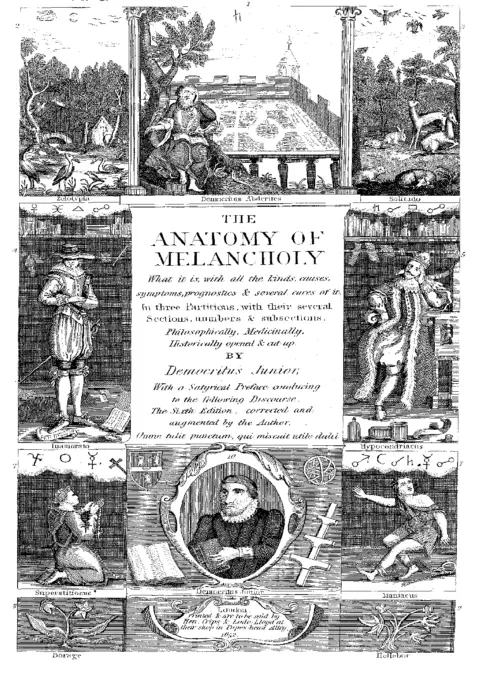
THE CLASSIC COLLECTION · 1617
"The Anatomy of Melancholy" by Robert Burton is a medical treatise first published in 1621. This massive work explores depression and its causes, symptoms, and cures, but ranges far beyond medicine into history, astronomy, geography, and literature. Written under the pseudonym Democritus Junior, Burton blends scientific analysis with humor and satire across over 500,000 words. Drawing from ancient authorities and medieval sources, he examines melancholy as both a passing mood and a serious ailment, creating a unique work that inspired generations of writers.
Introduction adapted from the source catalogue; source summaries may be automatically generated.
Free to read · English · 529,097 words · No account needed
MAKE TIME FOR A GOOD BOOK
On by default. Untick to stop anonymous reading totals. Each page counts after 10 seconds in view. How this works.
Anonymous counting is on unless you have switched it off.
He that invents anything for public good in any art or science, writes a treatise, [646]or performs any noble exploit, at home or abroad, [647] shall be accordingly enriched, [648]honoured, and preferred. I say with Hannibal in Ennius, Hostem qui feriet erit mihi Carthaginensis, let him be of what condition he will, in all offices, actions, he that deserves best shall have best. Tilianus in Philonius, out of a charitable mind no doubt, wished all his books were gold and silver, jewels and precious stones, [649]to redeem captives, set free prisoners, and relieve all poor distressed souls that wanted means; religiously done. I deny not, but to what purpose? Suppose this were so well done, within a little after, though a man had Croesus' wealth to bestow, there would be as many more. Wherefore I will suffer no [650]beggars, rogues, vagabonds, or idle persons at all, that cannot give an account of their lives how they [651]maintain themselves. If they be impotent, lame, blind, and single, they shall be sufficiently maintained in several hospitals, built for that purpose; if married and infirm, past work, or by inevitable loss, or some such like misfortune cast behind, by distribution of [652]corn, house-rent free, annual pensions or money, they shall be relieved, and highly rewarded for their good service they have formerly done; if able, they shall be enforced to work. [653]For I see no reason (as [654]he said) why an epicure or idle drone, a rich glutton, a usurer, should live at ease, and do nothing, live in honour, in all manner of pleasures, and oppress others, when as in the meantime a poor labourer, a smith, a carpenter, an husbandman that hath spent his time in continual labour, as an ass to carry burdens, to do the commonwealth good, and without whom we cannot live, shall be left in his old age to beg or starve, and lead a miserable life worse than a jument. As [655]all conditions shall be tied to their task, so none shall be overtired, but have their set times of recreations and holidays, indulgere genio, feasts and merry meetings, even to the meanest artificer, or basest servant, once a week to sing or dance, (though not all at once) or do whatsoever he shall please; like [656]that Saccarum festum amongst the Persians, those Saturnals in Rome, as well as his master. [657]If any be drunk, he shall drink no more wine or strong drink in a twelvemonth after. A bankrupt shall be [658] Catademiatus in Amphitheatro, publicly shamed, and he that cannot pay his debts, if by riot or negligence he have been impoverished, shall be for a twelvemonth imprisoned, if in that space his creditors be not satisfied, [659]he shall be hanged. He [660]that commits sacrilege shall lose his hands; he that bears false witness, or is of perjury convicted, shall have his tongue cut out, except he redeem it with his head. Murder, [661] adultery, shall be punished by death, [662]but not theft, except it be some more grievous offence, or notorious offenders: otherwise they shall be condemned to the galleys, mines, be his slaves whom they have offended, during their lives. I hate all hereditary slaves, and that duram Persarum legem as [663]Brisonius calls it; or as [664]Ammianus, impendio formidatas et abominandas leges, per quas ob noxam unius, omnis propinquitas perit hard law that wife and children, friends and allies, should suffer for the father's offence. No man shall marry until he [665]be 25, no woman till she be 20, [666] nisi alitur dispensatum fuerit. If one [667]die, the other party shall not marry till six months after; and because many families are compelled to live niggardly, exhaust and undone by great dowers, [668]none shall be given at all, or very little, and that by supervisors rated, they that are foul shall have a greater portion; if fair, none at all, or very little: [669]howsoever not to exceed such a rate as those supervisors shall think fit. And when once they come to those years, poverty shall hinder no man from marriage, or any other respect, [670]but all shall be rather enforced than hindered, [671]except they be [672]dismembered, or grievously deformed, infirm, or visited with some enormous hereditary disease, in body or mind; in such cases upon a great pain, or mulct, [673]man or woman shall not marry, other order shall be taken for them to their content. If people overabound, they shall be eased by [674]colonies. [675]No man shall wear weapons in any city. The same attire shall be kept, and that proper to several callings, by which they shall be distinguished. [676]Luxus funerum shall be taken away, that intempestive expense moderated, and many others. Brokers, takers of pawns, biting usurers, I will not admit; yet because hic cum hominibus non cum diis agitur, we converse here with men, not with gods, and for the hardness of men's hearts I will tolerate some kind of usury.[677]If we were honest, I confess, si probi essemus, we should have no use of it, but being as it is, we must necessarily admit it. Howsoever most divines contradict it, dicimus inficias, sed vox ea sola reperta est, it must be winked at by politicians. And yet some great doctors approve of it, Calvin, Bucer, Zanchius, P. Martyr, because by so many grand lawyers, decrees of emperors, princes' statutes, customs of commonwealths, churches' approbations it is permitted, &c. I will therefore allow it. But to no private persons, nor to every man that will, to orphans only, maids, widows, or such as by reason of their age, sex, education, ignorance of trading, know not otherwise how to employ it; and those so approved, not to let it out apart, but to bring their money to a [678]common bank which shall be allowed in every city, as in Genoa, Geneva, Nuremberg, Venice, at [679]5, 6, 7, not above 8 per centum, as the supervisors, or aerarii praefecti shall think fit. [680]And as it shall not be lawful for each man to be an usurer that will, so shall it not be lawful for all to take up money at use, not to prodigals and spendthrifts, but to merchants, young tradesmen, such as stand in need, or know honestly how to employ it, whose necessity, cause and condition the said supervisors shall approve of. I will have no private monopolies, to enrich one man, and beggar a multitude, [681]multiplicity of offices, of supplying by deputies, weights and measures, the same throughout, and those rectified by the Primum mobile and sun's motion, threescore miles to a degree according to observation, 1000 geometrical paces to a mile, five foot to a pace, twelve inches to a foot, &c. and from measures known it is an easy matter to rectify weights, &c. to cast up all, and resolve bodies by algebra, stereometry. I hate wars if they be not ad populi salutem upon urgent occasion, [682]odimus accipitrim, quia semper vivit in armis [683] offensive wars, except the cause be very just, I will not allow of. For I do highly magnify that saying of Hannibal to Scipio, in [684]Livy, It had been a blessed thing for you and us, if God had given that mind to our predecessors, that you had been content with Italy, we with Africa. For neither Sicily nor Sardinia are worth such cost and pains, so many fleets and armies, or so many famous Captains' lives. Omnia prius tentanda, fair means shall first be tried. [685]Peragit tranquilla potestas, Quod violenta nequit. I will have them proceed with all moderation: but hear you, Fabius my general, not Minutius, nam [686]qui Consilio nititur plus hostibus nocet, quam qui sini animi ratione, viribus: And in such wars to abstain as much as is possible from [687]depopulations, burning of towns, massacring of infants, &c. For defensive wars, I will have forces still ready at a small warning, by land and sea, a prepared navy, soldiers in procinctu, et quam [688]Bonfinius apud Hungaros suos vult, virgam ferream, and money, which is nerves belli, still in a readiness, and a sufficient revenue, a third part as in old [689]Rome and Egypt, reserved for the commonwealth; to avoid those heavy taxes and impositions, as well to defray this charge of wars, as also all other public defalcations, expenses, fees, pensions, reparations, chaste sports, feasts, donaries, rewards, and entertainments. All things in this nature especially I will have maturely done, and with great [690]deliberation: ne quid [691] temere, ne quid remisse ac timide fiat; Sid quo feror hospes? To prosecute the rest would require a volume. Manum de tabella, I have been over tedious in this subject; I could have here willingly ranged, but these straits wherein I am included will not permit. From commonwealths and cities, I will descend to families, which have as many corsives and molestations, as frequent discontents as the rest. Great affinity there is betwixt a political and economical body; they differ only in magnitude and proportion of business (so Scaliger [692]writes) as they have both likely the same period, as [693]Bodin and [694]Peucer hold, out of Plato, six or seven hundred years, so many times they have the same means of their vexation and overthrows; as namely, riot, a common ruin of both, riot in building, riot in profuse spending, riot in apparel, &c. be it in what kind soever, it produceth the same effects. A [695]chorographer of ours speaking obiter of ancient families, why they are so frequent in the north, continue so long, are so soon extinguished in the south, and so few, gives no other reason but this, luxus omnia dissipavit, riot hath consumed all, fine clothes and curious buildings came into this island, as he notes in his annals, not so many years since; non sine dispendio hospitalitatis to the decay of hospitality. Howbeit many times that word is mistaken, and under the name of bounty and hospitality, is shrouded riot and prodigality, and that which is commendable in itself well used, hath been mistaken heretofore, is become by his abuse, the bane and utter ruin of many a noble family. For some men live like the rich glutton, consuming themselves and their substance by continual feasting and invitations, with [696]Axilon in Homer, keep open house for all comers, giving entertainment to such as visit them, [697]keeping a table beyond their means, and a company of idle servants (though not so frequent as of old) are blown up on a sudden; and as Actaeon was by his hounds, devoured by their kinsmen, friends, and multitude of followers. [698]It is a wonder that Paulus Jovius relates of our northern countries, what an infinite deal of meat we consume on our tables; that I may truly say, 'tis not bounty, not hospitality, as it is often abused, but riot and excess, gluttony and prodigality; a mere vice; it brings in debt, want, and beggary, hereditary diseases, consumes their fortunes, and overthrows the good temperature of their bodies. To this I might here well add their inordinate expense in building, those fantastical houses, turrets, walks, parks, &c. gaming, excess of pleasure, and that prodigious riot in apparel, by which means they are compelled to break up house, and creep into holes. Sesellius in his commonwealth of [699]France, gives three reasons why the French nobility were so frequently bankrupts: First, because they had so many lawsuits and contentions one upon another, which were tedious and costly; by which means it came to pass, that commonly lawyers bought them out of their possessions. A second cause was their riot, they lived beyond their means, and were therefore swallowed up by merchants. (La Nove, a French writer, yields five reasons of his countrymen's poverty, to the same effect almost, and thinks verily if the gentry of France were divided into ten parts, eight of them would be found much impaired, by sales, mortgages, and debts, or wholly sunk in their estates.) The last was immoderate excess in apparel, which consumed their revenues. How this concerns and agrees with our present state, look you. But of this elsewhere. As it is in a man's body, if either head, heart, stomach, liver, spleen, or any one part be misaffected, all the rest suffer with it: so is it with this economical body. If the head be naught, a spendthrift, a drunkard, a whoremaster, a gamester, how shall the family live at ease? [700]Ipsa si cupiat solus servare, prorsus, non potest hanc familiam, as Demea said in the comedy, Safety herself cannot save it. A good, honest, painful man many times hath a shrew to his wife, a sickly, dishonest, slothful, foolish, careless woman to his mate, a proud, peevish flirt, a liquorish, prodigal quean, and by that means all goes to ruin: or if they differ in nature, he is thrifty, she spends all, he wise, she sottish and soft; what agreement can there be? what friendship? Like that of the thrush and swallow in Aesop, instead of mutual love, kind compellations, whore and thief is heard, they fling stools at one another's heads. [701]Quae intemperies vexat hanc familiam? All enforced marriages commonly produce such effects, or if on their behalves it be well, as to live and agree lovingly together, they may have disobedient and unruly children, that take ill courses to disquiet them, [702]their son is a thief, a spendthrift, their daughter a whore; a step [703]mother, or a daughter-in-law distempers all; [704]or else for want of means, many torturers arise, debts, dues, fees, dowries, jointures, legacies to be paid, annuities issuing out, by means of which, they have not wherewithal to maintain themselves in that pomp as their predecessors have done, bring up or bestow their children to their callings, to their birth and quality, [705]and will not descend to their present fortunes. Oftentimes, too, to aggravate the rest, concur many other inconveniences, unthankful friends, decayed friends, bad neighbours, negligent servants [706]servi furaces, Versipelles, callidi, occlusa sibi mille clavibus reserant, furtimque; raptant, consumunt, liguriunt; casualties, taxes, mulcts, chargeable offices, vain expenses, entertainments, loss of stock, enmities, emulations, frequent invitations, losses, suretyship, sickness, death of friends, and that which is the gulf of all, improvidence, ill husbandry, disorder and confusion, by which means they are drenched on a sudden in their estates, and at unawares precipitated insensibly into an inextricable labyrinth of debts, cares, woes, want, grief, discontent and melancholy itself. I have done with families, and will now briefly run over some few sorts and conditions of men. The most secure, happy, jovial, and merry in the world's esteem are princes and great men, free from melancholy: but for their cares, miseries, suspicions, jealousies, discontents, folly and madness, I refer you to Xenophon's Tyrannus, where king Hieron discourseth at large with Simonides the poet, of this subject. Of all others they are most troubled with perpetual fears, anxieties, insomuch, that as he said in [707]Valerius, if thou knewest with what cares and miseries this robe were stuffed, thou wouldst not stoop to take it up. Or put case they be secure and free from fears and discontents, yet they are void [708]of reason too oft, and precipitate in their actions, read all our histories, quos de stultis prodidere stulti, Iliades, Aeneides, Annales, and what is the subject? Stultorum regum, et populorum continet aestus.
Your reading position is saved on this browser. Take it to another device with a library code. Reading pages adapt to text, rather than matching a printed edition.
BEHIND THE BOOK
This eBook is for the use of anyone anywhere in the United States and most other parts of the world at no cost and with almost no restrictions whatsoever. You may copy it, give it away or re-use it under the terms of the Project Gutenberg License included with this eBook or online at www.gutenberg.org. If you are not located in the United States, you will have to check the laws of the country where you are located before using this eBook. Read the source licence.
The original source file, including credits and licence, is retained by this library. Request an original-format copy at no charge. Please include the book title and Project Gutenberg identifier #10800.
KEEP YOUR CURIOSITY GOING
David Patterson (Spirit) Hatch
Coulson Kernahan

Ralph Waldo Emerson
Frances Wright

Edwin Abbott Abbott

Joseph Droz