READ · DISCOVER · ENJOYClassic literature · Always free
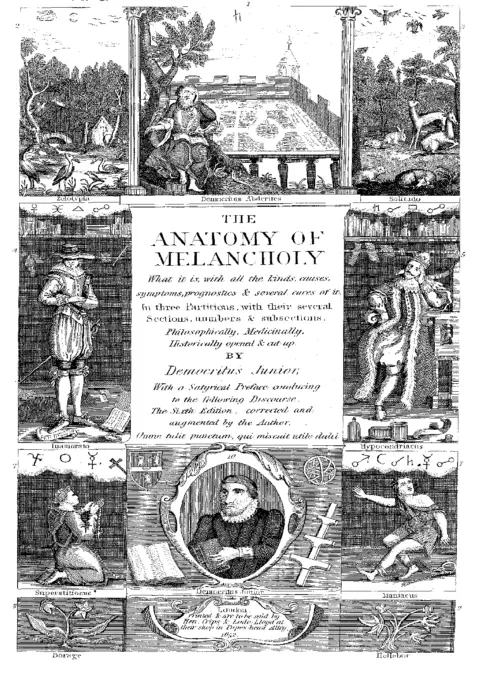
The Anatomy of Melancholy — digital edition cover

THE CLASSIC COLLECTION · 1617

The Anatomy of Melancholy

"The Anatomy of Melancholy" by Robert Burton is a medical treatise first published in 1621. This massive work explores depression and its causes, symptoms, and cures, but ranges far beyond medicine into history, astronomy, geography, and literature. Written under the pseudonym Democritus Junior, Burton blends scientific analysis with humor and satire across over 500,000 words. Drawing from ancient authorities and medieval sources, he examines melancholy as both a passing mood and a serious ailment, creating a unique work that inspired generations of writers.

Introduction adapted from the source catalogue; source summaries may be automatically generated.

Start reading ↓

Free to read · English · 529,097 words · No account needed

MAKE TIME FOR A GOOD BOOK

The Anatomy of Melancholy

On by default. Untick to stop anonymous reading totals. Each page counts after 10 seconds in view. How this works.

Anonymous counting is on unless you have switched it off.

The Anatomy of Melancholy

Through such a train of words if I should run,
The day would sooner than the tale be done:

but according to my promise, I will descend to particulars. This melancholy extends itself not to men only, but even to vegetals and sensibles. I speak not of those creatures which are saturnine, melancholy by nature, as lead, and such like minerals, or those plants, rue, cypress, &c. and hellebore itself, of which [468]Agrippa treats, fishes, birds, and beasts, hares, conies, dormice, &c., owls, bats, nightbirds, but that artificial, which is perceived in them all. Remove a plant, it will pine away, which is especially perceived in date trees, as you may read at large in Constantine's husbandry, that antipathy betwixt the vine and the cabbage, vine and oil. Put a bird in a cage, he will die for sullenness, or a beast in a pen, or take his young ones or companions from him, and see what effect it will cause. But who perceives not these common passions of sensible creatures, fear, sorrow, &c. Of all other, dogs are most subject to this malady, insomuch some hold they dream as men do, and through violence of melancholy run mad; I could relate many stories of dogs that have died for grief, and pined away for loss of their masters, but they are common in every [469]author. Kingdoms, provinces, and politic bodies are likewise sensible and subject to this disease, as [470]Boterus in his politics hath proved at large. As in human bodies (saith he) there be divers alterations proceeding from humours, so be there many diseases in a commonwealth, which do as diversely happen from several distempers, as you may easily perceive by their particular symptoms. For where you shall see the people civil, obedient to God and princes, judicious, peaceable and quiet, rich, fortunate, [471]and flourish, to live in peace, in unity and concord, a country well tilled, many fair built and populous cities, ubi incolae nitent as old [472]Cato said, the people are neat, polite and terse, ubi bene, beateque vivunt, which our politicians make the chief end of a commonwealth; and which [473] Aristotle, Polit. lib. 3, cap. 4, calls Commune bonum, Polybius lib. 6, optabilem et selectum statum, that country is free from melancholy; as it was in Italy in the time of Augustus, now in China, now in many other flourishing kingdoms of Europe. But whereas you shall see many discontents, common grievances, complaints, poverty, barbarism, beggary, plagues, wars, rebellions, seditions, mutinies, contentions, idleness, riot, epicurism, the land lie untilled, waste, full of bogs, fens, deserts, &c., cities decayed, base and poor towns, villages depopulated, the people squalid, ugly, uncivil; that kingdom, that country, must needs be discontent, melancholy, hath a sick body, and had need to be reformed. Now that cannot well be effected, till the causes of these maladies be first removed, which commonly proceed from their own default, or some accidental inconvenience: as to be situated in a bad clime, too far north, sterile, in a barren place, as the desert of Libya, deserts of Arabia, places void of waters, as those of Lop and Belgian in Asia, or in a bad air, as at Alexandretta, Bantam, Pisa, Durrazzo, S. John de Ulloa, &c., or in danger of the sea's continual inundations, as in many places of the Low Countries and elsewhere, or near some bad neighbours, as Hungarians to Turks, Podolians to Tartars, or almost any bordering countries, they live in fear still, and by reason of hostile incursions are oftentimes left desolate. So are cities by reason [474]of wars, fires, plagues, inundations, [475]wild beasts, decay of trades, barred havens, the sea's violence, as Antwerp may witness of late, Syracuse of old, Brundusium in Italy, Rye and Dover with us, and many that at this day suspect the sea's fury and rage, and labour against it as the Venetians to their inestimable charge. But the most frequent maladies are such as proceed from themselves, as first when religion and God's service is neglected, innovated or altered, where they do not fear God, obey their prince, where atheism, epicurism, sacrilege, simony, &c., and all such impieties are freely committed, that country cannot prosper. When Abraham came to Gerar, and saw a bad land, he said, sure the fear of God was not in that place. [476] Cyprian Echovius, a Spanish chorographer, above all other cities of Spain, commends Borcino, in which there was no beggar, no man poor, &c., but all rich, and in good estate, and he gives the reason, because they were more religious than, their neighbours: why was Israel so often spoiled by their enemies, led into captivity, &c., but for their idolatry, neglect of God's word, for sacrilege, even for one Achan's fault? And what shall we except that have such multitudes of Achans, church robbers, simoniacal patrons, &c., how can they hope to flourish, that neglect divine duties, that live most part like Epicures? Other common grievances are generally noxious to a body politic; alteration of laws and customs, breaking privileges, general oppressions, seditions, &c., observed by [477]Aristotle, Bodin, Boterus, Junius, Arniscus, &c. I will only point at some of chiefest. [478]Impotentia gubernandi, ataxia, confusion, ill government, which proceeds from unskilful, slothful, griping, covetous, unjust, rash, or tyrannizing magistrates, when they are fools, idiots, children, proud, wilful, partial, indiscreet, oppressors, giddy heads, tyrants, not able or unfit to manage such offices: [479]many noble cities and flourishing kingdoms by that means are desolate, the whole body groans under such heads, and all the members must needs be disaffected, as at this day those goodly provinces in Asia Minor, &c. groan under the burthen of a Turkish government; and those vast kingdoms of Muscovia, Russia, [480]under a tyrannizing duke. Who ever heard of more civil and rich populous countries than those of Greece, Asia Minor, abounding with all [481]wealth, multitudes of inhabitants, force, power, splendour and magnificence? and that miracle of countries, [482]the Holy Land, that in so small a compass of ground could maintain so many towns, cities, produce so many fighting men? Egypt another paradise, now barbarous and desert, and almost waste, by the despotical government of an imperious Turk, intolerabili servitutis jugo premitur ([483]one saith) not only fire and water, goods or lands, sed ipse spiritus ab insolentissimi victoris pendet nutu, such is their slavery, their lives and souls depend upon his insolent will and command. A tyrant that spoils all wheresoever he comes, insomuch that an [484]historian complains, if an old inhabitant should now see them, he would not know them, if a traveller, or stranger, it would grieve his heart to behold them. Whereas [485]Aristotle notes, Novae exactiones, nova onera imposita, new burdens and exactions daily come upon them, like those of which Zosimus, lib. 2, so grievous, ut viri uxores, patres filios prostituerent ut exactoribus e questu, &c., they must needs be discontent, hinc civitatum gemitus et ploratus, as [486] Tully holds, hence come those complaints and tears of cities, poor, miserable, rebellious, and desperate subjects, as [487]Hippolitus adds; and [488]as a judicious countryman of ours observed not long since, in a survey of that great Duchy of Tuscany, the people lived much grieved and discontent, as appeared by their manifold and manifest complainings in that kind. That the state was like a sick body which had lately taken physic, whose humours are not yet well settled, and weakened so much by purging, that nothing was left but melancholy. Whereas the princes and potentates are immoderate in lust, hypocrites, epicures, of no religion, but in show: Quid hypocrisi fragilius? what so brittle and unsure? what sooner subverts their estates than wandering and raging lusts, on their subjects' wives, daughters? to say no worse. That they should facem praeferre, lead the way to all virtuous actions, are the ringleaders oftentimes of all mischief and dissolute courses, and by that means their countries are plagued, [489]and they themselves often ruined, banished, or murdered by conspiracy of their subjects, as Sardanapalus was, Dionysius Junior, Heliogabalus, Periander, Pisistratus, Tarquinius, Timocrates, Childericus, Appius Claudius, Andronicus, Galeacius Sforza, Alexander Medices, &c. Whereas the princes or great men are malicious, envious, factious, ambitious, emulators, they tear a commonwealth asunder, as so many Guelfs and Gibelines disturb the quietness of it, [490]and with mutual murders let it bleed to death; our histories are too full of such barbarous inhumanities, and the miseries that issue from them. Whereas they be like so many horseleeches, hungry, griping, corrupt, [491] covetous, avaritice mancipia, ravenous as wolves, for as Tully writes: qui praeest prodest, et qui pecudibus praeest, debet eorum utilitati inservire: or such as prefer their private before the public good. For as [492]he said long since, res privatae publicis semper officere. Or whereas they be illiterate, ignorant, empirics in policy, ubi deest facultas, [493]virtus (Aristot. pol. 5, cap. 8.) et scientia, wise only by inheritance, and in authority by birthright, favour, or for their wealth and titles; there must needs be a fault, [494]a great defect: because as an [495]old philosopher affirms, such men are not always fit. Of an infinite number, few alone are senators, and of those few, fewer good, and of that small number of honest, good, and noble men, few that are learned, wise, discreet and sufficient, able to discharge such places, it must needs turn to the confusion of a state. For as the [496]Princes are, so are the people; Qualis Rex, talis grex: and which [497]Antigonus right well said of old, qui Macedonia regem erudit, omnes etiam subditos erudit, he that teacheth the king of Macedon, teacheth all his subjects, is a true saying still. For Princes are the glass, the school, the book, Where subjects' eyes do learn, do read, do look.

Your reading position is saved on this browser. Take it to another device with a library code. Reading pages adapt to text, rather than matching a printed edition.

BEHIND THE WORDS

About Robert Burton

Robert Burton (1577–1640). Explore The Anatomy of Melancholy in this collection. These books span philosophy.

Explore this author’s books →

THE READERS’ VERDICT

How did this story stay with you?

Not rated yet
Your rating for The Anatomy of Melancholy

Be the first to share your verdict.

One rating per browser, which you can change or remove. A necessary browser identifier remembers your vote. How ratings work

A GOOD STORY DESERVES COMPANY

Pass this book along.

A great read is even better when it’s shared.

SEND A LITTLE INSPIRATION

Share this book

BEHIND THE BOOK

Edition & source details.

Title
The Anatomy of Melancholy
Author
Robert Burton
Publication year
1617
Digital edition publisher
Project Gutenberg
Gutenberg release date
2004-01-01
Language
English
Source edition imprint
Not stated in source catalogue
Source identifier
Project Gutenberg #10800
Contributors
No additional named contributors in source metadata

Public-domain source & licence

This eBook is for the use of anyone anywhere in the United States and most other parts of the world at no cost and with almost no restrictions whatsoever. You may copy it, give it away or re-use it under the terms of the Project Gutenberg License included with this eBook or online at www.gutenberg.org. If you are not located in the United States, you will have to check the laws of the country where you are located before using this eBook. Read the source licence.

Full source licence and obtaining an original copy

The original source file, including credits and licence, is retained by this library. Request an original-format copy at no charge. Please include the book title and Project Gutenberg identifier #10800.

the full Project Gutenberg License must appear
prominently whenever any copy of a Project Gutenberg work (any work
on which the phrase “Project Gutenberg” appears, or with which the
phrase “Project Gutenberg” is associated) is accessed, displayed,
performed, viewed, copied or distributed:

This eBook is for the use of anyone anywhere in the United States and most
other parts of the world at no cost and with almost no restrictions
whatsoever. You may copy it, give it away or re-use it under the terms
of the Project Gutenberg™ License included with this eBook or online
at www.gutenberg.org. If you
are not located in the United States, you will have to check the laws
of the country where you are located before using this eBook.

1.E.2. If an individual Project Gutenberg electronic work is
derived from texts not protected by U.S. copyright law (does not
contain a notice indicating that it is posted with permission of the
copyright holder), the work can be copied and distributed to anyone in
the United States without paying any fees or charges. If you are
redistributing or providing access to a work with the phrase “Project
Gutenberg” associated with or appearing on the work, you must comply
either with the requirements of paragraphs 1.E.1 through 1.E.7 or
obtain permission for the use of the work and the Project Gutenberg
trademark as set forth in paragraphs 1.E.8 or 1.E.9.

1.E.3. If an individual Project Gutenberg electronic work is posted
with the permission of the copyright holder, your use and distribution
must comply with both paragraphs 1.E.1 through 1.E.7 and any
additional terms imposed by the copyright holder. Additional terms
will be linked to the Project Gutenberg License for all works
posted with the permission of the copyright holder found at the
beginning of this work.

1.E.4. Do not unlink or detach or remove the full Project Gutenberg
License terms from this work, or any files containing a part of this
work or any other work associated with Project Gutenberg.

1.E.5. Do not copy, display, perform, distribute or redistribute this
electronic work, or any part of this electronic work, without
prominently displaying the sentence set forth in paragraph 1.E.1 with
active links or immediate access to the full terms of the Project
Gutenberg License.

1.E.6. You may convert to and distribute this work in any binary,
compressed, marked up, nonproprietary or proprietary form, including
any word processing or hypertext form. However, if you provide access
to or distribute copies of a Project Gutenberg work in a format
other than “Plain Vanilla ASCII” or other format used in the official
version posted on the official Project Gutenberg website
(www.gutenberg.org), you must, at no additional cost, fee or expense
to the user, provide a copy, a means of exporting a copy, or a means
of obtaining a copy upon request, of the work in its original “Plain
Vanilla ASCII” or other form. Any alternate format must include the
full Project Gutenberg License as specified in paragraph 1.E.1.

1.E.7. Do not charge a fee for access to, viewing, displaying,
performing, copying or distributing any Project Gutenberg works
unless you comply with paragraph 1.E.8 or 1.E.9.

1.E.8. You may charge a reasonable fee for copies of or providing
access to or distributing Project Gutenberg electronic works
provided that:

• You pay a royalty fee of 20% of the gross profits you derive from
the use of Project Gutenberg works calculated using the method
you already use to calculate your applicable taxes. The fee is owed
to the owner of the Project Gutenberg trademark, but he has
agreed to donate royalties under this paragraph to the Project
Gutenberg Literary Archive Foundation. Royalty payments must be paid
within 60 days following each date on which you prepare (or are
legally required to prepare) your periodic tax returns. Royalty
payments should be clearly marked as such and sent to the Project
Gutenberg Literary Archive Foundation at the address specified in
Section 4, “Information about donations to the Project Gutenberg
Literary Archive Foundation.”

• You provide a full refund of any money paid by a user who notifies
you in writing (or by e-mail) within 30 days of receipt that s/he
does not agree to the terms of the full Project Gutenberg™
License. You must require such a user to return or destroy all
copies of the works possessed in a physical medium and discontinue
all use of and all access to other copies of Project Gutenberg™
works.

• You provide, in accordance with paragraph 1.F.3, a full refund of
any money paid for a work or a replacement copy, if a defect in the
electronic work is discovered and reported to you within 90 days of
receipt of the work.

• You comply with all other terms of this agreement for free
distribution of Project Gutenberg™ works.


1.E.9. If you wish to charge a fee or distribute a Project
Gutenberg™ electronic work or group of works on different terms than
are set forth in this agreement, you must obtain permission in writing
from the Project Gutenberg Literary Archive Foundation, the manager of
the Project Gutenberg™ trademark. Contact the Foundation as set
forth in Section 3 below.

1.F.

1.F.1. Project Gutenberg volunteers and employees expend considerable
effort to identify, do copyright research on, transcribe and proofread
works not protected by U.S. copyright law in creating the Project
Gutenberg™ collection. Despite these efforts, Project Gutenberg™
electronic works, and the medium on which they may be stored, may
contain “Defects,” such as, but not limited to, incomplete, inaccurate
or corrupt data, transcription errors, a copyright or other
intellectual property infringement, a defective or damaged disk or
other medium, a computer virus, or computer codes that damage or
cannot be read by your equipment.

1.F.2. LIMITED WARRANTY, DISCLAIMER OF DAMAGES - Except for the “Right
of Replacement or Refund” described in paragraph 1.F.3, the Project
Gutenberg Literary Archive Foundation, the owner of the Project
Gutenberg™ trademark, and any other party distributing a Project
Gutenberg™ electronic work under this agreement, disclaim all
liability to you for damages, costs and expenses, including legal
fees. YOU AGREE THAT YOU HAVE NO REMEDIES FOR NEGLIGENCE, STRICT
LIABILITY, BREACH OF WARRANTY OR BREACH OF CONTRACT EXCEPT THOSE
PROVIDED IN PARAGRAPH 1.F.3. YOU AGREE THAT THE FOUNDATION, THE
TRADEMARK OWNER, AND ANY DISTRIBUTOR UNDER THIS AGREEMENT WILL NOT BE
LIABLE TO YOU FOR ACTUAL, DIRECT, INDIRECT, CONSEQUENTIAL, PUNITIVE OR
INCIDENTAL DAMAGES EVEN IF YOU GIVE NOTICE OF THE POSSIBILITY OF SUCH
DAMAGE.

1.F.3. LIMITED RIGHT OF REPLACEMENT OR REFUND - If you discover a
defect in this electronic work within 90 days of receiving it, you can
receive a refund of the money (if any) you paid for it by sending a
written explanation to the person you received the work from. If you
received the work on a physical medium, you must return the medium
with your written explanation. The person or entity that provided you
with the defective work may elect to provide a replacement copy in
lieu of a refund. If you received the work electronically, the person
or entity providing it to you may choose to give you a second
opportunity to receive the work electronically in lieu of a refund. If
the second copy is also defective, you may demand a refund in writing
without further opportunities to fix the problem.

1.F.4. Except for the limited right of replacement or refund set forth
in paragraph 1.F.3, this work is provided to you ‘AS-IS’, WITH NO
OTHER WARRANTIES OF ANY KIND, EXPRESS OR IMPLIED, INCLUDING BUT NOT
LIMITED TO WARRANTIES OF MERCHANTABILITY OR FITNESS FOR ANY PURPOSE.

1.F.5. Some states do not allow disclaimers of certain implied
warranties or the exclusion or limitation of certain types of
damages. If any disclaimer or limitation set forth in this agreement
violates the law of the state applicable to this agreement, the
agreement shall be interpreted to make the maximum disclaimer or
limitation permitted by the applicable state law. The invalidity or
unenforceability of any provision of this agreement shall not void the
remaining provisions.

1.F.6. INDEMNITY - You agree to indemnify and hold the Foundation, the
trademark owner, any agent or employee of the Foundation, anyone
providing copies of Project Gutenberg™ electronic works in
accordance with this agreement, and any volunteers associated with the
production, promotion and distribution of Project Gutenberg™
electronic works, harmless from all liability, costs and expenses,
including legal fees, that arise directly or indirectly from any of
the following which you do or cause to occur: (a) distribution of this
or any Project Gutenberg work, (b) alteration, modification, or
additions or deletions to any Project Gutenberg work, and (c) any
Defect you cause.

Section 2. Information about the Mission of Project Gutenberg

Project Gutenberg is synonymous with the free distribution of
electronic works in formats readable by the widest variety of
computers including obsolete, old, middle-aged and new computers. It
exists because of the efforts of hundreds of volunteers and donations
from people in all walks of life.

Volunteers and financial support to provide volunteers with the
assistance they need are critical to reaching Project Gutenberg’s
goals and ensuring that the Project Gutenberg collection will
remain freely available for generations to come. In 2001, the Project
Gutenberg Literary Archive Foundation was created to provide a secure
and permanent future for Project Gutenberg and future
generations. To learn more about the Project Gutenberg Literary
Archive Foundation and how your efforts and donations can help, see
Sections 3 and 4 and the Foundation information page at www.gutenberg.org.

Section 3. Information about the Project Gutenberg Literary Archive Foundation

The Project Gutenberg Literary Archive Foundation is a non-profit
501(c)(3) educational corporation organized under the laws of the
state of Mississippi and granted tax exempt status by the Internal
Revenue Service. The Foundation’s EIN or federal tax identification
number is 64-6221541. Contributions to the Project Gutenberg Literary
Archive Foundation are tax deductible to the full extent permitted by
U.S. federal laws and your state’s laws.

The Foundation’s business office is located at 41 Watchung Plaza #516,
Montclair NJ 07042, USA, +1 (862) 621-9288. Email contact links and up
to date contact information can be found at the Foundation’s website
and official page at www.gutenberg.org/contact

Section 4. Information about Donations to the Project Gutenberg
Literary Archive Foundation

Project Gutenberg™ depends upon and cannot survive without widespread
public support and donations to carry out its mission of
increasing the number of public domain and licensed works that can be
freely distributed in machine-readable form accessible by the widest
array of equipment including outdated equipment. Many small donations
($1 to $5,000) are particularly important to maintaining tax exempt
status with the IRS.

The Foundation is committed to complying with the laws regulating
charities and charitable donations in all 50 states of the United
States. Compliance requirements are not uniform and it takes a
considerable effort, much paperwork and many fees to meet and keep up
with these requirements. We do not solicit donations in locations
where we have not received written confirmation of compliance. To SEND
DONATIONS or determine the status of compliance for any particular state
visit www.gutenberg.org/donate.

While we cannot and do not solicit contributions from states where we
have not met the solicitation requirements, we know of no prohibition
against accepting unsolicited donations from donors in such states who
approach us with offers to donate.

International donations are gratefully accepted, but we cannot make
any statements concerning tax treatment of donations received from
outside the United States. U.S. laws alone swamp our small staff.

Please check the Project Gutenberg web pages for current donation
methods and addresses. Donations are accepted in a number of other
ways including checks, online payments and credit card donations. To
donate, please visit: www.gutenberg.org/donate.

Section 5. General Information About Project Gutenberg electronic works

Professor Michael S. Hart was the originator of the Project
Gutenberg concept of a library of electronic works that could be
freely shared with anyone. For forty years, he produced and
distributed Project Gutenberg eBooks with only a loose network of
volunteer support.

Project Gutenberg eBooks are often created from several printed
editions, all of which are confirmed as not protected by copyright in
the U.S. unless a copyright notice is included. Thus, we do not
necessarily keep eBooks in compliance with any particular paper
edition.

Most people start at our website which has the main PG search
facility: www.gutenberg.org.

This website includes information about Project Gutenberg,
including how to make donations to the Project Gutenberg Literary
Archive Foundation, how to help produce our new eBooks, and how to
subscribe to our email newsletter to hear about new eBooks.


KEEP YOUR CURIOSITY GOING

Your next chapter awaits.

Your privacy choices

Reading is always free. You can change these settings at any time.

Book banners link to our books on simonward.net. They do not use advertising cookies or tracking.

Privacy & cookie policy · Reading data and privacy controls