
Last letters from the living dead man
David Patterson (Spirit) Hatch
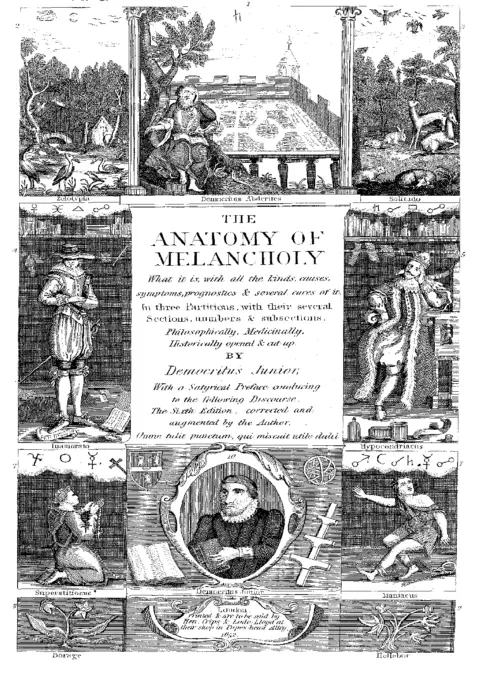
THE CLASSIC COLLECTION · 1617
"The Anatomy of Melancholy" by Robert Burton is a medical treatise first published in 1621. This massive work explores depression and its causes, symptoms, and cures, but ranges far beyond medicine into history, astronomy, geography, and literature. Written under the pseudonym Democritus Junior, Burton blends scientific analysis with humor and satire across over 500,000 words. Drawing from ancient authorities and medieval sources, he examines melancholy as both a passing mood and a serious ailment, creating a unique work that inspired generations of writers.
Introduction adapted from the source catalogue; source summaries may be automatically generated.
Free to read · English · 529,097 words · No account needed
MAKE TIME FOR A GOOD BOOK
On by default. Untick to stop anonymous reading totals. Each page counts after 10 seconds in view. How this works.
Anonymous counting is on unless you have switched it off.
Many such causes may be reckoned up, but they cannot avail, except opportunity be offered of time, place, and those other beautiful objects, or artificial enticements, as kissing, conference, discourse, gestures concur, with such like lascivious provocations. Kornmannus, in his book de linea amoris, makes five degrees of lust, out of [4805]Lucian belike, which he handles in five chapters, Visus, Colloquium, Convictus, Oscula, Tactus. [4806]Sight, of all other, is the first step of this unruly love, though sometime it be prevented by relation or hearing, or rather incensed. For there be those so apt, credulous, and facile to love, that if they hear of a proper man, or woman, they are in love before they see them, and that merely by relation, as Achilles Tatius observes. [4807]Such is their intemperance and lust, that they are as much maimed by report, as if they saw them. Callisthenes a rich young gentleman of Byzance in Thrace, hearing of [4808]Leucippe, Sostratus' fair daughter, was far in love with her, and, out of fame and common rumour, so much incensed, that he would needs have her to be his wife. And sometimes by reading they are so affected, as he in [4809]Lucian confesseth of himself, I never read that place of Panthea in Xenophon, but I am as much affected as if I were present with her. Such persons commonly [4810]feign a kind of beauty to themselves; and so did those three gentlewomen in [4811]Balthazar Castilio fall in love with a young man whom they never knew, but only heard him commended: or by reading of a letter; for there is a grace cometh from hearing, [4812] as a moral philosopher informeth us, as well from sight; and the species of love are received into the fantasy by relation alone: [4813]ut cupere ab aspectu, sic velle ab auditu, both senses affect. Interdum et absentes amamus, sometimes we love those that are absent, saith Philostratus, and gives instance in his friend Athenodorus, that loved a maid at Corinth whom he never saw; non oculi sed mens videt, we see with the eyes of our understanding. But the most familiar and usual cause of love is that which comes by sight, which conveys those admirable rays of beauty and pleasing graces to the heart. Plotinus derives love from sight, ἔρος quasi ὅρασις. [4814]Si nescis, oculi sunt in amore duces, the eyes are the harbingers of love, and the first step of love is sight, as [4815]Lilius Giraldus proves at large, hist. deor. syntag. 13. they as two sluices let in the influences of that divine, powerful, soul-ravishing, and captivating beauty, which, as [4816]one saith, is sharper than any dart or needle, wounds deeper into the heart; and opens a gap through our eyes to that lovely wound, which pierceth the soul itself (Ecclus. 18.) Through it love is kindled like a fire. This amazing, confounding, admirable, amiable beauty, [4817]than which in all nature's treasure (saith Isocrates) there is nothing so majestical and sacred, nothing so divine, lovely, precious, 'tis nature's crown, gold and glory; bonum si non summum, de summis tamen non infrequenter triumphans, whose power hence may be discerned; we contemn and abhor generally such things as are foul and ugly to behold, account them filthy, but love and covet that which is fair. 'Tis [4818] beauty in all things which pleaseth and allureth us, a fair hawk, a fine garment, a goodly building, a fair house, &c. That Persian Xerxes when he destroyed all those temples of the gods in Greece, caused that of Diana, in integrum servari, to be spared alone for that excellent beauty and magnificence of it. Inanimate beauty can so command. 'Tis that which painters, artificers, orators, all aim at, as Eriximachus the physician, in Plato contends, [4819]It was beauty first that ministered occasion to art, to find out the knowledge of carving, painting, building, to find out models, perspectives, rich furnitures, and so many rare inventions. Whiteness in the lily, red in the rose, purple in the violet, a lustre in all things without life, the clear light of the moon, the bright beams of the sun, splendour of gold, purple, sparkling diamond, the excellent feature of the horse, the majesty of the lion, the colour of birds, peacock's tails, the silver scales of fish, we behold with singular delight and admiration. [4820]And which is rich in plants, delightful in flowers, wonderful in beasts, but most glorious in men, doth make us affect and earnestly desire it, as when we hear any sweet harmony, an eloquent tongue, see any excellent quality, curious work of man, elaborate art, or aught that is exquisite, there ariseth instantly in us a longing for the same. We love such men, but most part for comeliness of person, we call them gods and goddesses, divine, serene, happy, &c. And of all mortal men they alone ([4821]Calcagninus holds) are free from calumny; qui divitiis, magistratu et gloria florent, injuria lacessimus, we backbite, wrong, hate renowned, rich, and happy men, we repine at their felicity, they are undeserving we think, fortune is a stepmother to us, a parent to them. We envy (saith [4822]Isocrates) wise, just, honest men, except with mutual offices and kindnesses, some good turn or other, they extort this love from us; only fair persons we love at first sight, desire their acquaintance, and adore them as so many gods: we had rather serve them than command others, and account ourselves the more beholding to them, the more service they enjoin us: though they be otherwise vicious, dishonest, we love them, favour them, and are ready to do them any good office for their [4823]beauty's sake, though they have no other good quality beside. Dic igitur o fomose, adolescens (as that eloquent Phavorinus breaks out in [4824]Stobeus) dic Autiloque, suavius nectare loqueris; dic o Telemache, vehementius Ulysse dicis; dic Alcibiades utcunque ebrius, libentius tibi licet ebrio auscultabimus. Speak, fair youth, speak Autiloquus, thy words are sweeter than nectar, speak O Telemachus, thou art more powerful than Ulysses, speak Alcibiades though drunk, we will willingly hear thee as thou art. Faults in such are no faults: for when the said Alcibiades had stolen Anytus his gold and silver plate, he was so far from prosecuting so foul a fact (though every man else condemned his impudence and insolency) that he wished it had been more, and much better (he loved him dearly) for his sweet sake. No worth is eminent in such lovely persons, all imperfections hid; non enim facile de his quos plurimum diligimus, turpitudinem suspicamur, for hearing, sight, touch, &c., our mind and all our senses are captivated, omnes sensus formosus delectat. Many men have been preferred for their person alone, chosen kings, as amongst the Indians, Persians, Ethiopians of old; the properest man of person the country could afford, was elected their sovereign lord; Gratior est pulchro veniens e corpore virtus, [4825]and so have many other nations thought and done, as [4826]Curtius observes: Ingens enim in corporis majestate veneratio est, for there is a majestical presence in such men; and so far was beauty adored amongst them, that no man was thought fit to reign, that was not in all parts complete and supereminent. Agis, king of Lacedaemon, had like to have been deposed, because he married a little wife, they would not have their royal issue degenerate. Who would ever have thought that Adrian' the Fourth, an English monk's bastard (as [4827]Papirius Massovius writes in his life), inops a suis relectus, squalidus et miser, a poor forsaken child, should ever come to be pope of Rome? But why was it? Erat acri ingenio, facundia expedita eleganti corpore, facieque laeta ac hilari, (as he follows it out of [4828]Nubrigensis, for he ploughs with his heifer,) he was wise, learned, eloquent, of a pleasant, a promising countenance, a goodly, proper man; he had, in a word, a winning look of his own, and that carried it, for that he was especially advanced. So Saul was a goodly person and a fair. Maximinus elected emperor, &c. Branchus the son of Apollo, whom he begot of Jance, Succron's daughter (saith Lactantius), when he kept King Admetus' herds in Thessaly, now grown a man, was an earnest suitor to his mother to know his father; the nymph denied him, because Apollo had conjured her to the contrary; yet overcome by his importunity at last she sent him to his father; when he came into Apollo's presence, malas Dei reverenter osculatus, he carried himself so well, and was so fair a young man, that Apollo was infinitely taken with the beauty of his person, he could scarce look off him, and said he was worthy of such parents, gave him a crown of gold, the spirit of divination, and in conclusion made him a demigod. O vis superba formae, a goddess beauty is, whom the very gods adore, nam pulchros dii amant; she is Amoris domina, love's harbinger, love's loadstone, a witch, a charm, &c. Beauty is a dower of itself, a sufficient patrimony, an ample commendation, an accurate epistle, as [4829]Lucian, [4830]Apuleius, Tiraquellus, and some others conclude. Imperio digna forma, beauty deserves a kingdom, saith Abulensis, paradox. 2. cap. 110. immortality; and [4831]more have got this honour and eternity for their beauty, than for all other virtues besides: and such as are fair, are worthy to be honoured of God and men. That Idalian Ganymede was therefore fetched by Jupiter into heaven, Hephaestion dear to Alexander, Antinous to Adrian. Plato calls beauty for that cause a privilege of nature, Naturae gaudentis opus, nature's masterpiece, a dumb comment; Theophrastus, a silent fraud; still rhetoric Carneades, that persuades without speech, a kingdom without a guard, because beautiful persons command as so many captains; Socrates, a tyranny, which tyranniseth over tyrants themselves; which made Diogenes belike call proper women queens, quod facerent homines quae praeciperent, because men were so obedient to their commands. They will adore, cringe, compliment, and bow to a common wench (if she be fair) as if she were a noble woman, a countess, a queen, or a goddess. Those intemperate young men of Greece erected at Delphos a golden image with infinite cost, to the eternal memory of Phryne the courtesan, as Aelian relates, for she was a most beautiful woman, insomuch, saith [4832]Athenaeus, that Apelles and Praxiteles drew Venus's picture from her. Thus young men will adore and honour beauty; nay kings themselves I say will do it, and voluntarily submit their sovereignty to a lovely woman. Wine is strong, kings are strong, but a woman strongest, 1 Esd. iv. 10. as Zerobabel proved at large to King Darius, his princes and noblemen. Kings sit still and command sea and land, &c., all pay tribute to the king; but women make kings pay tribute, and have dominion over them. When they have got gold and silver, they submit all to a beautiful woman, give themselves wholly to her, gape and gaze on her, and all men desire her more than gold or silver, or any precious thing: they will leave father and mother, and venture their lives for her, labour and travel to get, and bring all their gains to women, steal, fight, and spoil for their mistress's sake. And no king so strong, but a fair woman is stronger than he is. All things (as [4833]he proceeds) fear to touch the king; yet I saw him and Apame his concubine, the daughter of the famous Bartacus, sitting on the right hand of the king, and she took the crown off his head, and put it on her own, and stroke him with her left hand; yet the king gaped and gazed on her, and when she laughed he laughed, and when she was angry he flattered to be reconciled to her. So beauty commands even kings themselves; nay whole armies and kingdoms are captivated together with their kings: [4834]Forma vincit armatos, ferrum pulchritudo captivat; vincentur specie, qui non vincentur proelio. And 'tis a great matter saith [4835]Xenophon, and of which all fair persons may worthily brag, that a strong man must labour for his living if he will have aught, a valiant man must fight and endanger himself for it, a wise man speak, show himself, and toil; but a fair and beautiful person doth all with ease, he compasseth his desire without any pains-taking: God and men, heaven and earth conspire to honour him; every one pities him above other, if he be in need, [4836]and all the world is willing to do him good. [4837]Chariclea fell into the hand of pirates, but when all the rest were put to the edge of the sword, she alone was preserved for her person. [4838]When Constantinople was sacked by the Turk, Irene escaped, and was so far from being made a captive, that she even captivated the Grand Signior himself. So did Rosamond insult over King Henry the Second. [4839]———I was so fair an object; Whom fortune made my king, my love made subject; He found by proof the privilege of beauty, That it had power to countermand all duty.
Your reading position is saved on this browser. Take it to another device with a library code. Reading pages adapt to text, rather than matching a printed edition.
BEHIND THE BOOK
This eBook is for the use of anyone anywhere in the United States and most other parts of the world at no cost and with almost no restrictions whatsoever. You may copy it, give it away or re-use it under the terms of the Project Gutenberg License included with this eBook or online at www.gutenberg.org. If you are not located in the United States, you will have to check the laws of the country where you are located before using this eBook. Read the source licence.
The original source file, including credits and licence, is retained by this library. Request an original-format copy at no charge. Please include the book title and Project Gutenberg identifier #10800.
KEEP YOUR CURIOSITY GOING
David Patterson (Spirit) Hatch
Coulson Kernahan

Ralph Waldo Emerson
Frances Wright

Edwin Abbott Abbott

Joseph Droz