
Last letters from the living dead man
David Patterson (Spirit) Hatch
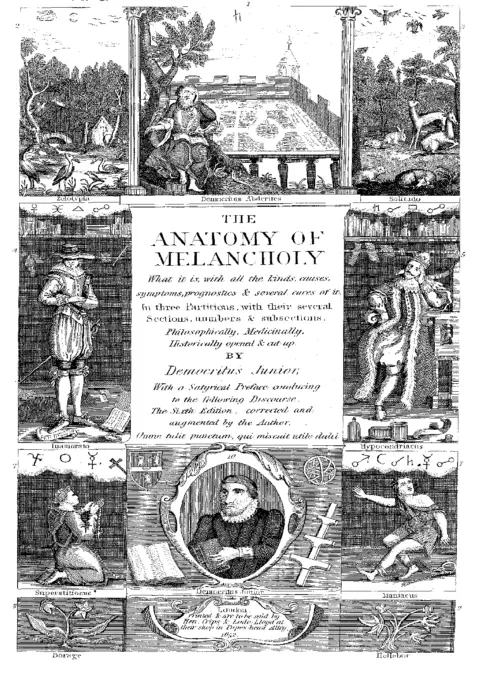
THE CLASSIC COLLECTION · 1617
"The Anatomy of Melancholy" by Robert Burton is a medical treatise first published in 1621. This massive work explores depression and its causes, symptoms, and cures, but ranges far beyond medicine into history, astronomy, geography, and literature. Written under the pseudonym Democritus Junior, Burton blends scientific analysis with humor and satire across over 500,000 words. Drawing from ancient authorities and medieval sources, he examines melancholy as both a passing mood and a serious ailment, creating a unique work that inspired generations of writers.
Introduction adapted from the source catalogue; source summaries may be automatically generated.
Free to read · English · 529,097 words · No account needed
MAKE TIME FOR A GOOD BOOK
On by default. Untick to stop anonymous reading totals. Each page counts after 10 seconds in view. How this works.
Anonymous counting is on unless you have switched it off.
Come, lusty Lyda, fill's a cup of sack,
And, sirrah drawer, bigger pots we lack,
And Scio wines that have so good a smack.
I say with him in [4313]A. Gellius, let us maintain the vigour of our souls with a moderate cup of wine, [4314]Natis in usum laetitiae scyphis, and drink to refresh our mind; if there be any cold sorrow in it, or torpid bashfulness, let's wash it all away.—Nunc vino pellite curas; so saith [4315]Horace, so saith Anacreon, Μεθύοντα γαρ με κεῖσθαι Πολὺ κρεισσον ἤ θανόντα.
Let's drive down care with a cup of wine: and so say I too, (though I drink none myself) for all this may be done, so that it be modestly, soberly, opportunely used: so that they be not drunk with wine, wherein is excess, which our [4316]Apostle forewarns; for as Chrysostom well comments on that place, ad laetitiam datum est vinum, non ad ebrietatem, 'tis for mirth wine, but not for madness: and will you know where, when, and how that is to be understood? Vis discere ubi bonum sit vinum? Audi quid dicat Scriptura, hear the Scriptures, Give wine to them that are in sorrow, or as Paul bid Timothy drink wine for his stomach's sake, for concoction, health, or some such honest occasion. Otherwise, as [4317] Pliny telleth us; if singular moderation be not had, [4318]nothing so pernicious, 'tis mere vinegar, blandus daemon, poison itself. But hear a more fearful doom, Habac. ii. 15. and 16. Woe be to him that makes his neighbour drunk, shameful spewing shall be upon his glory. Let not good fellows triumph therefore (saith Matthiolus) that I have so much commended wine, if it be immoderately taken, instead of making glad, it confounds both body and soul, it makes a giddy head, a sorrowful heart. And 'twas well said of the poet of old, Vine causeth mirth and grief, [4319]nothing so good for some, so bad for others, especially as [4320]one observes, qui a causa calida male habent, that are hot or inflamed. And so of spices, they alone, as I have showed, cause head-melancholy themselves, they must not use wine as an [4321]ordinary drink, or in their diet. But to determine with Laurentius, c. 8. de melan. wine is bad for madmen, and such as are troubled with heat in their inner parts or brains; but to melancholy, which is cold (as most is), wine, soberly used, may be very good. I may say the same of the decoction of China roots, sassafras, sarsaparilla, guaiacum: China, saith Manardus, makes a good colour in the face, takes away melancholy, and all infirmities proceeding from cold, even so sarsaparilla provokes sweat mightily, guaiacum dries, Claudinus, consult. 89. & 46. Montanus, Capivaccius, consult. 188. Scoltzii, make frequent and good use of guaiacum and China, [4322]so that the liver be not incensed, good for such as are cold, as most melancholy men are, but by no means to be mentioned in hot. The Turks have a drink called coffee (for they use no wine), so named of a berry as black as soot, and as bitter, (like that black drink which was in use amongst the Lacedaemonians, and perhaps the same,) which they sip still of, and sup as warm as they can suffer; they spend much time in those coffeehouses, which are somewhat like our alehouses or taverns, and there they sit chatting and drinking to drive away the time, and to be merry together, because they find by experience that kind of drink, so used, helpeth digestion, and procureth alacrity. Some of them take opium to this purpose. Borage, balm, saffron, gold, I have spoken of; Montaltus, c. 23. commends scorzonera roots condite. Garcius ab Horto, plant. hist. lib. 2. cap. 25. makes mention of an herb called datura, [4323]which, if it be eaten for twenty-four hours following, takes away all sense of grief, makes them incline to laughter and mirth: and another called bauge, like in effect to opium, which puts them for a time into a kind of ecstasy, and makes them gently to laugh. One of the Roman emperors had a seed, which he did ordinarily eat to exhilarate himself. [4324]Christophorus Ayrerus prefers bezoar stone, and the confection of alkermes, before other cordials, and amber in some cases. [4325]Alkermes comforts the inner parts; and bezoar stone hath an especial virtue against all melancholy affections, [4326]it refresheth the heart, and corroborates the whole body. [4327]Amber provokes urine, helps the body, breaks wind, &c. After a purge, 3 or 4 grains of bezoar stone, and 3 grains of ambergris, drunk or taken in borage or bugloss water, in which gold hot hath been quenched, will do much good, and the purge shall diminish less (the heart so refreshed) of the strength and substance of the body. ℞. confect. Alkermes ℥ß lap. Bezor. ℈j. Succini albi subtiliss. pulverisat. ℈jj. cum Syrup, de cort. citri; fiat electuarium. To bezoar stone most subscribe, Manardus, and [4328]many others; it takes away sadness, and makes him merry that useth it; I have seen some that have been much diseased with faintness, swooning, and melancholy, that taking the weight of three grains of this stone, in the water of oxtongue, have been cured. Garcias ab Horto brags how many desperate cures he hath done upon melancholy men by this alone, when all physicians had forsaken them. But alkermes many except against; in some cases it may help, if it be good and of the best, such as that of Montpelier in France, which [4329]Iodocus Sincerus, Itinerario Galliae, so much magnifies, and would have no traveller omit to see it made. But it is not so general a medicine as the other. Fernelius, consil. 49, suspects alkermes, by reason of its heat, [4330]nothing (saith he) sooner exasperates this disease, than the use of hot working meats and medicines, and would have them for that cause warily taken. I conclude, therefore, of this and all other medicines, as Thucydides of the plague at Athens, no remedy could be prescribed for it, Nam quod uni profuit, hoc aliis erat exitio: there is no Catholic medicine to be had: that which helps one, is pernicious to another. Diamargaritum frigidum, diambra, diaboraginatum, electuarium laetificans Galeni et Rhasis, de gemmis, dianthos, diamoscum dulce et amarum, electuarium conciliatoris, syrup. Cidoniorum de pomis, conserves of roses, violets, fumitory, enula campana, satyrion, lemons, orange-pills, condite, &c., have their good use. [4331]℞. Diamoschi dulcis et amari ana ℨjj. Diabuglossati, Diaboraginati, sacchari violacei ana j. misce cum syrupo de pomis. Every physician is full of such receipts: one only I will add for the rareness of it, which I find recorded by many learned authors, as an approved medicine against dotage, head-melancholy, and such diseases of the brain. Take a [4332]ram's head that never meddled with an ewe, cut off at a blow, and the horns only take away, boil it well, skin and wool together; after it is well sod, take out the brains, and put these spices to it, cinnamon, ginger, nutmeg, mace, cloves, ana ℥ß, mingle the powder of these spices with it, and heat them in a platter upon a chafing-dish of coals together, stirring them well, that they do not burn; take heed it be not overmuch dried, or drier than a calf's brains ready to be eaten. Keep it so prepared, and for three days give it the patient fasting, so that he fast two hours after it. It may be eaten with bread in an egg or broth, or any way, so it be taken. For fourteen days let him use this diet, drink no wine, &c. Gesner, hist. animal. lib. 1. pag. 917. Caricterius, pract. 13. in Nich. de metri. pag. 129. Iatro: Wittenberg. edit. Tubing. pag. 62, mention this medicine, though with some variation; he that list may try it, [4333]and many such. Odoraments to smell to, of rosewater, violet flowers, balm, rose-cakes, vinegar, &c., do much recreate the brains and spirits, according to Solomon. Prov. xxvii. 9. They rejoice the heart, and as some say, nourish; 'tis a question commonly controverted in our schools, an odores nutriant; let Ficinus, lib. 2. cap. 18. decide it; [4334]many arguments he brings to prove it; as of Democritus, that lived by the smell of bread alone, applied to his nostrils, for some few days, when for old age he could eat no meat. Ferrerius, lib. 2. meth. speaks of an excellent confection of his making, of wine, saffron, &c., which he prescribed to dull, weak, feeble, and dying men to smell to, and by it to have done very much good, aeque fere profuisse olfactu, et potu, as if he had given them drink. Our noble and learned Lord [4335]Verulam, in his book de vita et morte, commends, therefore, all such cold smells as any way serve to refrigerate the spirits. Montanus, consil. 31, prescribes a form which he would have his melancholy patient never to have out of his hands. If you will have them spagirically prepared, look in Oswaldus Crollius, basil. Chymica. Irrigations of the head shaven, [4336]of the flowers of water lilies, lettuce, violets, camomile, wild mallows, wether's-head, &c., must be used many mornings together. Montan. consil. 31, would have the head so washed once a week. Laelius a Fonte Eugubinus consult. 44, for an Italian count, troubled with head-melancholy, repeats many medicines which he tried, [4337]but two alone which did the cure; use of whey made of goat's milk, with the extract of hellebore, and irrigations of the head with water lilies, lettuce, violets, camomile, &c., upon the suture of the crown. Piso commends a ram's lungs applied hot to the fore part of the head, [4338]or a young lamb divided in the back, exenterated, &c.; all acknowledge the chief cure in moistening throughout. Some, saith Laurentius, use powders and caps to the brain; but forasmuch as such aromatical things are hot and dry, they must be sparingly administered. Unto the heart we may do well to apply bags, epithems, ointments, of which Laurentius, c. 9. de melan. gives examples. Bruel prescribes an epithem for the heart, of bugloss, borage, water-lily, violet waters, sweet-wine, balm leaves, nutmegs, cloves, &c. For the belly, make a fomentation of oil, [4339]in which the seeds of cumin, rue, carrots, dill, have been boiled. Baths are of wonderful great force in this malady, much admired by [4340] Galen, [4341]Aetius, Rhasis, &c., of sweet water, in which is boiled the leaves of mallows, roses, violets, water-lilies, wether's-head, flowers of bugloss, camomile, melilot, &c. Guianer, cap. 8. tract. 15, would have them used twice a day, and when they came forth of the baths, their back bones to be anointed with oil of almonds, violets, nymphea, fresh capon grease, &c. Amulets and things to be borne about, I find prescribed, taxed by some, approved by Renodeus, Platerus, (amuleta inquit non negligenda) and others; look for them in Mizaldus, Porta, Albertus, &c. Bassardus Viscontinus, ant. philos. commends hypericon, or St. John's wort gathered on a [4342]Friday in the hour of Jupiter, when it comes to his effectual operation (that is about the full moon in July); so gathered and borne, or hung about the neck, it mightily helps this affection, and drives away all fantastical spirits. [4343]Philes, a Greek author that flourished in the time of Michael Paleologus, writes that a sheep or kid's skin, whom a wolf worried, [4344]Haedus inhumani raptus ab ore lupi, ought not at all to be worn about a man, because it causeth palpitation of the heart, not for any fear, but a secret virtue which amulets have. A ring made of the hoof of an ass's right fore foot carried about, &c. I say with [4345]Renodeus, they are not altogether to be rejected. Paeony doth cure epilepsy; precious stones most diseases; [4346]a wolf's dung borne with one helps the colic, [4347]a spider an ague, &c. Being in the country in the vacation time not many years since, at Lindley in Leicestershire, my father's house, I first observed this amulet of a spider in a nut-shell lapped in silk, &c., so applied for an ague by [4348]my mother; whom, although I knew to have excellent skill in chirurgery, sore eyes, aches, &c., and such experimental medicines, as all the country where she dwelt can witness, to have done many famous and good cures upon diverse poor folks, that were otherwise destitute of help: yet among all other experiments, this methought was most absurd and ridiculous, I could see no warrant for it. Quid aranea cum febre? For what antipathy? till at length rambling amongst authors (as often I do) I found this very medicine in Dioscorides, approved by Matthiolus, repeated by Alderovandus, cap. de Aranea, lib. de insectis, I began to have a better opinion of it, and to give more credit to amulets, when I saw it in some parties answer to experience. Some medicines are to be exploded, that consist of words, characters, spells, and charms, which can do no good at all, but out of a strong conceit, as Pomponatius proves; or the devil's policy, who is the first founder and teacher of them.
Your reading position is saved on this browser. Take it to another device with a library code. Reading pages adapt to text, rather than matching a printed edition.
BEHIND THE BOOK
This eBook is for the use of anyone anywhere in the United States and most other parts of the world at no cost and with almost no restrictions whatsoever. You may copy it, give it away or re-use it under the terms of the Project Gutenberg License included with this eBook or online at www.gutenberg.org. If you are not located in the United States, you will have to check the laws of the country where you are located before using this eBook. Read the source licence.
The original source file, including credits and licence, is retained by this library. Request an original-format copy at no charge. Please include the book title and Project Gutenberg identifier #10800.
KEEP YOUR CURIOSITY GOING
David Patterson (Spirit) Hatch
Coulson Kernahan

Ralph Waldo Emerson
Frances Wright

Edwin Abbott Abbott

Joseph Droz