READ · DISCOVER · ENJOYClassic literature · Always free
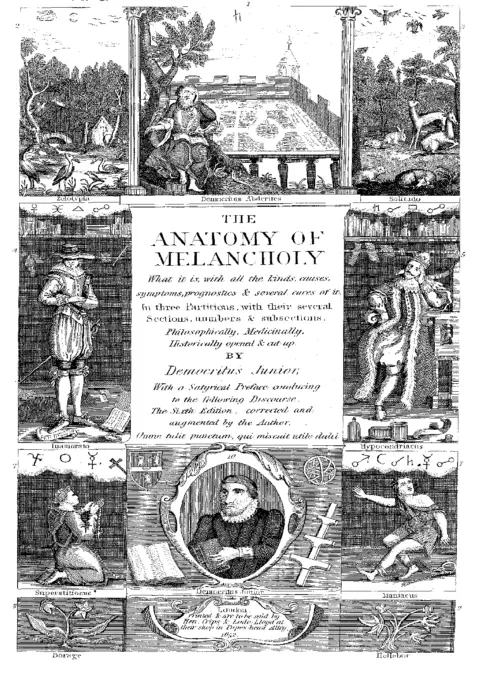
The Anatomy of Melancholy — digital edition cover

THE CLASSIC COLLECTION · 1617

The Anatomy of Melancholy

"The Anatomy of Melancholy" by Robert Burton is a medical treatise first published in 1621. This massive work explores depression and its causes, symptoms, and cures, but ranges far beyond medicine into history, astronomy, geography, and literature. Written under the pseudonym Democritus Junior, Burton blends scientific analysis with humor and satire across over 500,000 words. Drawing from ancient authorities and medieval sources, he examines melancholy as both a passing mood and a serious ailment, creating a unique work that inspired generations of writers.

Introduction adapted from the source catalogue; source summaries may be automatically generated.

Start reading ↓

Free to read · English · 529,097 words · No account needed

MAKE TIME FOR A GOOD BOOK

The Anatomy of Melancholy

On by default. Untick to stop anonymous reading totals. Each page counts after 10 seconds in view. How this works.

Anonymous counting is on unless you have switched it off.

The Anatomy of Melancholy

Pliny, lib. 24. c. 1, bitterly taxeth all compound medicines, [4169] Men's knavery, imposture, and captious wits, have invented those shops, in which every man's life is set to sale: and by and by came in those compositions and inexplicable mixtures, far-fetched out of India and Arabia; a medicine for a botch must be had as far as the Red Sea. And 'tis not without cause which he saith; for out of question they are much to [4170]blame in their compositions, whilst they make infinite variety of mixtures, as [4171]Fuchsius notes. They think they get themselves great credit, excel others, and to be more learned than the rest, because they make many variations; but he accounts them fools, and whilst they brag of their skill, and think to get themselves a name, they become ridiculous, betray their ignorance and error. A few simples well prepared and understood, are better than such a heap of nonsense, confused compounds, which are in apothecaries' shops ordinarily sold. In which many vain, superfluous, corrupt, exolete, things out of date are to be had (saith Cornarius); a company of barbarous names given to syrups, juleps, an unnecessary company of mixed medicines; rudis indigestaque moles. Many times (as Agrippa taxeth) there is by this means [4172]more danger from the medicine than from the disease, when they put together they know not what, or leave it to an illiterate apothecary to be made, they cause death and horror for health. Those old physicians had no such mixtures; a simple potion of hellebore in Hippocrates' time was the ordinary purge; and at this day, saith [4173]Mat. Riccius, in that flourishing commonwealth of China, their physicians give precepts quite opposite to ours, not unhappy in their physic; they use altogether roots, herbs, and simples in their medicines, and all their physic in a manner is comprehended in a herbal: no science, no school, no art, no degree, but like a trade, every man in private is instructed of his master. [4174]Cardan cracks that he can cure all diseases with water alone, as Hippocrates of old did most infirmities with one medicine. Let the best of our rational physicians demonstrate and give a sufficient reason for those intricate mixtures, why just so many simples in mithridate or treacle, why such and such quantity; may they not be reduced to half or a quarter? Frustra fit per plura (as the saying is) quod fieri potest per pauciora; 300 simples in a julep, potion, or a little pill, to what end or purpose? I know not what [4175]Alkindus, Capivaccius, Montagna, and Simon Eitover, the best of them all and most rational, have said in this kind; but neither he, they, nor any one of them, gives his reader, to my judgment, that satisfaction which he ought; why such, so many simples? Rog. Bacon hath taxed many errors in his tract de graduationibus, explained some things, but not cleared. Mercurialis in his book de composit. medicin. gives instance in Hamech, and Philonium Romanum, which Hamech an Arabian, and Philonius a Roman, long since composed, but crasse as the rest. If they be so exact, as by him it seems they were, and those mixtures so perfect, why doth Fernelius alter the one, and why is the other obsolete? [4176]Cardan taxeth Galen for presuming out of his ambition to correct Theriachum Andromachi, and we as justly may carp at all the rest. Galen's medicines are now exploded and rejected; what Nicholas Meripsa, Mesue, Celsus, Scribanius, Actuarius, &c. writ of old, are most part contemned. Mellichius, Cordus, Wecker, Quercetan, Renodeus, the Venetian, Florentine states have their several receipts, and magistrals: they of Nuremberg have theirs, and Augustana Pharmacopoeia, peculiar medicines to the meridian of the city: London hers, every city, town, almost every private man hath his own mixtures, compositions, receipts, magistrals, precepts, as if he scorned antiquity, and all others in respect of himself. But each man must correct and alter to show his skill, every opinionative fellow must maintain his own paradox, be it what it will; Delirant reges, plectuntur Achivi: they dote, and in the meantime the poor patients pay for their new experiments, the commonalty rue it. Thus others object, thus I may conceive out of the weakness of my apprehension; but to say truth, there is no such fault, no such ambition, no novelty, or ostentation, as some suppose; but as [4177]one answers, this of compound medicines, is a most noble and profitable invention found out, and brought into physic with great judgment, wisdom, counsel and discretion. Mixed diseases must have mixed remedies, and such simples are commonly mixed as have reference to the part affected, some to qualify, the rest to comfort, some one part, some another. Cardan and Brassavola both hold that Nullum simplex medicamentum sine noxa, no simple medicine is without hurt or offence; and although Hippocrates, Erasistratus, Diocles of old, in the infancy of this art, were content with ordinary simples: yet now, saith [4178]Aetius, necessity compelleth to seek for new remedies, and to make compounds of simples, as well to correct their harms if cold, dry, hot, thick, thin, insipid, noisome to smell, to make them savoury to the palate, pleasant to taste and take, and to preserve them for continuance, by admixtion of sugar, honey, to make them last months and years for several uses. In such cases, compound medicines may be approved, and Arnoldus in his 18. aphorism, doth allow of it. [4179]If simples cannot, necessity compels us to use compounds; so for receipts and magistrals, dies diem docet, one day teacheth another, and they are as so many words or phrases, Que nunc sunt in honore vocabula si volet usus, ebb and flow with the season, and as wits vary, so they may be infinitely varied. Quisque suum placitum quo capiatur habet. Every man as he likes, so many men so many minds, and yet all tending to good purpose, though not the same way. As arts and sciences, so physic is still perfected amongst the rest; Horae musarum nutrices, and experience teacheth us every day [4180]many things which our predecessors knew not of. Nature is not effete, as he saith, or so lavish, to bestow all her gifts upon an age, but hath reserved some for posterity, to show her power, that she is still the same, and not old or consumed. Birds and beasts can cure themselves by nature, [4181]naturae usu ea plerumque cognoscunt quae homines vix longo labore et doctrina assequuntur, but men must use much labour and industry to find it out. But I digress. Compound medicines are inwardly taken, or outwardly applied. Inwardly taken, be either liquid or solid: liquid, are fluid or consisting. Fluid, as wines and syrups. The wines ordinarily used to this disease are wormwood wine, tamarisk, and buglossatum, wine made of borage and bugloss, the composition of which is specified in Arnoldus Villanovanus, lib. de vinis, of borage, balm, bugloss, cinnamon, &c. and highly commended for its virtues: [4182]it drives away leprosy, scabs, clears the blood, recreates the spirits, exhilarates the mind, purgeth the brain of those anxious black melancholy fumes, and cleanseth the whole body of that black humour by urine. To which I add, saith Villanovanus, that it will bring madmen, and such raging bedlamites as are tied in chains, to the use of their reason again. My conscience bears me witness, that I do not lie, I saw a grave matron helped by this means; she was so choleric, and so furious sometimes, that she was almost mad, and beside herself; she said, and did she knew not what, scolded, beat her maids, and was now ready to be bound till she drank of this borage wine, and by this excellent remedy was cured, which a poor foreigner, a silly beggar, taught her by chance, that came to crave an alms from door to door. The juice of borage, if it be clarified, and drunk in wine, will do as much, the roots sliced and steeped, &c. saith Ant. Mizaldus, art. med. who cities this story verbatim out of Villanovanus, and so doth Magninus a physician of Milan, in his regimen of health. Such another excellent compound water I find in Rubeus de distill. sect. 3. which he highly magnifies out of Savanarola, [4183]for such as are solitary, dull, heavy or sad without a cause, or be troubled with trembling of heart. Other excellent compound waters for melancholy, he cites in the same place. [4184]If their melancholy be not inflamed, or their temperature over-hot. Evonimus hath a precious aquavitae to this purpose, for such as are cold. But he and most commend aurum potabile, and every writer prescribes clarified whey, with borage, bugloss, endive, succory, &c. of goat's milk especially, some indefinitely at all times, some thirty days together in the spring, every morning fasting, a good draught. Syrups are very good, and often used to digest this humour in the heart, spleen, liver, &c. As syrup of borage (there is a famous syrup of borage highly commended by Laurentius to this purpose in his tract of melancholy), de pomis of king Sabor, now obsolete, of thyme and epithyme, hops, scolopendria, fumitory, maidenhair, bizantine, &c. These are most used for preparatives to other physic, mixed with distilled waters of like nature, or in juleps otherwise. Consisting, are conserves or confections; conserves of borage, bugloss, balm, fumitory, succory, maidenhair, violets, roses, wormwood, &c. Confections, treacle, mithridate, eclegms, or linctures, &c. Solid, as aromatical confections: hot, diambra, diamargaritum calidum, dianthus, diamoschum dulce, electuarium de gemmis laetificans Galeni et Rhasis, diagalanga, diaciminum dianisum, diatrion piperion, diazinziber, diacapers, diacinnamonum: Cold, as diamargaritum frigidum, diacorolli, diarrhodon abbatis, diacodion, &c. as every pharmacopoeia will show you, with their tables or losings that are made out of them: with condites and the like. Outwardly used as occasion serves, as amulets, oils hot and cold, as of camomile, staechados, violets, roses, almonds, poppy, nymphea, mandrake, &c. to be used after bathing, or to procure sleep. Ointments composed of the said species, oils and wax, &c., as Alablastritum Populeum, some hot, some cold, to moisten, procure sleep, and correct other accidents. Liniments are made of the same matter to the like purpose: emplasters of herbs, flowers, roots, &c., with oils, and other liquors mixed and boiled together. Cataplasms, salves, or poultices made of green herbs, pounded, or sod in water till they be soft, which are applied to the hypochondries, and other parts, when the body is empty. Cerotes are applied to several parts and frontals, to take away pain, grief, heat, procure sleep. Fomentations or sponges, wet in some decoctions, &c., epithemata, or those moist medicines, laid on linen, to bathe and cool several parts misaffected. Sacculi, or little bags of herbs, flowers, seeds, roots, and the like, applied to the head, heart, stomach, &c., odoraments, balls, perfumes, posies to smell to, all which have their several uses in melancholy, as shall be shown, when I treat of the cure of the distinct species by themselves.

Your reading position is saved on this browser. Take it to another device with a library code. Reading pages adapt to text, rather than matching a printed edition.

BEHIND THE WORDS

About Robert Burton

Robert Burton (1577–1640). Explore The Anatomy of Melancholy in this collection. These books span philosophy.

Explore this author’s books →

THE READERS’ VERDICT

How did this story stay with you?

Not rated yet
Your rating for The Anatomy of Melancholy

Be the first to share your verdict.

One rating per browser, which you can change or remove. A necessary browser identifier remembers your vote. How ratings work

A GOOD STORY DESERVES COMPANY

Pass this book along.

A great read is even better when it’s shared.

SEND A LITTLE INSPIRATION

Share this book

BEHIND THE BOOK

Edition & source details.

Title
The Anatomy of Melancholy
Author
Robert Burton
Publication year
1617
Digital edition publisher
Project Gutenberg
Gutenberg release date
2004-01-01
Language
English
Source edition imprint
Not stated in source catalogue
Source identifier
Project Gutenberg #10800
Contributors
No additional named contributors in source metadata

Public-domain source & licence

This eBook is for the use of anyone anywhere in the United States and most other parts of the world at no cost and with almost no restrictions whatsoever. You may copy it, give it away or re-use it under the terms of the Project Gutenberg License included with this eBook or online at www.gutenberg.org. If you are not located in the United States, you will have to check the laws of the country where you are located before using this eBook. Read the source licence.

Full source licence and obtaining an original copy

The original source file, including credits and licence, is retained by this library. Request an original-format copy at no charge. Please include the book title and Project Gutenberg identifier #10800.

the full Project Gutenberg License must appear
prominently whenever any copy of a Project Gutenberg work (any work
on which the phrase “Project Gutenberg” appears, or with which the
phrase “Project Gutenberg” is associated) is accessed, displayed,
performed, viewed, copied or distributed:

This eBook is for the use of anyone anywhere in the United States and most
other parts of the world at no cost and with almost no restrictions
whatsoever. You may copy it, give it away or re-use it under the terms
of the Project Gutenberg™ License included with this eBook or online
at www.gutenberg.org. If you
are not located in the United States, you will have to check the laws
of the country where you are located before using this eBook.

1.E.2. If an individual Project Gutenberg electronic work is
derived from texts not protected by U.S. copyright law (does not
contain a notice indicating that it is posted with permission of the
copyright holder), the work can be copied and distributed to anyone in
the United States without paying any fees or charges. If you are
redistributing or providing access to a work with the phrase “Project
Gutenberg” associated with or appearing on the work, you must comply
either with the requirements of paragraphs 1.E.1 through 1.E.7 or
obtain permission for the use of the work and the Project Gutenberg
trademark as set forth in paragraphs 1.E.8 or 1.E.9.

1.E.3. If an individual Project Gutenberg electronic work is posted
with the permission of the copyright holder, your use and distribution
must comply with both paragraphs 1.E.1 through 1.E.7 and any
additional terms imposed by the copyright holder. Additional terms
will be linked to the Project Gutenberg License for all works
posted with the permission of the copyright holder found at the
beginning of this work.

1.E.4. Do not unlink or detach or remove the full Project Gutenberg
License terms from this work, or any files containing a part of this
work or any other work associated with Project Gutenberg.

1.E.5. Do not copy, display, perform, distribute or redistribute this
electronic work, or any part of this electronic work, without
prominently displaying the sentence set forth in paragraph 1.E.1 with
active links or immediate access to the full terms of the Project
Gutenberg License.

1.E.6. You may convert to and distribute this work in any binary,
compressed, marked up, nonproprietary or proprietary form, including
any word processing or hypertext form. However, if you provide access
to or distribute copies of a Project Gutenberg work in a format
other than “Plain Vanilla ASCII” or other format used in the official
version posted on the official Project Gutenberg website
(www.gutenberg.org), you must, at no additional cost, fee or expense
to the user, provide a copy, a means of exporting a copy, or a means
of obtaining a copy upon request, of the work in its original “Plain
Vanilla ASCII” or other form. Any alternate format must include the
full Project Gutenberg License as specified in paragraph 1.E.1.

1.E.7. Do not charge a fee for access to, viewing, displaying,
performing, copying or distributing any Project Gutenberg works
unless you comply with paragraph 1.E.8 or 1.E.9.

1.E.8. You may charge a reasonable fee for copies of or providing
access to or distributing Project Gutenberg electronic works
provided that:

• You pay a royalty fee of 20% of the gross profits you derive from
the use of Project Gutenberg works calculated using the method
you already use to calculate your applicable taxes. The fee is owed
to the owner of the Project Gutenberg trademark, but he has
agreed to donate royalties under this paragraph to the Project
Gutenberg Literary Archive Foundation. Royalty payments must be paid
within 60 days following each date on which you prepare (or are
legally required to prepare) your periodic tax returns. Royalty
payments should be clearly marked as such and sent to the Project
Gutenberg Literary Archive Foundation at the address specified in
Section 4, “Information about donations to the Project Gutenberg
Literary Archive Foundation.”

• You provide a full refund of any money paid by a user who notifies
you in writing (or by e-mail) within 30 days of receipt that s/he
does not agree to the terms of the full Project Gutenberg™
License. You must require such a user to return or destroy all
copies of the works possessed in a physical medium and discontinue
all use of and all access to other copies of Project Gutenberg™
works.

• You provide, in accordance with paragraph 1.F.3, a full refund of
any money paid for a work or a replacement copy, if a defect in the
electronic work is discovered and reported to you within 90 days of
receipt of the work.

• You comply with all other terms of this agreement for free
distribution of Project Gutenberg™ works.


1.E.9. If you wish to charge a fee or distribute a Project
Gutenberg™ electronic work or group of works on different terms than
are set forth in this agreement, you must obtain permission in writing
from the Project Gutenberg Literary Archive Foundation, the manager of
the Project Gutenberg™ trademark. Contact the Foundation as set
forth in Section 3 below.

1.F.

1.F.1. Project Gutenberg volunteers and employees expend considerable
effort to identify, do copyright research on, transcribe and proofread
works not protected by U.S. copyright law in creating the Project
Gutenberg™ collection. Despite these efforts, Project Gutenberg™
electronic works, and the medium on which they may be stored, may
contain “Defects,” such as, but not limited to, incomplete, inaccurate
or corrupt data, transcription errors, a copyright or other
intellectual property infringement, a defective or damaged disk or
other medium, a computer virus, or computer codes that damage or
cannot be read by your equipment.

1.F.2. LIMITED WARRANTY, DISCLAIMER OF DAMAGES - Except for the “Right
of Replacement or Refund” described in paragraph 1.F.3, the Project
Gutenberg Literary Archive Foundation, the owner of the Project
Gutenberg™ trademark, and any other party distributing a Project
Gutenberg™ electronic work under this agreement, disclaim all
liability to you for damages, costs and expenses, including legal
fees. YOU AGREE THAT YOU HAVE NO REMEDIES FOR NEGLIGENCE, STRICT
LIABILITY, BREACH OF WARRANTY OR BREACH OF CONTRACT EXCEPT THOSE
PROVIDED IN PARAGRAPH 1.F.3. YOU AGREE THAT THE FOUNDATION, THE
TRADEMARK OWNER, AND ANY DISTRIBUTOR UNDER THIS AGREEMENT WILL NOT BE
LIABLE TO YOU FOR ACTUAL, DIRECT, INDIRECT, CONSEQUENTIAL, PUNITIVE OR
INCIDENTAL DAMAGES EVEN IF YOU GIVE NOTICE OF THE POSSIBILITY OF SUCH
DAMAGE.

1.F.3. LIMITED RIGHT OF REPLACEMENT OR REFUND - If you discover a
defect in this electronic work within 90 days of receiving it, you can
receive a refund of the money (if any) you paid for it by sending a
written explanation to the person you received the work from. If you
received the work on a physical medium, you must return the medium
with your written explanation. The person or entity that provided you
with the defective work may elect to provide a replacement copy in
lieu of a refund. If you received the work electronically, the person
or entity providing it to you may choose to give you a second
opportunity to receive the work electronically in lieu of a refund. If
the second copy is also defective, you may demand a refund in writing
without further opportunities to fix the problem.

1.F.4. Except for the limited right of replacement or refund set forth
in paragraph 1.F.3, this work is provided to you ‘AS-IS’, WITH NO
OTHER WARRANTIES OF ANY KIND, EXPRESS OR IMPLIED, INCLUDING BUT NOT
LIMITED TO WARRANTIES OF MERCHANTABILITY OR FITNESS FOR ANY PURPOSE.

1.F.5. Some states do not allow disclaimers of certain implied
warranties or the exclusion or limitation of certain types of
damages. If any disclaimer or limitation set forth in this agreement
violates the law of the state applicable to this agreement, the
agreement shall be interpreted to make the maximum disclaimer or
limitation permitted by the applicable state law. The invalidity or
unenforceability of any provision of this agreement shall not void the
remaining provisions.

1.F.6. INDEMNITY - You agree to indemnify and hold the Foundation, the
trademark owner, any agent or employee of the Foundation, anyone
providing copies of Project Gutenberg™ electronic works in
accordance with this agreement, and any volunteers associated with the
production, promotion and distribution of Project Gutenberg™
electronic works, harmless from all liability, costs and expenses,
including legal fees, that arise directly or indirectly from any of
the following which you do or cause to occur: (a) distribution of this
or any Project Gutenberg work, (b) alteration, modification, or
additions or deletions to any Project Gutenberg work, and (c) any
Defect you cause.

Section 2. Information about the Mission of Project Gutenberg

Project Gutenberg is synonymous with the free distribution of
electronic works in formats readable by the widest variety of
computers including obsolete, old, middle-aged and new computers. It
exists because of the efforts of hundreds of volunteers and donations
from people in all walks of life.

Volunteers and financial support to provide volunteers with the
assistance they need are critical to reaching Project Gutenberg’s
goals and ensuring that the Project Gutenberg collection will
remain freely available for generations to come. In 2001, the Project
Gutenberg Literary Archive Foundation was created to provide a secure
and permanent future for Project Gutenberg and future
generations. To learn more about the Project Gutenberg Literary
Archive Foundation and how your efforts and donations can help, see
Sections 3 and 4 and the Foundation information page at www.gutenberg.org.

Section 3. Information about the Project Gutenberg Literary Archive Foundation

The Project Gutenberg Literary Archive Foundation is a non-profit
501(c)(3) educational corporation organized under the laws of the
state of Mississippi and granted tax exempt status by the Internal
Revenue Service. The Foundation’s EIN or federal tax identification
number is 64-6221541. Contributions to the Project Gutenberg Literary
Archive Foundation are tax deductible to the full extent permitted by
U.S. federal laws and your state’s laws.

The Foundation’s business office is located at 41 Watchung Plaza #516,
Montclair NJ 07042, USA, +1 (862) 621-9288. Email contact links and up
to date contact information can be found at the Foundation’s website
and official page at www.gutenberg.org/contact

Section 4. Information about Donations to the Project Gutenberg
Literary Archive Foundation

Project Gutenberg™ depends upon and cannot survive without widespread
public support and donations to carry out its mission of
increasing the number of public domain and licensed works that can be
freely distributed in machine-readable form accessible by the widest
array of equipment including outdated equipment. Many small donations
($1 to $5,000) are particularly important to maintaining tax exempt
status with the IRS.

The Foundation is committed to complying with the laws regulating
charities and charitable donations in all 50 states of the United
States. Compliance requirements are not uniform and it takes a
considerable effort, much paperwork and many fees to meet and keep up
with these requirements. We do not solicit donations in locations
where we have not received written confirmation of compliance. To SEND
DONATIONS or determine the status of compliance for any particular state
visit www.gutenberg.org/donate.

While we cannot and do not solicit contributions from states where we
have not met the solicitation requirements, we know of no prohibition
against accepting unsolicited donations from donors in such states who
approach us with offers to donate.

International donations are gratefully accepted, but we cannot make
any statements concerning tax treatment of donations received from
outside the United States. U.S. laws alone swamp our small staff.

Please check the Project Gutenberg web pages for current donation
methods and addresses. Donations are accepted in a number of other
ways including checks, online payments and credit card donations. To
donate, please visit: www.gutenberg.org/donate.

Section 5. General Information About Project Gutenberg electronic works

Professor Michael S. Hart was the originator of the Project
Gutenberg concept of a library of electronic works that could be
freely shared with anyone. For forty years, he produced and
distributed Project Gutenberg eBooks with only a loose network of
volunteer support.

Project Gutenberg eBooks are often created from several printed
editions, all of which are confirmed as not protected by copyright in
the U.S. unless a copyright notice is included. Thus, we do not
necessarily keep eBooks in compliance with any particular paper
edition.

Most people start at our website which has the main PG search
facility: www.gutenberg.org.

This website includes information about Project Gutenberg,
including how to make donations to the Project Gutenberg Literary
Archive Foundation, how to help produce our new eBooks, and how to
subscribe to our email newsletter to hear about new eBooks.


KEEP YOUR CURIOSITY GOING

Your next chapter awaits.

Your privacy choices

Reading is always free. You can change these settings at any time.

Book banners link to our books on simonward.net. They do not use advertising cookies or tracking.

Privacy & cookie policy · Reading data and privacy controls