
Last letters from the living dead man
David Patterson (Spirit) Hatch
THE CLASSIC COLLECTION · 1617
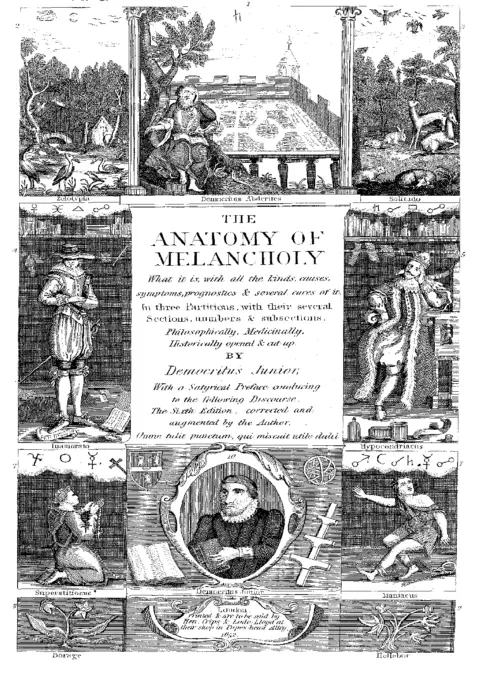
"The Anatomy of Melancholy" by Robert Burton is a medical treatise first published in 1621. This massive work explores depression and its causes, symptoms, and cures, but ranges far beyond medicine into history, astronomy, geography, and literature. Written under the pseudonym Democritus Junior, Burton blends scientific analysis with humor and satire across over 500,000 words. Drawing from ancient authorities and medieval sources, he examines melancholy as both a passing mood and a serious ailment, creating a unique work that inspired generations of writers.
Introduction adapted from the source catalogue; source summaries may be automatically generated.
Free to read · English · 529,097 words · No account needed
MAKE TIME FOR A GOOD BOOK
On by default. Untick to stop anonymous reading totals. Each page counts after 10 seconds in view. How this works.
Anonymous counting is on unless you have switched it off.
One reels to this, another to that wall,
'Tis the same error that deludes them all.
[223]They dote all, but not alike, Μανία γαρ πᾶσιν ὁμοια, not in the same kind, One is covetous, a second lascivious, a third ambitious, a fourth envious, &c. as Damasippus the Stoic hath well illustrated in the poet, [224]Desipiunt omnes aeque ac tu.
And they who call you fool, with equal claim
May plead an ample title to the name.
'Tis an inbred malady in every one of us, there is seminarium stultitiae, a seminary of folly, which if it be stirred up, or get ahead, will run in infinitum, and infinitely varies, as we ourselves are severally addicted, saith [225]Balthazar Castilio: and cannot so easily be rooted out, it takes such fast hold, as Tully holds, altae radices stultitiae, [226]so we are bred, and so we continue. Some say there be two main defects of wit, error and ignorance, to which all others are reduced; by ignorance we know not things necessary, by error we know them falsely. Ignorance is a privation, error a positive act. From ignorance comes vice, from error heresy, &c. But make how many kinds you will, divide and subdivide, few men are free, or that do not impinge on some one kind or other. [227]Sic plerumque agitat stultos inscitia, as he that examines his own and other men's actions shall find. [228]Charon in Lucian, as he wittily feigns, was conducted by Mercury to such a place, where he might see all the world at once; after he had sufficiently viewed, and looked about, Mercury would needs know of him what he had observed: He told him that he saw a vast multitude and a promiscuous, their habitations like molehills, the men as emmets, he could discern cities like so many hives of bees, wherein every bee had a sting, and they did nought else but sting one another, some domineering like hornets bigger than the rest, some like filching wasps, others as drones. Over their heads were hovering a confused company of perturbations, hope, fear, anger, avarice, ignorance, &c., and a multitude of diseases hanging, which they still pulled on their pates. Some were brawling, some fighting, riding, running, sollicite ambientes, callide litigantes for toys and trifles, and such momentary things, Their towns and provinces mere factions, rich against poor, poor against rich, nobles against artificers, they against nobles, and so the rest. In conclusion, he condemned them all for madmen, fools, idiots, asses, O stulti, quaenam haec est amentia? O fools, O madmen, he exclaims, insana studia, insani labores, &c. Mad endeavours, mad actions, mad, mad, mad, [229]O saeclum insipiens et infacetum, a giddy-headed age. Heraclitus the philosopher, out of a serious meditation of men's lives, fell a weeping, and with continual tears bewailed their misery, madness, and folly. Democritus on the other side, burst out a laughing, their whole life seemed to him so ridiculous, and he was so far carried with this ironical passion, that the citizens of Abdera took him to be mad, and sent therefore ambassadors to Hippocrates, the physician, that he would exercise his skill upon him. But the story is set down at large by Hippocrates, in his epistle to Damogetus, which because it is not impertinent to this discourse, I will insert verbatim almost as it is delivered by Hippocrates himself, with all the circumstances belonging unto it. When Hippocrates was now come to Abdera, the people of the city came flocking about him, some weeping, some intreating of him, that he would do his best. After some little repast, he went to see Democritus, the people following him, whom he found (as before) in his garden in the suburbs all alone, [230]sitting upon a stone under a plane tree, without hose or shoes, with a book on his knees, cutting up several beasts, and busy at his study. The multitude stood gazing round about to see the congress. Hippocrates, after a little pause, saluted him by his name, whom he resaluted, ashamed almost that he could not call him likewise by his, or that he had forgot it. Hippocrates demanded of him what he was doing: he told him that he was [231]busy in cutting up several beasts, to find out the cause of madness and melancholy. Hippocrates commended his work, admiring his happiness and leisure. And why, quoth Democritus, have not you that leisure? Because, replied Hippocrates, domestic affairs hinder, necessary to be done for ourselves, neighbours, friends; expenses, diseases, frailties and mortalities which happen; wife, children, servants, and such business which deprive us of our time. At this speech Democritus profusely laughed (his friends and the people standing by, weeping in the mean time, and lamenting his madness). Hippocrates asked the reason why he laughed. He told him, at the vanities and the fopperies of the time, to see men so empty of all virtuous actions, to hunt so far after gold, having no end of ambition; to take such infinite pains for a little glory, and to be favoured of men; to make such deep mines into the earth for gold, and many times to find nothing, with loss of their lives and fortunes. Some to love dogs, others horses, some to desire to be obeyed in many provinces,[232] and yet themselves will know no obedience. [233]Some to love their wives dearly at first, and after a while to forsake and hate them; begetting children, with much care and cost for their education, yet when they grow to man's estate, [234]to despise, neglect, and leave them naked to the world's mercy. [235]Do not these behaviours express their intolerable folly? When men live in peace, they covet war, detesting quietness, [236] deposing kings, and advancing others in their stead, murdering some men to beget children of their wives. How many strange humours are in men! When they are poor and needy, they seek riches, and when they have them, they do not enjoy them, but hide them under ground, or else wastefully spend them. O wise Hippocrates, I laugh at such things being done, but much more when no good comes of them, and when they are done to so ill purpose. There is no truth or justice found amongst them, for they daily plead one against another, [237]the son against the father and the mother, brother against brother, kindred and friends of the same quality; and all this for riches, whereof after death they cannot be possessors. And yet notwithstanding they will defame and kill one another, commit all unlawful actions, contemning God and men, friends and country. They make great account of many senseless things, esteeming them as a great part of their treasure, statues, pictures, and such like movables, dear bought, and so cunningly wrought, as nothing but speech wanteth in them, [238]and yet they hate living persons speaking to them. [239]Others affect difficult things; if they dwell on firm land they will remove to an island, and thence to land again, being no way constant to their desires. They commend courage and strength in wars, and let themselves be conquered by lust and avarice; they are, in brief, as disordered in their minds, as Thersites was in his body. And now, methinks, O most worthy Hippocrates, you should not reprehend my laughing, perceiving so many fooleries in men; [240]for no man will mock his own folly, but that which he seeth in a second, and so they justly mock one another. The drunkard calls him a glutton whom he knows to be sober. Many men love the sea, others husbandry; briefly, they cannot agree in their own trades and professions, much less in their lives and actions. When Hippocrates heard these words so readily uttered, without premeditation, to declare the world's vanity, full of ridiculous contrariety, he made answer, that necessity compelled men to many such actions, and divers wills ensuing from divine permission, that we might not be idle, being nothing is so odious to them as sloth and negligence. Besides, men cannot foresee future events, in this uncertainty of human affairs; they would not so marry, if they could foretell the causes of their dislike and separation; or parents, if they knew the hour of their children's death, so tenderly provide for them; or an husbandman sow, if he thought there would be no increase; or a merchant adventure to sea, if he foresaw shipwreck; or be a magistrate, if presently to be deposed. Alas, worthy Democritus, every man hopes the best, and to that end he doth it, and therefore no such cause, or ridiculous occasion of laughter. Democritus hearing this poor excuse, laughed again aloud, perceiving he wholly mistook him, and did not well understand what he had said concerning perturbations and tranquillity of the mind. Insomuch, that if men would govern their actions by discretion and providence, they would not declare themselves fools as now they do, and he should have no cause of laughter; but (quoth he) they swell in this life as if they were immortal, and demigods, for want of understanding. It were enough to make them wise, if they would but consider the mutability of this world, and how it wheels about, nothing being firm and sure. He that is now above, tomorrow is beneath; he that sate on this side today, tomorrow is hurled on the other: and not considering these matters, they fall into many inconveniences and troubles, coveting things of no profit, and thirsting after them, tumbling headlong into many calamities. So that if men would attempt no more than what they can bear, they should lead contented lives, and learning to know themselves, would limit their ambition, [241]they would perceive then that nature hath enough without seeking such superfluities, and unprofitable things, which bring nothing with them but grief and molestation. As a fat body is more subject to diseases, so are rich men to absurdities and fooleries, to many casualties and cross inconveniences. There are many that take no heed what happeneth to others by bad conversation, and therefore overthrow themselves in the same manner through their own fault, not foreseeing dangers manifest. These are things (O more than mad, quoth he) that give me matter of laughter, by suffering the pains of your impieties, as your avarice, envy, malice, enormous villainies, mutinies, unsatiable desires, conspiracies, and other incurable vices; besides your [242]dissimulation and hypocrisy, bearing deadly hatred one to the other, and yet shadowing it with a good face, flying out into all filthy lusts, and transgressions of all laws, both of nature and civility. Many things which they have left off, after a while they fall to again, husbandry, navigation; and leave again, fickle and inconstant as they are. When they are young, they would be old, and old, young. [243] Princes commend a private life; private men itch after honour: a magistrate commends a quiet life; a quiet man would be in his office, and obeyed as he is: and what is the cause of all this, but that they know not themselves? Some delight to destroy, [244]one to build, another to spoil one country to enrich another and himself. [245]In all these things they are like children, in whom is no judgment or counsel and resemble beasts, saving that beasts are better than they, as being contented with nature. [246] When shall you see a lion hide gold in the ground, or a bull contend for better pasture? When a boar is thirsty, he drinks what will serve him, and no more; and when his belly is full, ceaseth to eat: but men are immoderate in both, as in lust—they covet carnal copulation at set times; men always, ruinating thereby the health of their bodies. And doth it not deserve laughter to see an amorous fool torment himself for a wench; weep, howl for a misshapen slut, a dowdy sometimes, that might have his choice of the finest beauties? Is there any remedy for this in physic? I do anatomise and cut up these poor beasts, [247]to see these distempers, vanities, and follies, yet such proof were better made on man's body, if my kind nature would endure it: [248]who from the hour of his birth is most miserable; weak, and sickly; when he sucks he is guided by others, when he is grown great practiseth unhappiness [249]and is sturdy, and when old, a child again, and repenteth him of his life past. And here being interrupted by one that brought books, he fell to it again, that all were mad, careless, stupid. To prove my former speeches, look into courts, or private houses. [250]Judges give judgment according to their own advantage, doing manifest wrong to poor innocents to please others. Notaries alter sentences, and for money lose their deeds. Some make false monies; others counterfeit false weights. Some abuse their parents, yea corrupt their own sisters; others make long libels and pasquils, defaming men of good life, and extol such as are lewd and vicious. Some rob one, some another: [251]magistrates make laws against thieves, and are the veriest thieves themselves. Some kill themselves, others despair, not obtaining their desires. Some dance, sing, laugh, feast and banquet, whilst others sigh, languish, mourn and lament, having neither meat, drink, nor clothes. [252]Some prank up their bodies, and have their minds full of execrable vices. Some trot about [253]to bear false witness, and say anything for money; and though judges know of it, yet for a bribe they wink at it, and suffer false contracts to prevail against equity. Women are all day a dressing, to pleasure other men abroad, and go like sluts at home, not caring to please their own husbands whom they should. Seeing men are so fickle, so sottish, so intemperate, why should not I laugh at those to whom [254]folly seems wisdom, will not be cured, and perceive it not? It grew late: Hippocrates left him; and no sooner was he come away, but all the citizens came about flocking, to know how he liked him. He told them in brief, that notwithstanding those small neglects of his attire, body, diet, [255]the world had not a wiser, a more learned, a more honest man, and they were much deceived to say that he was mad. Thus Democritus esteemed of the world in his time, and this was the cause of his laughter: and good cause he had.
Your reading position is saved on this browser. Take it to another device with a library code. Reading pages adapt to text, rather than matching a printed edition.
BEHIND THE BOOK
This eBook is for the use of anyone anywhere in the United States and most other parts of the world at no cost and with almost no restrictions whatsoever. You may copy it, give it away or re-use it under the terms of the Project Gutenberg License included with this eBook or online at www.gutenberg.org. If you are not located in the United States, you will have to check the laws of the country where you are located before using this eBook. Read the source licence.
The original source file, including credits and licence, is retained by this library. Request an original-format copy at no charge. Please include the book title and Project Gutenberg identifier #10800.
KEEP YOUR CURIOSITY GOING
David Patterson (Spirit) Hatch
Coulson Kernahan

Ralph Waldo Emerson
Frances Wright

Edwin Abbott Abbott

Joseph Droz