
Last letters from the living dead man
David Patterson (Spirit) Hatch
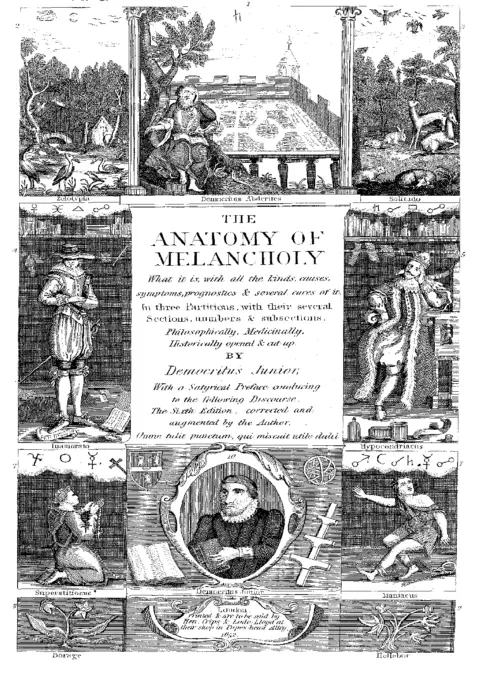
THE CLASSIC COLLECTION · 1617
"The Anatomy of Melancholy" by Robert Burton is a medical treatise first published in 1621. This massive work explores depression and its causes, symptoms, and cures, but ranges far beyond medicine into history, astronomy, geography, and literature. Written under the pseudonym Democritus Junior, Burton blends scientific analysis with humor and satire across over 500,000 words. Drawing from ancient authorities and medieval sources, he examines melancholy as both a passing mood and a serious ailment, creating a unique work that inspired generations of writers.
Introduction adapted from the source catalogue; source summaries may be automatically generated.
Free to read · English · 529,097 words · No account needed
MAKE TIME FOR A GOOD BOOK
On by default. Untick to stop anonymous reading totals. Each page counts after 10 seconds in view. How this works.
Anonymous counting is on unless you have switched it off.
Like tall Orion stalking o'er the flood:
When with his brawny breast he cuts the waves,
His shoulder scarce the topmost billow laves.
What in Maximinus, Ajax, Caligula, and the rest of those great Zanzummins, or gigantical Anakims, heavy, vast, barbarous lubbers? [3617]———si membra tibi dant grandia Parcae, Mentis eges?
Their body, saith [3618]Lemnius, is a burden to them, and their spirits not so lively, nor they so erect and merry: Non est in magno corpore mica salis: a little diamond is more worth than a rocky mountain: which made Alexander Aphrodiseus positively conclude, The lesser, the [3619]wiser, because the soul was more contracted in such a body. Let Bodine in his 5. c. method, hist. plead the rest; the lesser they are, as in Asia, Greece, they have generally the finest wits. And for bodily stature which some so much admire, and goodly presence, 'tis true, to say the best of them, great men are proper, and tall, I grant,—caput inter nubila condunt, (hide their heads in the clouds); but belli pusilli little men are pretty: Sed si bellus homo est Cotta, pusillus homo est. Sickness, diseases, trouble many, but without a cause; [3620]It may be 'tis for the good of their souls: Pars fati fuit, the flesh rebels against the spirit; that which hurts the one, must needs help the other. Sickness is the mother of modesty, putteth us in mind of our mortality; and when we are in the full career of worldly pomp and jollity, she pulleth us by the ear, and maketh us know ourselves. [3621]Pliny calls it, the sum of philosophy, If we could but perform that in our health, which we promise in our sickness. Quum infirmi sumus, optimi sumus; [3622]for what sick man (as [3623] Secundus expostulates with Rufus) was ever lascivious, covetous, or ambitious? he envies no man, admires no man, flatters no man, despiseth no man, listens not after lies and tales, &c. And were it not for such gentle remembrances, men would have no moderation of themselves, they would be worse than tigers, wolves, and lions: who should keep them in awe? princes, masters, parents, magistrates, judges, friends, enemies, fair or foul means cannot contain us, but a little sickness, (as [3624]Chrysostom observes) will correct and amend us. And therefore with good discretion, [3625]Jovianus Pontanus caused this short sentence to be engraven on his tomb in Naples: Labour, sorrow, grief, sickness, want and woe, to serve proud masters, bear that superstitious yoke, and bury your clearest friends, &c., are the sauces of our life. If thy disease be continuate and painful to thee, it will not surely last: and a light affliction, which is but for a moment, causeth unto us a far more excellent and eternal weight of glory, 2 Cor. iv. 17. bear it with patience; women endure much sorrow in childbed, and yet they will not contain; and those that are barren, wish for this pain; be courageous, [3626]there is as much valour to be shown in thy bed, as in an army, or at a sea fight: aut vincetur, aut vincet, thou shalt be rid at last. In the mean time, let it take its course, thy mind is not any way disabled. Bilibaldus Pirkimerus, senator to Charles the Fifth, ruled all Germany, lying most part of his days sick of the gout upon his bed. The more violent thy torture is, the less it will continue: and though it be severe and hideous for the time, comfort thyself as martyrs do, with honour and immortality. [3627]That famous philosopher Epicurus, being in as miserable pain of stone and colic, as a man might endure, solaced himself with a conceit of immortality; the joy of his soul for his rare inventions, repelled the pain of his bodily torments. Baseness of birth is a great disparagement to some men, especially if they be wealthy, bear office, and come to promotion in a commonwealth; then (as [3628]he observes) if their birth be not answerable to their calling, and to their fellows, they are much abashed and ashamed of themselves. Some scorn their own father and mother, deny brothers and sisters, with the rest of their kindred and friends, and will not suffer them to come near them, when they are in their pomp, accounting it a scandal to their greatness to have such beggarly beginnings. Simon in Lucian, having now got a little wealth, changed his name from Simon to Simonides, for that there were so many beggars of his kin, and set the house on fire where he was born, because no body should point at it. Others buy titles, coats of arms, and by all means screw themselves into ancient families, falsifying pedigrees, usurping scutcheons, and all because they would not seem to be base. The reason is, for that this gentility is so much admired by a company of outsides, and such honour attributed unto it, as amongst [3629]Germans, Frenchmen, and Venetians, the gentry scorn the commonalty, and will not suffer them to match with them; they depress, and make them as so many asses, to carry burdens. In our ordinary talk and fallings out, the most opprobrious and scurrile name we can fasten upon a man, or first give, is to call him base rogue, beggarly rascal, and the like: Whereas in my judgment, this ought of all other grievances to trouble men least. Of all vanities and fopperies, to brag of gentility is the greatest; for what is it they crack so much of, and challenge such superiority, as if they were demigods? Birth? Tantane vos generis tenuit fiducia vestri? [3630]It is non ens, a mere flash, a ceremony, a toy, a thing of nought. Consider the beginning, present estate, progress, ending of gentry, and then tell me what it is. [3631]Oppression, fraud, cozening, usury, knavery, bawdry, murder, and tyranny, are the beginning of many ancient families: [3632]one hath been a bloodsucker, a parricide, the death of many a silly soul in some unjust quarrels, seditions, made many an orphan and poor widow, and for that he is made a lord or an earl, and his posterity gentlemen for ever after. Another hath been a bawd, a pander to some great men, a parasite, a slave, [3633]prostituted himself, his wife, daughter, to some lascivious prince, and for that he is exalted. Tiberius preferred many to honours in his time, because they were famous whoremasters and sturdy drinkers; many come into this parchment-row (so [3634]one calls it) by flattery or cozening; search your old families, and you shall scarce find of a multitude (as Aeneas Sylvius observes) qui sceleratum non habent ortum, that have not a wicked beginning; aut qui vi et dolo eo fastigii non ascendunt, as that plebeian in [3635]Machiavel in a set oration proved to his fellows, that do not rise by knavery, force, foolery, villainy, or such indirect means. They are commonly able that are wealthy; virtue and riches seldom settle on one man: who then sees not the beginning of nobility? spoils enrich one, usury another, treason a third, witchcraft a fourth, flattery a fifth, lying, stealing, bearing false witness a sixth, adultery the seventh, &c. One makes a fool of himself to make his lord merry, another dandles my young master, bestows a little nag on him, a third marries a cracked piece, &c. Now may it please your good worship, your lordship, who was the first founder of your family? The poet answers, [3636]Aut Pastor fuit, aut illud quod dicere nolo. Are he or you the better gentleman? If he, then we have traced him to his form. If you, what is it of which thou boastest so much? That thou art his son. It may be his heir, his reputed son, and yet indeed a priest or a serving man may be the true father of him; but we will not controvert that now; married women are all honest; thou art his son's son's son, begotten and born infra quatuor maria, &c. Thy great great great grandfather was a rich citizen, and then in all likelihood a usurer, a lawyer, and then a—a courtier, and then a—a country gentleman, and then he scraped it out of sheep, &c. And you are the heir of all his virtues, fortunes, titles; so then, what is your gentry, but as Hierom saith, Opes antiquae, inveteratae divitiae, ancient wealth? that is the definition of gentility. The father goes often to the devil, to make his son a gentleman. For the present, what is it? It began (saith [3637]Agrippa) with strong impiety, with tyranny, oppression, &c. and so it is maintained: wealth began it (no matter how got), wealth continueth and increaseth it. Those Roman knights were so called, if they could dispend per annum so much. [3638]In the kingdom of Naples and France, he that buys such lands, buys the honour, title, barony, together with it; and they that can dispend so much amongst us, must be called to bear office, to be knights, or fine for it, as one observes, [3639]nobiliorum ex censu judicant, our nobles are measured by their means. And what now is the object of honour? What maintains our gentry but wealth? [3640]Nobilitas sine re projecta vilior alga. Without means gentry is naught worth, nothing so contemptible and base. [3641]Disputare de nobilitate generis, sine divitiis, est disputare de nobilitate stercoris, saith Nevisanus the lawyer, to dispute of gentry without wealth, is (saving your reverence) to discuss the original of a merd. So that it is wealth alone that denominates, money which maintains it, gives esse to it, for which every man may have it. And what is their ordinary exercise? [3642]sit to eat, drink, lie down to sleep, and rise to play: wherein lies their worth and sufficiency? in a few coats of arms, eagles, lions, serpents, bears, tigers, dogs, crosses, bends, fesses, &c., and such like baubles, which they commonly set up in their galleries, porches, windows, on bowls, platters, coaches, in tombs, churches, men's sleeves, &c. [3643]If he can hawk and hunt, ride a horse, play at cards and dice, swagger, drink, swear, take tobacco with a grace, sing, dance, wear his clothes in fashion, court and please his mistress, talk big fustian, [3644]insult, scorn, strut, contemn others, and use a little mimical and apish compliment above the rest, he is a complete, (Egregiam vero laudem) a well-qualified gentleman; these are most of their employments, this their greatest commendation. What is gentry, this parchment nobility then, but as [3645] Agrippa defines it, a sanctuary of knavery and naughtiness, a cloak for wickedness and execrable vices, of pride, fraud, contempt, boasting, oppression, dissimulation, lust, gluttony, malice, fornication, adultery, ignorance, impiety? A nobleman therefore in some likelihood, as he concludes, is an atheist, an oppressor, an epicure, a [3646]gull, a dizzard, an illiterate idiot, an outside, a glowworm, a proud fool, an arrant ass, Ventris et inguinis mancipium, a slave to his lust and belly, solaque libidine fortis. And as Salvianus observed of his countrymen the Aquitanes in France, sicut titulis primi fuere, sic et vitiis (as they were the first in rank so also in rottenness); and Cabinet du Roy, their own writer, distinctly of the rest. The nobles of Berry are most part lechers, they of Touraine thieves, they of Narbonne covetous, they of Guienne coiners, they of Provence atheists, they of Rheims superstitious, they of Lyons treacherous, of Normandy proud, of Picardy insolent, &c. We may generally conclude, the greater men, the more vicious. In fine, as [3647]Aeneas Sylvius adds, they are most part miserable, sottish, and filthy fellows, like the walls of their houses, fair without, foul within. What dost thou vaunt of now? [3648]What dost thou gape and wonder at? admire him for his brave apparel, horses, dogs, fine houses, manors, orchards, gardens, walks? Why? a fool may be possessor of this as well as he; and he that accounts him a better man, a nobleman for having of it, he is a fool himself. Now go and brag of thy gentility. This is it belike which makes the [3649]Turks at this day scorn nobility, and all those huffing bombast titles, which so much elevate their poles: except it be such as have got it at first, maintain it by some supereminent quality, or excellent worth. And for this cause, the Ragusian commonwealth, Switzers, and the united provinces, in all their aristocracies, or democratical monarchies, (if I may so call them,) exclude all these degrees of hereditary honours, and will admit of none to bear office, but such as are learned, like those Athenian Areopagites, wise, discreet, and well brought up. The [3650]Chinese observe the same customs, no man amongst them noble by birth; out of their philosophers and doctors they choose magistrates: their politic nobles are taken from such as be moraliter nobiles virtuous noble; nobilitas ut olim ab officio, non a natura, as in Israel of old, and their office was to defend and govern their country in war and peace, not to hawk, hunt, eat, drink, game alone, as too many do. Their Loysii, Mandarini, literati, licentiati, and such as have raised themselves by their worth, are their noblemen only, though fit to govern a state: and why then should any that is otherwise of worth be ashamed of his birth? why should not he be as much respected that leaves a noble posterity, as he that hath had noble ancestors? nay why not more? for plures solem orientem we adore the sun rising most part; and how much better is it to say, Ego meis majoribus virtute praeluxi, (I have outshone my ancestors in virtues), to boast himself of his virtues, than of his birth? Cathesbeius, sultan of Egypt and Syria, was by his condition a slave, but for worth, valour, and manhood second to no king, and for that cause (as, [3651]Jovius writes) elected emperor of the Mamelukes. That poor Spanish Pizarro for his valour made by Charles the fifth marquess of Anatillo; the Turkey Pashas are all such. Pertinax, Philippus Arabs, Maximinus, Probus, Aurelius, &c., from common soldiers, became emperors, Cato, Cincinnatus, &c. consuls. Pius Secundus, Sixtus Quintus, Johan, Secundus, Nicholas Quintus, &c. popes. Socrates, Virgil, Horace, libertino parte natus. [3652]The kings of Denmark fetch their pedigree, as some say, from one Ulfo, that was the son of a bear. [3653]E tenui casa saepe vir magnus exit, many a worthy man comes out of a poor cottage. Hercules, Romulus, Alexander (by Olympia's confession), Themistocles, Jugurtha, King Arthur, William the Conqueror, Homer, Demosthenes, P. Lumbard, P. Comestor, Bartholus, Adrian the fourth Pope, &c., bastards; and almost in every kingdom, the most ancient families have been at first princes' bastards: their worthiest captains, best wits, greatest scholars, bravest spirits in all our annals, have been base. [3654]Cardan, in his subtleties, gives a reason why they are most part better able than others in body and mind, and so, per consequens, more fortunate. Castruccius Castrucanus, a poor child, found in the field, exposed to misery, became prince of Lucca and Senes in Italy, a most complete soldier and worthy captain; Machiavel compares him to Scipio or Alexander. And 'tis a wonderful thing ([3655] saith he) to him that shall consider of it, that all those, or the greatest part of them, that have done the bravest exploits here upon earth, and excelled the rest of the nobles of their time, have been still born in some abject, obscure place, or of base and obscure abject parents. A most memorable observation, [3656]Scaliger accounts it, et non praetereundum, maximorum virorum plerosque patres ignoratos, matres impudicas fuisse. [3657]I could recite a great catalogue of them, every kingdom, every province will yield innumerable examples: and why then should baseness of birth be objected to any man? Who thinks worse of Tully for being arpinas, an upstart? Or Agathocles, that Silician king, for being a potter's son? Iphicrates and Marius were meanly born. What wise man thinks better of any person for his nobility? as he said in [3658]Machiavel, omnes eodem patre nati, Adam's sons, conceived all and born in sin, &c. We are by nature all as one, all alike, if you see us naked; let us wear theirs and they our clothes, and what is the difference? To speak truth, as [3659]Bale did of P. Schalichius, I more esteem thy worth, learning, honesty, than thy nobility; honour thee more that thou art a writer, a doctor of divinity, than Earl of the Huns, Baron of Skradine, or hast title to such and such provinces, &c. Thou art more fortunate and great (so [3660]Jovius writes to Cosmo de Medici, then Duke of Florence) for thy virtues, than for thy lovely wife, and happy children, friends, fortunes, or great duchy of Tuscany. So I account thee; and who doth not so indeed? [3661]Abdolominus was a gardener, and yet by Alexander for his virtues made King of Syria. How much better is it to be born of mean parentage, and to excel in worth, to be morally noble, which is preferred before that natural nobility, by divines, philosophers, and [3662]politicians, to be learned, honest, discreet, well-qualified, to be fit for any manner of employment, in country and commonwealth, war and peace, than to be Degeneres Neoptolemi, as many brave nobles are, only wise because rich, otherwise idiots, illiterate, unfit for any manner of service? [3663] Udalricus, Earl of Cilia, upbraided John Huniades with the baseness of his birth, but he replied, in te Ciliensis comitatus turpiter extinguitur, in me gloriose Bistricensis exoritur, thine earldom is consumed with riot, mine begins with honour and renown. Thou hast had so many noble ancestors; what is that to thee? Vix ea nostra voco, [3664]when thou art a dizzard thyself: quod prodest, Pontice, longo stemmate censeri? &c. I conclude, hast thou a sound body, and a good soul, good bringing up? Art thou virtuous, honest, learned, well-qualified, religious, are thy conditions good?—thou art a true nobleman, perfectly noble, although born of Thersites—dum modo tu sis—Aeacidae similis, non natus, sed factus, noble κατ' ἐξοχήν, [3665]for neither sword, nor fire, nor water, nor sickness, nor outward violence, nor the devil himself can take thy good parts from thee. Be not ashamed of thy birth then, thou art a gentleman all the world over, and shalt be honoured, when as he, strip him of his fine clothes, [3666]dispossess him of his wealth, is a funge (which [3667] Polynices in his banishment found true by experience, gentry was not esteemed) like a piece of coin in another country, that no man will take, and shall be contemned. Once more, though thou be a barbarian, born at Tontonteac, a villain, a slave, a Saldanian Negro, or a rude Virginian in Dasamonquepec, he a French monsieur, a Spanish don, a signor of Italy, I care not how descended, of what family, of what order, baron, count, prince, if thou be well qualified, and he not, but a degenerate Neoptolemus, I tell thee in a word, thou art a man, and he is a beast. Let no terrae filius, or upstart, insult at this which I have said, no worthy gentleman take offence. I speak it not to detract from such as are well deserving, truly virtuous and noble: I do much respect and honour true gentry and nobility; I was born of worshipful parents myself, in an ancient family, but I am a younger brother, it concerns me not: or had I been some great heir, richly endowed, so minded as I am, I should not have been elevated at all, but so esteemed of it, as of all other human happiness, honours, &c., they have their period, are brittle and inconstant. As [3668] he said of that great river Danube, it riseth from a small fountain, a little brook at first, sometimes broad, sometimes narrow, now slow, then swift, increased at last to an incredible greatness by the confluence of sixty navigable rivers, it vanisheth in conclusion, loseth his name, and is suddenly swallowed up of the Euxine sea: I may say of our greatest families, they were mean at first, augmented by rich marriages, purchases, offices, they continue for some ages, with some little alteration of circumstances, fortunes, places, &c., by some prodigal son, for some default, or for want of issue they are defaced in an instant, and their memory blotted out. So much in the mean time I do attribute to Gentility, that if he be well-descended, of worshipful or noble parentage, he will express it in his conditions, [3669]———nec enim feroces Progenerant aquilae columbas.
Your reading position is saved on this browser. Take it to another device with a library code. Reading pages adapt to text, rather than matching a printed edition.
BEHIND THE BOOK
This eBook is for the use of anyone anywhere in the United States and most other parts of the world at no cost and with almost no restrictions whatsoever. You may copy it, give it away or re-use it under the terms of the Project Gutenberg License included with this eBook or online at www.gutenberg.org. If you are not located in the United States, you will have to check the laws of the country where you are located before using this eBook. Read the source licence.
The original source file, including credits and licence, is retained by this library. Request an original-format copy at no charge. Please include the book title and Project Gutenberg identifier #10800.
KEEP YOUR CURIOSITY GOING
David Patterson (Spirit) Hatch
Coulson Kernahan

Ralph Waldo Emerson
Frances Wright

Edwin Abbott Abbott

Joseph Droz