
Last letters from the living dead man
David Patterson (Spirit) Hatch
THE CLASSIC COLLECTION · 1617
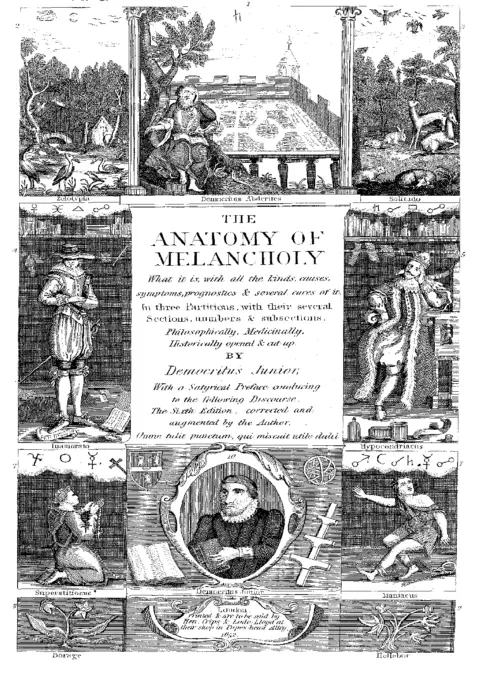
"The Anatomy of Melancholy" by Robert Burton is a medical treatise first published in 1621. This massive work explores depression and its causes, symptoms, and cures, but ranges far beyond medicine into history, astronomy, geography, and literature. Written under the pseudonym Democritus Junior, Burton blends scientific analysis with humor and satire across over 500,000 words. Drawing from ancient authorities and medieval sources, he examines melancholy as both a passing mood and a serious ailment, creating a unique work that inspired generations of writers.
Introduction adapted from the source catalogue; source summaries may be automatically generated.
Free to read · English · 529,097 words · No account needed
MAKE TIME FOR A GOOD BOOK
On by default. Untick to stop anonymous reading totals. Each page counts after 10 seconds in view. How this works.
Anonymous counting is on unless you have switched it off.
———when in friendship joined
A mutual succour in each other find.
And 'tis proper to them both, and I hope not unbeseeming me, who am by my profession a divine, and by mine inclination a physician. I had Jupiter in my sixth house; I say with [170]Beroaldus, non sum medicus, nec medicinae prorsus expers, in the theory of physic I have taken some pains, not with an intent to practice, but to satisfy myself, which was a cause likewise of the first undertaking of this subject. If these reasons do not satisfy thee, good reader, as Alexander Munificus that bountiful prelate, sometimes bishop of Lincoln, when he had built six castles, ad invidiam operis eluendam, saith [171]Mr. Camden, to take away the envy of his work (which very words Nubrigensis hath of Roger the rich bishop of Salisbury, who in king Stephen's time built Shirburn castle, and that of Devises), to divert the scandal or imputation, which might be thence inferred, built so many religious houses. If this my discourse be over-medicinal, or savour too much of humanity, I promise thee that I will hereafter make thee amends in some treatise of divinity. But this I hope shall suffice, when you have more fully considered of the matter of this my subject, rem substratam, melancholy, madness, and of the reasons following, which were my chief motives: the generality of the disease, the necessity of the cure, and the commodity or common good that will arise to all men by the knowledge of it, as shall at large appear in the ensuing preface. And I doubt not but that in the end you will say with me, that to anatomise this humour aright, through all the members of this our Microcosmus, is as great a task, as to reconcile those chronological errors in the Assyrian monarchy, find out the quadrature of a circle, the creeks and sounds of the north-east, or north-west passages, and all out as good a discovery as that hungry [172]Spaniard's of Terra Australis Incognita, as great trouble as to perfect the motion of Mars and Mercury, which so crucifies our astronomers, or to rectify the Gregorian Calendar. I am so affected for my part, and hope as [173]Theophrastus did by his characters, That our posterity, O friend Policles, shall be the better for this which we have written, by correcting and rectifying what is amiss in themselves by our examples, and applying our precepts and cautions to their own use. And as that great captain Zisca would have a drum made of his skin when he was dead, because he thought the very noise of it would put his enemies to flight, I doubt not but that these following lines, when they shall be recited, or hereafter read, will drive away melancholy (though I be gone) as much as Zisca's drum could terrify his foes. Yet one caution let me give by the way to my present, or my future reader, who is actually melancholy, that he read not the [174]symptoms or prognostics in this following tract, lest by applying that which he reads to himself, aggravating, appropriating things generally spoken, to his own person (as melancholy men for the most part do) he trouble or hurt himself, and get in conclusion more harm than good. I advise them therefore warily to peruse that tract, Lapides loquitur (so said [175]Agrippa de occ. Phil.) et caveant lectores ne cerebrum iis excutiat. The rest I doubt not they may securely read, and to their benefit. But I am over-tedious, I proceed. Of the necessity and generality of this which I have said, if any man doubt, I shall desire him to make a brief survey of the world, as [176] Cyprian adviseth Donat, supposing himself to be transported to the top of some high mountain, and thence to behold the tumults and chances of this wavering world, he cannot choose but either laugh at, or pity it. S. Hierom out of a strong imagination, being in the wilderness, conceived with himself, that he then saw them dancing in Rome; and if thou shalt either conceive, or climb to see, thou shalt soon perceive that all the world is mad, that it is melancholy, dotes; that it is (which Epichthonius Cosmopolites expressed not many years since in a map) made like a fool's head (with that motto, Caput helleboro dignum) a crazed head, cavea stultorum, a fool's paradise, or as Apollonius, a common prison of gulls, cheaters, flatterers, &c. and needs to be reformed. Strabo in the ninth book of his geography, compares Greece to the picture of a man, which comparison of his, Nic. Gerbelius in his exposition of Sophianus' map, approves; the breast lies open from those Acroceraunian hills in Epirus, to the Sunian promontory in Attica; Pagae and Magaera are the two shoulders; that Isthmus of Corinth the neck; and Peloponnesus the head. If this allusion hold, 'tis sure a mad head; Morea may be Moria; and to speak what I think, the inhabitants of modern Greece swerve as much from reason and true religion at this day, as that Morea doth from the picture of a man. Examine the rest in like sort, and you shall find that kingdoms and provinces are melancholy, cities and families, all creatures, vegetal, sensible, and rational, that all sorts, sects, ages, conditions, are out of tune, as in Cebes' table, omnes errorem bibunt, before they come into the world, they are intoxicated by error's cup, from the highest to the lowest have need of physic, and those particular actions in [177]Seneca, where father and son prove one another mad, may be general; Porcius Latro shall plead against us all. For indeed who is not a fool, melancholy, mad?—[178] Qui nil molitur inepte, who is not brain-sick? Folly, melancholy, madness, are but one disease, Delirium is a common name to all. Alexander, Gordonius, Jason Pratensis, Savanarola, Guianerius, Montaltus, confound them as differing secundum magis et minus; so doth David, Psal. xxxvii. 5. I said unto the fools, deal not so madly, and 'twas an old Stoical paradox, omnes stultos insanire, [179]all fools are mad, though some madder than others. And who is not a fool, who is free from melancholy? Who is not touched more or less in habit or disposition? If in disposition, ill dispositions beget habits, if they persevere, saith [180]Plutarch, habits either are, or turn to diseases. 'Tis the same which Tully maintains in the second of his Tusculans, omnium insipientum animi in morbo sunt, et perturbatorum, fools are sick, and all that are troubled in mind: for what is sickness, but as [181]Gregory Tholosanus defines it, A dissolution or perturbation of the bodily league, which health combines: and who is not sick, or ill-disposed? in whom doth not passion, anger, envy, discontent, fear and sorrow reign? Who labours not of this disease? Give me but a little leave, and you shall see by what testimonies, confessions, arguments, I will evince it, that most men are mad, that they had as much need to go a pilgrimage to the Anticyrae (as in [182]Strabo's time they did) as in our days they run to Compostella, our Lady of Sichem, or Lauretta, to seek for help; that it is like to be as prosperous a voyage as that of Guiana, and that there is much more need of hellebore than of tobacco. That men are so misaffected, melancholy, mad, giddy-headed, hear the testimony of Solomon, Eccl. ii. 12. And I turned to behold wisdom, madness and folly, &c. And ver. 23: All his days are sorrow, his travel grief, and his heart taketh no rest in the night. So that take melancholy in what sense you will, properly or improperly, in disposition or habit, for pleasure or for pain, dotage, discontent, fear, sorrow, madness, for part, or all, truly, or metaphorically, 'tis all one. Laughter itself is madness according to Solomon, and as St. Paul hath it, Worldly sorrow brings death. The hearts of the sons of men are evil, and madness is in their hearts while they live, Eccl. ix. 3. Wise men themselves are no better. Eccl. i. 18. In the multitude of wisdom is much grief, and he that increaseth wisdom, increaseth sorrow, chap. ii. 17. He hated life itself, nothing pleased him: he hated his labour, all, as [183]he concludes, is sorrow, grief, vanity, vexation of spirit. And though he were the wisest man in the world, sanctuarium sapientiae, and had wisdom in abundance, he will not vindicate himself, or justify his own actions. Surely I am more foolish than any man, and have not the understanding of a man in me, Prov. xxx. 2. Be they Solomon's words, or the words of Agur, the son of Jakeh, they are canonical. David, a man after God's own heart, confesseth as much of himself, Psal. xxxvii. 21, 22. So foolish was I and ignorant, I was even as a beast before thee. And condemns all for fools, Psal. xciii.; xxxii. 9; xlix. 20. He compares them to beasts, horses, and mules, in which there is no understanding. The apostle Paul accuseth himself in like sort, 2 Cor. ix. 21. I would you would suffer a little my foolishness, I speak foolishly. The whole head is sick, saith Esay, and the heart is heavy, cap. i. 5. And makes lighter of them than of oxen and asses, the ox knows his owner, &c.: read Deut. xxxii. 6; Jer. iv.; Amos, iii. 1; Ephes. v. 6. Be not mad, be not deceived, foolish Galatians, who hath bewitched you? How often are they branded with this epithet of madness and folly? No word so frequent amongst the fathers of the Church and divines; you may see what an opinion they had of the world, and how they valued men's actions. I know that we think far otherwise, and hold them most part wise men that are in authority, princes, magistrates, [184]rich men, they are wise men born, all politicians and statesmen must needs be so, for who dare speak against them? And on the other, so corrupt is our judgment, we esteem wise and honest men fools. Which Democritus well signified in an epistle of his to Hippocrates: [185]the Abderites account virtue madness, and so do most men living. Shall I tell you the reason of it? [186]Fortune and Virtue, Wisdom and Folly, their seconds, upon a time contended in the Olympics; every man thought that Fortune and Folly would have the worst, and pitied their cases; but it fell out otherwise. Fortune was blind and cared not where she stroke, nor whom, without laws, Audabatarum instar, &c. Folly, rash and inconsiderate, esteemed as little what she said or did. Virtue and Wisdom gave [187]place, were hissed out, and exploded by the common people; Folly and Fortune admired, and so are all their followers ever since: knaves and fools commonly fare and deserve best in worldlings' eyes and opinions. Many good men have no better fate in their ages: Achish, 1 Sam. xxi. 14, held David for a madman. [188]Elisha and the rest were no otherwise esteemed. David was derided of the common people, Ps. ix. 7, I am become a monster to many. And generally we are accounted fools for Christ, 1 Cor. xiv. We fools thought his life madness, and his end without honour, Wisd. v. 4. Christ and his Apostles were censured in like sort, John x.; Mark iii.; Acts xxvi. And so were all Christians in [189]Pliny's time, fuerunt et alii, similis dementiae, &c. And called not long after, [190]Vesaniae sectatores, eversores hominum, polluti novatores, fanatici, canes, malefici, venefici, Galilaei homunciones, &c. 'Tis an ordinary thing with us, to account honest, devout, orthodox, divine, religious, plain-dealing men, idiots, asses, that cannot, or will not lie and dissemble, shift, flatter, accommodare se ad eum locum ubi nati sunt, make good bargains, supplant, thrive, patronis inservire; solennes ascendendi modos apprehendere, leges, mores, consuetudines recte observare, candide laudare, fortiter defendere, sententias amplecti, dubitare de nullus, credere omnia, accipere omnia, nihil reprehendere, caeteraque quae promotionem ferunt et securitatem, quae sine ambage felicem, reddunt hominem, et vere sapientem apud nos; that cannot temporise as other men do, [191]hand and take bribes, &c. but fear God, and make a conscience of their doings. But the Holy Ghost that knows better how to judge, he calls them fools. The fool hath said in his heart, Psal. liii. 1. And their ways utter their folly, Psal. xlix. 14. [192]For what can be more mad, than for a little worldly pleasure to procure unto themselves eternal punishment? As Gregory and others inculcate unto us. Yea even all those great philosophers the world hath ever had in admiration, whose works we do so much esteem, that gave precepts of wisdom to others, inventors of Arts and Sciences, Socrates the wisest man of his time by the Oracle of Apollo, whom his two scholars, [193]Plato and [194] Xenophon, so much extol and magnify with those honourable titles, best and wisest of all mortal men, the happiest, and most just; and as [195] Alcibiades incomparably commends him; Achilles was a worthy man, but Bracides and others were as worthy as himself; Antenor and Nestor were as good as Pericles, and so of the rest; but none present, before, or after Socrates, nemo veterum neque eorum qui nunc sunt, were ever such, will match, or come near him. Those seven wise men of Greece, those Britain Druids, Indian Brachmanni, Ethiopian Gymnosophist, Magi of the Persians, Apollonius, of whom Philostratus, Non doctus, sed natus sapiens, wise from his cradle, Eoicuras so much admired by his scholar Lucretius: Qui genus humanum ingenio superavit, et omnes Perstrinxit stellas exortus ut aetherius sol.
Your reading position is saved on this browser. Take it to another device with a library code. Reading pages adapt to text, rather than matching a printed edition.
BEHIND THE BOOK
This eBook is for the use of anyone anywhere in the United States and most other parts of the world at no cost and with almost no restrictions whatsoever. You may copy it, give it away or re-use it under the terms of the Project Gutenberg License included with this eBook or online at www.gutenberg.org. If you are not located in the United States, you will have to check the laws of the country where you are located before using this eBook. Read the source licence.
The original source file, including credits and licence, is retained by this library. Request an original-format copy at no charge. Please include the book title and Project Gutenberg identifier #10800.
KEEP YOUR CURIOSITY GOING
David Patterson (Spirit) Hatch
Coulson Kernahan

Ralph Waldo Emerson
Frances Wright

Edwin Abbott Abbott

Joseph Droz