
Last letters from the living dead man
David Patterson (Spirit) Hatch
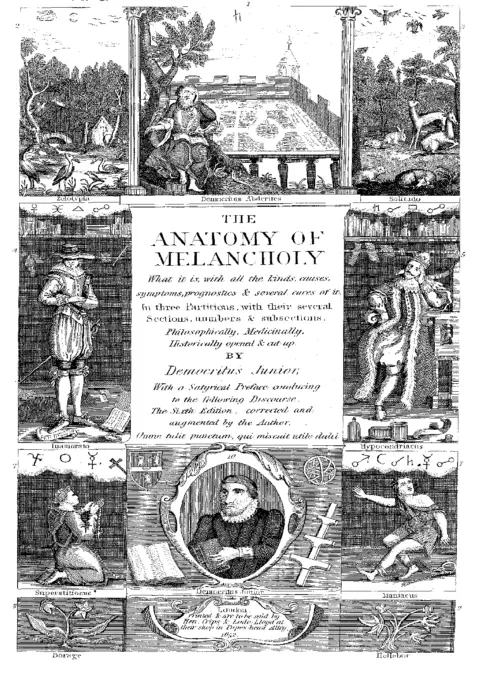
THE CLASSIC COLLECTION · 1617
"The Anatomy of Melancholy" by Robert Burton is a medical treatise first published in 1621. This massive work explores depression and its causes, symptoms, and cures, but ranges far beyond medicine into history, astronomy, geography, and literature. Written under the pseudonym Democritus Junior, Burton blends scientific analysis with humor and satire across over 500,000 words. Drawing from ancient authorities and medieval sources, he examines melancholy as both a passing mood and a serious ailment, creating a unique work that inspired generations of writers.
Introduction adapted from the source catalogue; source summaries may be automatically generated.
Free to read · English · 529,097 words · No account needed
MAKE TIME FOR A GOOD BOOK
On by default. Untick to stop anonymous reading totals. Each page counts after 10 seconds in view. How this works.
Anonymous counting is on unless you have switched it off.
Exercise rectified of Body and Mind.
To that great inconvenience, which comes on the one side by immoderate and unseasonable exercise, too much solitariness and idleness on the other, must be opposed as an antidote, a moderate and seasonable use of it, and that both of body and mind, as a most material circumstance, much conducing to this cure, and to the general preservation of our health. The heavens themselves run continually round, the sun riseth and sets, the moon increaseth and decreaseth, stars and planets keep their constant motions, the air is still tossed by the winds, the waters ebb and flow to their conservation no doubt, to teach us that we should ever be in action. For which cause Hieron prescribes Rusticus the monk, that he be always occupied about some business or other, [3209]that the devil do not find him idle. [3210]Seneca would have a man do something, though it be to no purpose. [3211]Xenophon wisheth one rather to play at tables, dice, or make a jester of himself (though he might be far better employed) than do nothing. The [3212]Egyptians of old, and many flourishing commonwealths since, have enjoined labour and exercise to all sorts of men, to be of some vocation and calling, and give an account of their time, to prevent those grievous mischiefs that come by idleness: for as fodder, whip, and burthen belong to the ass: so meat, correction, and work unto the servant, Ecclus. xxxiii. 23. The Turks enjoin all men whatsoever, of what degree, to be of some trade or other, the Grand Signior himself is not excused. [3213]In our memory (saith Sabellicus) Mahomet the Turk, he that conquered Greece, at that very time when he heard ambassadors of other princes, did either carve or cut wooden spoons, or frame something upon a table. [3214]This present sultan makes notches for bows. The Jews are most severe in this examination of time. All well-governed places, towns, families, and every discreet person will be a law unto himself. But amongst us the badge of gentry is idleness: to be of no calling, not to labour, for that's derogatory to their birth, to be a mere spectator, a drone, fruges consumere natus, to have no necessary employment to busy himself about in church and commonwealth (some few governors exempted), but to rise to eat, &c., to spend his days in hawking, hunting, &c., and such like disports and recreations ([3215]which our casuists tax), are the sole exercise almost, and ordinary actions of our nobility, and in which they are too immoderate. And thence it comes to pass, that in city and country so many grievances of body and mind, and this feral disease of melancholy so frequently rageth, and now domineers almost all over Europe amongst our great ones. They know not how to spend their time (disports excepted, which are all their business), what to do, or otherwise how to bestow themselves: like our modern Frenchmen, that had rather lose a pound of blood in a single combat, than a drop of sweat in any honest labour. Every man almost hath something or other to employ himself about, some vocation, some trade, but they do all by ministers and servants, ad otia duntaxat se natos existimant, imo ad sui ipsius plerumque et aliorum perniciem, [3216]as one freely taxeth such kind of men, they are all for pastimes, 'tis all their study, all their invention tends to this alone, to drive away time, as if they were born some of them to no other ends. Therefore to correct and avoid these errors and inconveniences, our divines, physicians, and politicians, so much labour, and so seriously exhort; and for this disease in particular, [3217]there can be no better cure than continual business, as Rhasis holds, to have some employment or other, which may set their mind awork, and distract their cogitations. Riches may not easily be had without labour and industry, nor learning without study, neither can our health be preserved without bodily exercise. If it be of the body, Guianerius allows that exercise which is gentle, [3218]and still after those ordinary frications which must be used every morning. Montaltus, cap. 26. and Jason Pratensis use almost the same words, highly commending exercise if it be moderate; a wonderful help so used, Crato calls it, and a great means to preserve our health, as adding strength to the whole body, increasing natural heat, by means of which the nutriment is well concocted in the stomach, liver, and veins, few or no crudities left, is happily distributed over all the body. Besides, it expels excrements by sweat and other insensible vapours; insomuch, that [3219]Galen prefers exercise before all physic, rectification of diet, or any regimen in what kind soever; 'tis nature's physician. [3220]Fulgentius, out of Gordonius de conserv. vit. hom. lib. 1. cap. 7. terms exercise, a spur of a dull, sleepy nature, the comforter of the members, cure of infirmity, death of diseases, destruction of all mischiefs and vices. The fittest time for exercise is a little before dinner, a little before supper, [3221]or at any time when the body is empty. Montanus, consil. 31. prescribes it every morning to his patient, and that, as [3222]Calenus adds, after he hath done his ordinary needs, rubbed his body, washed his hands and face, combed his head and gargarised. What kind of exercise he should use, Galen tells us, lib. 2. et 3. de sanit. tuend. and in what measure, [3223] till the body be ready to sweat, and roused up; ad ruborem, some say, non ad sudorem, lest it should dry the body too much; others enjoin those wholesome businesses, as to dig so long in his garden, to hold the plough, and the like. Some prescribe frequent and violent labour and exercises, as sawing every day so long together (epid. 6. Hippocrates confounds them), but that is in some cases, to some peculiar men; [3224]the most forbid, and by no means will have it go farther than a beginning sweat, as being [3225]perilous if it exceed. Of these labours, exercises, and recreations, which are likewise included, some properly belong to the body, some to the mind, some more easy, some hard, some with delight, some without, some within doors, some natural, some are artificial. Amongst bodily exercises, Galen commends ludum parvae pilae, to play at ball, be it with the hand or racket, in tennis-courts or otherwise, it exerciseth each part of the body, and doth much good, so that they sweat not too much. It was in great request of old amongst the Greeks, Romans, Barbarians, mentioned by Homer, Herodotus, and Plinius. Some write, that Aganella, a fair maid of Corcyra, was the inventor of it, for she presented the first ball that ever was made to Nausica, the daughter of King Alcinous, and taught her how to use it. The ordinary sports which are used abroad are hawking, hunting, hilares venandi labores, [3226]one calls them, because they recreate body and mind, [3227]another, the [3228]best exercise that is, by which alone many have been [3229]freed from all feral diseases. Hegesippus, lib. 1. cap. 37. relates of Herod, that he was eased of a grievous melancholy by that means. Plato, 7. de leg. highly magnifies it, dividing it into three parts, by land, water, air. Xenophon, in Cyropaed. graces it with a great name, Deorum munus, the gift of the gods, a princely sport, which they have ever used, saith Langius, epist. 59. lib. 2. as well for health as pleasure, and do at this day, it being the sole almost and ordinary sport of our noblemen in Europe, and elsewhere all over the world. Bohemus, de mor. gent. lib. 3. cap. 12. styles it therefore, studium nobilium, communiter venantur, quod sibi solis licere contendunt, 'tis all their study, their exercise, ordinary business, all their talk: and indeed some dote too much after it, they can do nothing else, discourse of naught else. Paulus Jovius, descr. Brit. doth in some sort tax our [3230] English nobility for it, for living in the country so much, and too frequent use of it, as if they had no other means but hawking and hunting to approve themselves gentlemen with. Hawking comes near to hunting, the one in the air, as the other on the earth, a sport as much affected as the other, by some preferred. [3231]It was never heard of amongst the Romans, invented some twelve hundred years since, and first mentioned by Firmicus, lib. 5. cap. 8. The Greek emperors began it, and now nothing so frequent: he is nobody that in the season hath not a hawk on his fist. A great art, and many [3232]books written of it. It is a wonder to hear [3233]what is related of the Turks' officers in this behalf, how many thousand men are employed about it, how many hawks of all sorts, how much revenues consumed on that only disport, how much time is spent at Adrianople alone every year to that purpose. The [3234]Persian kings hawk after butterflies with sparrows made to that use, and stares: lesser hawks for lesser games they have, and bigger for the rest, that they may produce their sport to all seasons. The Muscovian emperors reclaim eagles to fly at hinds, foxes, &c., and such a one was sent for a present to [3235]Queen Elizabeth: some reclaim ravens, castrils, pies, &c., and man them for their pleasures. Fowling is more troublesome, but all out as delightsome to some sorts of men, be it with guns, lime, nets, glades, gins, strings, baits, pitfalls, pipes, calls, stalking-horses, setting-dogs, decoy-ducks, &c., or otherwise. Some much delight to take larks with day-nets, small birds with chaff-nets, plovers, partridge, herons, snipe, &c. Henry the Third, king of Castile (as Mariana the Jesuit reports of him, lib. 3. cap. 7.) was much affected [3236]with catching of quails, and many gentlemen take a singular pleasure at morning and evening to go abroad with their quail-pipes, and will take any pains to satisfy their delight in that kind. The [3237]Italians have gardens fitted to such use, with nets, bushes, glades, sparing no cost or industry, and are very much affected with the sport. Tycho Brahe, that great astronomer, in the chorography of his Isle of Huena, and Castle of Uraniburge, puts down his nets, and manner of catching small birds, as an ornament and a recreation, wherein he himself was sometimes employed. Fishing is a kind of hunting by water, be it with nets, weels, baits, angling, or otherwise, and yields all out as much pleasure to some men as dogs or hawks; [3238]When they draw their fish upon the bank, saith Nic. Henselius Silesiographiae, cap. 3. speaking of that extraordinary delight his countrymen took in fishing, and in making of pools. James Dubravius, that Moravian, in his book de pisc. telleth, how travelling by the highway side in Silesia, he found a nobleman, [3239]booted up to the groins, wading himself, pulling the nets, and labouring as much as any fisherman of them all: and when some belike objected to him the baseness of his office, he excused himself, [3240]that if other men might hunt hares, why should not he hunt carps? Many gentlemen in like sort with us will wade up to the arm-holes upon such occasions, and voluntarily undertake that to satisfy their pleasures, which a poor man for a good stipend would scarce be hired to undergo. Plutarch, in his book de soler. animal. speaks against all fishing, [3241]as a filthy, base, illiberal employment, having neither wit nor perspicacity in it, nor worth the labour. But he that shall consider the variety of baits for all seasons, and pretty devices which our anglers have invented, peculiar lines, false flies, several sleights, &c. will say, that it deserves like commendation, requires as much study and perspicacity as the rest, and is to be preferred before many of them. Because hawking and hunting are very laborious, much riding, and many dangers accompany them; but this is still and quiet: and if so be the angler catch no fish, yet he hath a wholesome walk to the brookside, pleasant shade by the sweet silver streams; he hath good air, and sweet smells of fine fresh meadow flowers, he hears the melodious harmony of birds, he sees the swans, herons, ducks, water-horns, coots, &c., and many other fowl, with their brood, which he thinketh better than the noise of hounds, or blast of horns, and all the sport that they can make. Many other sports and recreations there be, much in use, as ringing, bowling, shooting, which Ascam recommends in a just volume, and hath in former times been enjoined by statute, as a defensive exercise, and an [3242]honour to our land, as well may witness our victories in France. Keelpins, tronks, quoits, pitching bars, hurling, wrestling, leaping, running, fencing, mustering, swimming, wasters, foils, football, balloon, quintain, &c., and many such, which are the common recreations of the country folks. Riding of great horses, running at rings, tilts and tournaments, horse races, wild-goose chases, which are the disports of greater men, and good in themselves, though many gentlemen by that means gallop quite out of their fortunes. But the most pleasant of all outward pastimes is that of [3243]Areteus, deambulatio per amoena loca, to make a petty progress, a merry journey now and then with some good companions, to visit friends, see cities, castles, towns, [3244]Visere saepe amnes nitidos, per amaenaque Tempe, Et placidas summis sectari in montibus auras.
Your reading position is saved on this browser. Take it to another device with a library code. Reading pages adapt to text, rather than matching a printed edition.
BEHIND THE BOOK
This eBook is for the use of anyone anywhere in the United States and most other parts of the world at no cost and with almost no restrictions whatsoever. You may copy it, give it away or re-use it under the terms of the Project Gutenberg License included with this eBook or online at www.gutenberg.org. If you are not located in the United States, you will have to check the laws of the country where you are located before using this eBook. Read the source licence.
The original source file, including credits and licence, is retained by this library. Request an original-format copy at no charge. Please include the book title and Project Gutenberg identifier #10800.
KEEP YOUR CURIOSITY GOING
David Patterson (Spirit) Hatch
Coulson Kernahan

Ralph Waldo Emerson
Frances Wright

Edwin Abbott Abbott

Joseph Droz