
Last letters from the living dead man
David Patterson (Spirit) Hatch
THE CLASSIC COLLECTION · 1617
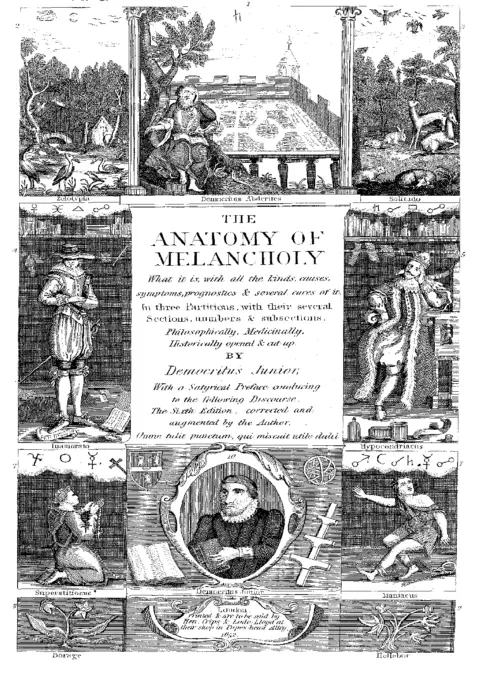
"The Anatomy of Melancholy" by Robert Burton is a medical treatise first published in 1621. This massive work explores depression and its causes, symptoms, and cures, but ranges far beyond medicine into history, astronomy, geography, and literature. Written under the pseudonym Democritus Junior, Burton blends scientific analysis with humor and satire across over 500,000 words. Drawing from ancient authorities and medieval sources, he examines melancholy as both a passing mood and a serious ailment, creating a unique work that inspired generations of writers.
Introduction adapted from the source catalogue; source summaries may be automatically generated.
Free to read · English · 529,097 words · No account needed
MAKE TIME FOR A GOOD BOOK
On by default. Untick to stop anonymous reading totals. Each page counts after 10 seconds in view. How this works.
Anonymous counting is on unless you have switched it off.
SUBSECT. III.—Particular Symptoms from the influence of Stars, parts of the Body, and Humours.
Some men have peculiar symptoms, according to their temperament and crisis, which they had from the stars and those celestial influences, variety of wits and dispositions, as Anthony Zara contends, Anat. ingen. sect. 1. memb. 11, 12, 13, 14. plurimum irritant influentiae, caelestes, unde cientur animi aegritudines et morbi corporum. [2538]One saith, diverse diseases of the body and mind proceed from their influences, [2539]as I have already proved out of Ptolemy, Pontanus, Lemnius, Cardan, and others as they are principal significators of manners, diseases, mutually irradiated, or lords of the geniture, &c. Ptolomeus in his centiloquy, Hermes, or whosoever else the author of that tract, attributes all these symptoms, which are in melancholy men, to celestial influences: which opinion Mercurialis de affect, lib. cap. 10. rejects; but, as I say, [2540]Jovianus Pontanus and others stiffly defend. That some are solitary, dull, heavy, churlish; some again blithe, buxom, light, and merry, they ascribe wholly to the stars. As if Saturn be predominant in his nativity, and cause melancholy in his temperature, then [2541]he shall be very austere, sullen, churlish, black of colour, profound in his cogitations, full of cares, miseries, and discontents, sad and fearful, always silent, solitary, still delighting in husbandry, in woods, orchards, gardens, rivers, ponds, pools, dark walks and close: Cogitationes sunt velle aedificare, velle arbores plantare, agros colere, &c. To catch birds, fishes, &c. still contriving and musing of such matters. If Jupiter domineers, they are more ambitious, still meditating of kingdoms, magistracies, offices, honours, or that they are princes, potentates, and how they would carry themselves, &c. If Mars, they are all for wars, brave combats, monomachies, testy, choleric, harebrain, rash, furious, and violent in their actions. They will feign themselves victors, commanders, are passionate and satirical in their speeches, great braggers, ruddy of colour. And though they be poor in show, vile and base, yet like Telephus and Peleus in the [2542]poet, Ampullas jactant et sesquipedalia verba, forget their swelling and gigantic words, their mouths are full of myriads, and tetrarchs at their tongues' end. If the sun, they will be lords, emperors, in conceit at least, and monarchs, give offices, honours, &c. If Venus, they are still courting of their mistresses, and most apt to love, amorously given, they seem to hear music, plays, see fine pictures, dancers, merriments, and the like. Ever in love, and dote on all they see. Mercurialists are solitary, much in contemplation, subtle, poets, philosophers, and musing most part about such matters. If the moon have a hand, they are all for peregrinations, sea voyages, much affected with travels, to discourse, read, meditate of such things; wandering in their thoughts, diverse, much delighting in waters, to fish, fowl, &c. But the most immediate symptoms proceed from the temperature itself, and the organical parts, as head, liver, spleen, mesaraic veins, heart, womb, stomach, &c., and most especially from distemperature of spirits (which, as [2543]Hercules de Saxonia contends, are wholly immaterial), or from the four humours in those seats, whether they be hot or cold, natural, unnatural, innate or adventitious, intended or remitted, simple or mixed, their diverse mixtures, and several adustions, combinations, which may be as diversely varied, as those [2544]four first qualities in [2545] Clavius, and produce as many several symptoms and monstrous fictions as wine doth effect, which as Andreas Bachius observes, lib. 3. de vino, cap. 20. are infinite. Of greater note be these. If it be natural melancholy, as Lod. Mercatus, lib. 1. cap. 17. de melan. T. Bright. c. 16. hath largely described, either of the spleen, or of the veins, faulty by excess of quantity, or thickness of substance, it is a cold and dry humour, as Montanus affirms, consil. 26 the parties are sad, timorous and fearful. Prosper Calenus, in his book de atra bile, will have them to be more stupid than ordinary, cold, heavy, solitary, sluggish. Si multam atram bilem et frigidam habent. Hercules de Saxonia, c. 19. l. 7. [2546]holds these that are naturally melancholy, to be of a leaden colour or black, and so doth Guianerius, c. 3. tract. 15. and such as think themselves dead many times, or that they see, talk with black men, dead men, spirits and goblins frequently, if it be in excess. These symptoms vary according to the mixture of those four humours adust, which is unnatural melancholy. For as Trallianus hath written, cap. 16. l. 7. [2547]There is not one cause of this melancholy, nor one humour which begets, but divers diversely intermixed, from whence proceeds this variety of symptoms: and those varying again as they are hot or cold. [2548]Cold melancholy (saith Benedic. Vittorius Faventinus pract. mag.) is a cause of dotage, and more mild symptoms, if hot or more adust, of more violent passions, and furies. Fracastorius, l. 2. de intellect. will have us to consider well of it, [2549]with what kind of melancholy every one is troubled, for it much avails to know it; one is enraged by fervent heat, another is possessed by sad and cold; one is fearful, shamefaced; the other impudent and bold; as Ajax, Arma rapit superosque furens inpraelia poscit: quite mad or tending to madness. Nunc hos, nunc impetit illos. Bellerophon on the other side, solis errat male sanus in agris, wanders alone in the woods; one despairs, weeps, and is weary of his life, another laughs, &c. All which variety is produced from the several degrees of heat and cold, which [2550]Hercules de Saxonia will have wholly proceed from the distemperature of spirits alone, animal especially, and those immaterial, the next and immediate causes of melancholy, as they are hot, cold, dry, moist, and from their agitation proceeds that diversity of symptoms, which he reckons up, in the [2551]thirteenth chap. of his Tract of Melancholy, and that largely through every part. Others will have them come from the diverse adustion of the four humours, which in this unnatural melancholy, by corruption of blood, adust choler, or melancholy natural, [2552]by excessive distemper of heat turned, in comparison of the natural, into a sharp lye by force of adustion, cause, according to the diversity of their matter, diverse and strange symptoms, which T. Bright reckons up in his following chapter. So doth [2553]Arculanus, according to the four principal humours adust, and many others. For example, if it proceed from phlegm, (which is seldom and not so frequently as the rest) [2554]it stirs up dull symptoms, and a kind of stupidity, or impassionate hurt: they are sleepy, saith [2555]Savanarola, dull, slow, cold, blockish, ass-like, Asininam melancholiam, [2556] Melancthon calls it, they are much given to weeping, and delight in waters, ponds, pools, rivers, fishing, fowling, &c. (Arnoldus breviar. 1. cap. 18.) They are [2557]pale of colour, slothful, apt to sleep, heavy; [2558]much troubled with headache, continual meditation, and muttering to themselves; they dream of waters, [2559]that they are in danger of drowning, and fear such things, Rhasis. They are fatter than others that are melancholy, of a muddy complexion, apter to spit, [2560] sleep, more troubled with rheum than the rest, and have their eyes still fixed on the ground. Such a patient had Hercules de Saxonia, a widow in Venice, that was fat and very sleepy still; Christophorus a Vega another affected in the same sort. If it be inveterate or violent, the symptoms are more evident, they plainly denote and are ridiculous to others, in all their gestures, actions, speeches; imagining impossibilities, as he in Christophorus a Vega, that thought he was a tun of wine, [2561]and that Siennois, that resolved within himself not to piss, for fear he should drown all the town. If it proceed from blood adust, or that there be a mixture of blood in it, [2562]such are commonly ruddy of complexion, and high-coloured, according to Salust. Salvianus, and Hercules de Saxonia. And as Savanarola, Vittorius Faventinus Emper. farther adds, [2563]the veins of their eyes be red, as well as their faces. They are much inclined to laughter, witty and merry, conceited in discourse, pleasant, if they be not far gone, much given to music, dancing, and to be in women's company. They meditate wholly on such things, and think [2564]they see or hear plays, dancing, and suchlike sports (free from all fear and sorrow, as [2565]Hercules de Saxonia supposeth.) If they be more strongly possessed with this kind of melancholy, Arnoldus adds, Breviar. lib. 1. cap. 18. Like him of Argos in the Poet, that sate laughing [2566]all day long, as if he had been at a theatre. Such another is mentioned by [2567]Aristotle, living at Abydos, a town of Asia Minor, that would sit after the same fashion, as if he had been upon a stage, and sometimes act himself; now clap his hands, and laugh, as if he had been well pleased with the sight. Wolfius relates of a country fellow called Brunsellius, subject to this humour, [2568]that being by chance at a sermon, saw a woman fall off from a form half asleep, at which object most of the company laughed, but he for his part was so much moved, that for three whole days after he did nothing but laugh, by which means he was much weakened, and worse a long time following. Such a one was old Sophocles, and Democritus himself had hilare delirium, much in this vein. Laurentius cap. 3. de melan. thinks this kind of melancholy, which is a little adust with some mixture of blood, to be that which Aristotle meant, when he said melancholy men of all others are most witty, which causeth many times a divine ravishment, and a kind of enthusiasmus, which stirreth them up to be excellent philosophers, poets, prophets, &c. Mercurialis, consil. 110. gives instance in a young man his patient, sanguine melancholy, [2569]of a great wit, and excellently learned. If it arise from choler adust, they are bold and impudent, and of a more harebrain disposition, apt to quarrel, and think of such things, battles, combats, and their manhood, furious; impatient in discourse, stiff, irrefragable and prodigious in their tenets; and if they be moved, most violent, outrageous, [2570]ready to disgrace, provoke any, to kill themselves and others; Arnoldus adds, stark mad by fits, [2571]they sleep little, their urine is subtle and fiery. (Guianerius.) In their fits you shall hear them speak all manner of languages, Hebrew, Greek, and Latin, that never were taught or knew them before. Apponensis in com. in Pro. sec. 30. speaks of a mad woman that spake excellent good Latin: and Rhasis knew another, that could prophecy in her fit, and foretell things truly to come. [2572]Guianerius had a patient could make Latin verses when the moon was combust, otherwise illiterate. Avicenna and some of his adherents will have these symptoms, when they happen, to proceed from the devil, and that they are rather demoniaci, possessed, than mad or melancholy, or both together, as Jason Pratensis thinks, Immiscent se mali genii, &c. but most ascribe it to the humour, which opinion Montaltus cap. 21. stiffly maintains, confuting Avicenna and the rest, referring it wholly to the quality and disposition of the humour and subject. Cardan de rerum var. lib. 8. cap. 10. holds these men of all others fit to be assassins, bold, hardy, fierce, and adventurous, to undertake anything by reason of their choler adust. [2573]This humour, saith he, prepares them to endure death itself, and all manner of torments with invincible courage, and 'tis a wonder to see with what alacrity they will undergo such tortures, ut supra naturam res videatur: he ascribes this generosity, fury, or rather stupidity, to this adustion of choler and melancholy: but I take these rather to be mad or desperate, than properly melancholy; for commonly this humour so adust and hot, degenerates into madness. If it come from melancholy itself adust, those men, saith Avicenna, [2574] are usually sad and solitary, and that continually, and in excess, more than ordinarily suspicious more fearful, and have long, sore, and most corrupt imaginations; cold and black, bashful, and so solitary, that as [2575]Arnoldus writes, they will endure no company, they dream of graves still, and dead men, and think themselves bewitched or dead: if it be extreme, they think they hear hideous noises, see and talk [2576]with black men, and converse familiarly with devils, and such strange chimeras and visions, (Gordonius) or that they are possessed by them, that somebody talks to them, or within them. Tales melancholici plerumque daemoniaci, Montaltus consil. 26. ex Avicenna. Valescus de Taranta had such a woman in cure, [2577]that thought she had to do with the devil: and Gentilis Fulgosus quaest. 55. writes that he had a melancholy friend, that [2578] had a black man in the likeness of a soldier still following him wheresoever he was. Laurentius cap. 7. hath many stories of such as have thought themselves bewitched by their enemies; and some that would eat no meat as being dead. [2579]Anno 1550 an advocate of Paris fell into such a melancholy fit, that he believed verily he was dead, he could not be persuaded otherwise, or to eat or drink, till a kinsman of his, a scholar of Bourges, did eat before him dressed like a corse. The story, saith Serres, was acted in a comedy before Charles the Ninth. Some think they are beasts, wolves, hogs, and cry like dogs, foxes, bray like asses, and low like kine, as King Praetus' daughters. [2580]Hildesheim spicel. 2. de mania, hath an example of a Dutch baron so affected, and Trincavelius lib. 1. consil. 11. another of a nobleman in his country, [2581]that thought he was certainly a beast, and would imitate most of their voices, with many such symptoms, which may properly be reduced to this kind. If it proceed from the several combinations of these four humours, or spirits, Herc. de Saxon. adds hot, cold, dry, moist, dark, confused, settled, constringed, as it participates of matter, or is without matter, the symptoms are likewise mixed. One thinks himself a giant, another a dwarf. One is heavy as lead, another is as light as a feather. Marcellus Donatus l. 2. cap. 41. makes mention out of Seneca, of one Seneccio, a rich man, [2582]that thought himself and everything else he had, great: great wife, great horses, could not abide little things, but would have great pots to drink in, great hose, and great shoes bigger than his feet. Like her in [2583]Trallianus, that supposed she could shake all the world with her finger, and was afraid to clinch her hand together, lest she should crush the world like an apple in pieces: or him in Galen, that thought he was [2584]Atlas, and sustained heaven with his shoulders. Another thinks himself so little, that he can creep into a mouse-hole: one fears heaven will fall on his head: a second is a cock; and such a one, [2585]Guianerius saith he saw at Padua, that would clap his hands together and crow. [2586]Another thinks he is a nightingale, and therefore sings all the night long; another he is all glass, a pitcher, and will therefore let nobody come near him, and such a one [2587]Laurentius gives out upon his credit, that he knew in France. Christophorus a Vega cap. 3. lib. 14. Skenkius and Marcellus Donatus l. 2. cap. 1. have many such examples, and one amongst the rest of a baker in Ferrara that thought he was composed of butter, and durst not sit in the sun, or come near the fire for fear of being melted: of another that thought he was a case of leather, stuffed with wind. Some laugh, weep; some are mad, some dejected, moped, in much agony, some by fits, others continuate, &c. Some have a corrupt ear, they think they hear music, or some hideous noise as their phantasy conceives, corrupt eyes, some smelling, some one sense, some another. [2588]Lewis the Eleventh had a conceit everything did stink about him, all the odoriferous perfumes they could get, would not ease him, but still he smelled a filthy stink. A melancholy French poet in [2589]Laurentius, being sick of a fever, and troubled with waking, by his physicians was appointed to use unguentum populeum to anoint his temples; but he so distasted the smell of it, that for many years after, all that came near him he imagined to scent of it, and would let no man talk with him but aloof off, or wear any new clothes, because he thought still they smelled of it; in all other things wise and discreet, he would talk sensibly, save only in this. A gentleman in Limousin, saith Anthony Verdeur, was persuaded he had but one leg, affrighted by a wild boar, that by chance struck him on the leg; he could not be satisfied his leg was sound (in all other things well) until two Franciscans by chance coming that way, fully removed him from the conceit. Sed abunde fabularum audivimus,—enough of story-telling.
Your reading position is saved on this browser. Take it to another device with a library code. Reading pages adapt to text, rather than matching a printed edition.
BEHIND THE BOOK
This eBook is for the use of anyone anywhere in the United States and most other parts of the world at no cost and with almost no restrictions whatsoever. You may copy it, give it away or re-use it under the terms of the Project Gutenberg License included with this eBook or online at www.gutenberg.org. If you are not located in the United States, you will have to check the laws of the country where you are located before using this eBook. Read the source licence.
The original source file, including credits and licence, is retained by this library. Request an original-format copy at no charge. Please include the book title and Project Gutenberg identifier #10800.
KEEP YOUR CURIOSITY GOING
David Patterson (Spirit) Hatch
Coulson Kernahan

Ralph Waldo Emerson
Frances Wright

Edwin Abbott Abbott

Joseph Droz