
Last letters from the living dead man
David Patterson (Spirit) Hatch
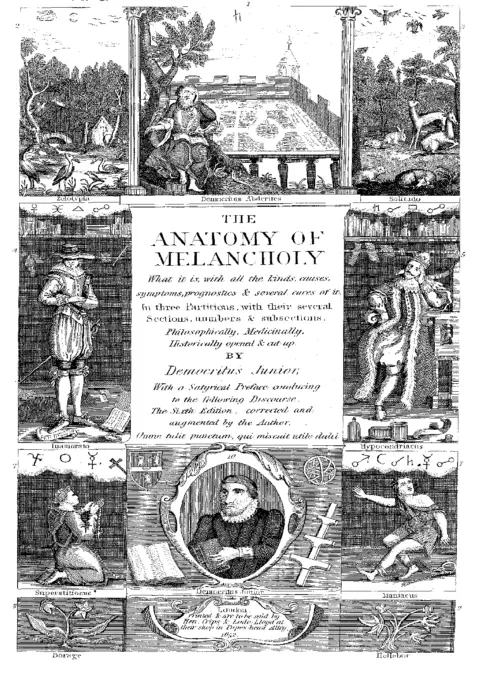
THE CLASSIC COLLECTION · 1617
"The Anatomy of Melancholy" by Robert Burton is a medical treatise first published in 1621. This massive work explores depression and its causes, symptoms, and cures, but ranges far beyond medicine into history, astronomy, geography, and literature. Written under the pseudonym Democritus Junior, Burton blends scientific analysis with humor and satire across over 500,000 words. Drawing from ancient authorities and medieval sources, he examines melancholy as both a passing mood and a serious ailment, creating a unique work that inspired generations of writers.
Introduction adapted from the source catalogue; source summaries may be automatically generated.
Free to read · English · 529,097 words · No account needed
MAKE TIME FOR A GOOD BOOK
On by default. Untick to stop anonymous reading totals. Each page counts after 10 seconds in view. How this works.
Anonymous counting is on unless you have switched it off.
no company long, or to persevere in any action or business. [2512]Et similis regum pueris, pappare minutum Poscit, et iratus mammae lallare recusat,
eftsoons pleased, and anon displeased, as a man that's bitten with fleas, or that cannot sleep turns to and fro in his bed, their restless minds are tossed and vary, they have no patience to read out a book, to play out a game or two, walk a mile, sit an hour, &c., erected and dejected in an instant; animated to undertake, and upon a word spoken again discouraged. Passionate.] Extreme passionate, Quicquid volunt valde volunt; and what they desire, they do most furiously seek; anxious ever, and very solicitous, distrustful, and timorous, envious, malicious, profuse one while, sparing another, but most part covetous, muttering, repining, discontent, and still complaining, grudging, peevish, injuriarum tenaces, prone to revenge, soon troubled, and most violent in all their imaginations, not affable in speech, or apt to vulgar compliment, but surly, dull, sad, austere; cogitabundi still, very intent, and as [2513] Albertus Durer paints melancholy, like a sad woman leaning on her arm with fixed looks, neglected habit, &c., held therefore by some proud, soft, sottish, or half-mad, as the Abderites esteemed of Democritus: and yet of a deep reach, excellent apprehension, judicious, wise, and witty: for I am of that [2514]nobleman's mind, Melancholy advanceth men's conceits, more than any humour whatsoever, improves their meditations more than any strong drink or sack. They are of profound judgment in some things, although in others non recte judicant inquieti, saith Fracastorius, lib. 2. de Intell. And as Arculanus, c. 16. in 9. Rhasis, terms it, Judicium plerumque perversum, corrupti, cum judicant honesta inhonesta, et amicitiam habent pro inimicitia: they count honesty dishonesty, friends as enemies, they will abuse their best friends, and dare not offend their enemies. Cowards most part et ad inferendam injuriam timidissimi, saith Cardan, lib. 8. cap. 4. de rerum varietate: loath to offend, and if they chance to overshoot themselves in word or deed: or any small business or circumstance be omitted, forgotten, they are miserably tormented, and frame a thousand dangers and inconveniences to themselves, ex musca elephantem, if once they conceit it: overjoyed with every good rumour, tale, or prosperous event, transported beyond themselves: with every small cross again, bad news, misconceived injury, loss, danger, afflicted beyond measure, in great agony, perplexed, dejected, astonished, impatient, utterly undone: fearful, suspicious of all. Yet again, many of them desperate harebrains, rash, careless, fit to be assassinates, as being void of all fear and sorrow, according to [2515]Hercules de Saxonia, Most audacious, and such as dare walk alone in the night, through deserts and dangerous places, fearing none. Amorous.] They are prone to love, and [2516]easy to be taken; Propensi ad amorem et excandescentiam (Montaltus cap. 21.) quickly enamoured, and dote upon all, love one dearly, till they see another, and then dote on her, Et hanc, et hanc, et illam, et omnes, the present moves most, and the last commonly they love best. Yet some again Anterotes, cannot endure the sight of a woman, abhor the sex, as that same melancholy [2517]duke of Muscovy, that was instantly sick, if he came but in sight of them; and that [2518]Anchorite, that fell into a cold palsy, when a woman was brought before him. Humorous.] Humorous they are beyond all measure, sometimes profusely laughing, extraordinarily merry, and then again weeping without a cause, (which is familiar with many gentlewomen,) groaning, sighing, pensive, sad, almost distracted, multa absurda fingunt, et a ratione aliena (saith [2519]Frambesarius), they feign many absurdities, vain, void of reason: one supposeth himself to be a dog, cock, bear, horse, glass, butter, &c. He is a giant, a dwarf, as strong as an hundred men, a lord, duke, prince, &c. And if he be told he hath a stinking breath, a great nose, that he is sick, or inclined to such or such a disease, he believes it eftsoons, and peradventure by force of imagination will work it out. Many of them are immovable, and fixed in their conceits, others vary upon every object, heard or seen. If they see a stage-play, they run upon that a week after; if they hear music, or see dancing, they have nought but bagpipes in their brain: if they see a combat, they are all for arms. [2520]If abused, an abuse troubles them long after; if crossed, that cross, &c. Restless in their thoughts and actions, continually meditating, Velut aegri somnia, vanae finguntur species; more like dreams, than men awake, they fain a company of antic, fantastical conceits, they have most frivolous thoughts, impossible to be effected; and sometimes think verily they hear and see present before their eyes such phantasms or goblins, they fear, suspect, or conceive, they still talk with, and follow them. In fine, cogitationes somniantibus similes, id vigilant, quod alii somniant cogitabundi, still, saith Avicenna, they wake, as others dream, and such for the most part are their imaginations and conceits, [2521]absurd, vain, foolish toys, yet they are [2522]most curious and solicitous, continual, et supra modum, Rhasis cont. lib. 1. cap. 9. praemeditantur de aliqua re. As serious in a toy, as if it were a most necessary business, of great moment, importance, and still, still, still thinking of it: saeviunt in se, macerating themselves. Though they do talk with you, and seem to be otherwise employed, and to your thinking very intent and busy, still that toy runs in their mind, that fear, that suspicion, that abuse, that jealousy, that agony, that vexation, that cross, that castle in the air, that crotchet, that whimsy, that fiction, that pleasant waking dream, whatsoever it is. Nec interrogant (saith [2523]Fracastorius) nec interrogatis recte respondent. They do not much heed what you say, their mind is on another matter; ask what you will, they do not attend, or much intend that business they are about, but forget themselves what they are saying, doing, or should otherwise say or do, whither they are going, distracted with their own melancholy thoughts. One laughs upon a sudden, another smiles to himself, a third frowns, calls, his lips go still, he acts with his hand as he walks, &c. 'Tis proper to all melancholy men, saith [2524]Mercurialis, con. 11. What conceit they have once entertained, to be most intent, violent, and continually about it. Invitas occurrit, do what they may they cannot be rid of it, against their wills they must think of it a thousand times over, Perpetuo molestantur nec oblivisci possunt, they are continually troubled with it, in company, out of company; at meat, at exercise, at all times and places, [2525]non desinunt ea, quae, minime volunt, cogitare, if it be offensive especially, they cannot forget it, they may not rest or sleep for it, but still tormenting themselves, Sysiphi saxum volvunt sibi ipsis, as [2526]Brunner observes, Perpetua calamitas et miserabile flagellum. Bashfulness.] [2527]Crato, [2528]Laurentius, and Fernelius, put bashfulness for an ordinary symptom, sabrusticus pudor, or vitiosus pudor, is a thing which much haunts and torments them. If they have been misused, derided, disgraced, chidden, &c., or by any perturbation of mind, misaffected, it so far troubles them, that they become quite moped many times, and so disheartened, dejected, they dare not come abroad, into strange companies especially, or manage their ordinary affairs, so childish, timorous, and bashful, they can look no man in the face; some are more disquieted in this kind, some less, longer some, others shorter, by fits, &c., though some on the other side (according to [2529]Fracastorius) be inverecundi et pertinaces, impudent and peevish. But most part they are very shamefaced, and that makes them with Pet. Blesensis, Christopher Urswick, and many such, to refuse honours, offices, and preferments, which sometimes fall into their mouths, they cannot speak, or put forth themselves as others can, timor hos, pudor impedit illos, timorousness and bashfulness hinder their proceedings, they are contented with their present estate, unwilling to undertake any office, and therefore never likely to rise. For that cause they seldom visit their friends, except some familiars: pauciloqui, of few words, and oftentimes wholly silent. [2530] Frambeserius, a Frenchman, had two such patients, omnino taciturnos, their friends could not get them to speak: Rodericus a Fonseca consult. tom. 2. 85. consil. gives instance in a young man, of twenty-seven years of age, that was frequently silent, bashful, moped, solitary, that would not eat his meat, or sleep, and yet again by fits apt to be angry, &c. Solitariness.] Most part they are, as Plater notes, desides, taciturni, aegre impulsi, nec nisi coacti procedunt, &c. they will scarce be compelled to do that which concerns them, though it be for their good, so diffident, so dull, of small or no compliment, unsociable, hard to be acquainted with, especially of strangers; they had rather write their minds than speak, and above all things love solitariness. Ob voluptatem, an ob timorem soli sunt? Are they so solitary for pleasure (one asks,) or pain? for both; yet I rather think for fear and sorrow, &c. [2531]Hinc metuunt cupiuntque, dolent fugiuntque, nec auras Respiciunt, clausi tenebris, et carcere caeco.
Your reading position is saved on this browser. Take it to another device with a library code. Reading pages adapt to text, rather than matching a printed edition.
BEHIND THE BOOK
This eBook is for the use of anyone anywhere in the United States and most other parts of the world at no cost and with almost no restrictions whatsoever. You may copy it, give it away or re-use it under the terms of the Project Gutenberg License included with this eBook or online at www.gutenberg.org. If you are not located in the United States, you will have to check the laws of the country where you are located before using this eBook. Read the source licence.
The original source file, including credits and licence, is retained by this library. Request an original-format copy at no charge. Please include the book title and Project Gutenberg identifier #10800.
KEEP YOUR CURIOSITY GOING
David Patterson (Spirit) Hatch
Coulson Kernahan

Ralph Waldo Emerson
Frances Wright

Edwin Abbott Abbott

Joseph Droz