
Last letters from the living dead man
David Patterson (Spirit) Hatch
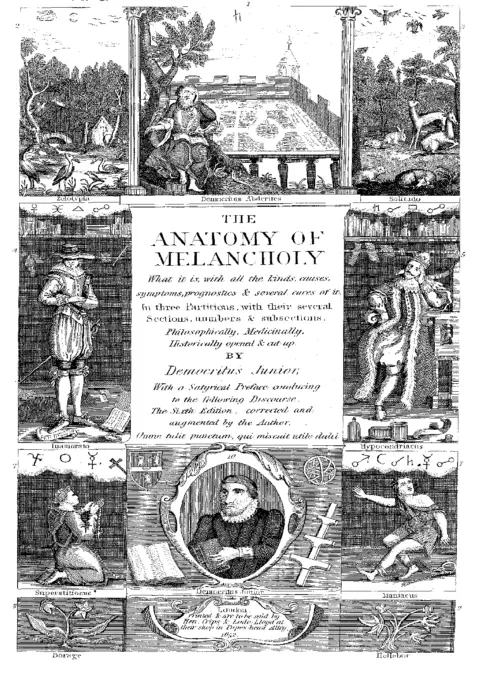
THE CLASSIC COLLECTION · 1617
"The Anatomy of Melancholy" by Robert Burton is a medical treatise first published in 1621. This massive work explores depression and its causes, symptoms, and cures, but ranges far beyond medicine into history, astronomy, geography, and literature. Written under the pseudonym Democritus Junior, Burton blends scientific analysis with humor and satire across over 500,000 words. Drawing from ancient authorities and medieval sources, he examines melancholy as both a passing mood and a serious ailment, creating a unique work that inspired generations of writers.
Introduction adapted from the source catalogue; source summaries may be automatically generated.
Free to read · English · 529,097 words · No account needed
MAKE TIME FOR A GOOD BOOK
On by default. Untick to stop anonymous reading totals. Each page counts after 10 seconds in view. How this works.
Anonymous counting is on unless you have switched it off.
Such feral accidents can want and penury produce. Be it by suretyship, shipwreck, fire, spoil and pillage of soldiers, or what loss soever, it boots not, it will work the like effect, the same desolation in provinces and cities, as well as private persons. The Romans were miserably dejected after the battle of Cannae, the men amazed for fear, the stupid women tore their hair and cried. The Hungarians, when their king Ladislaus and bravest soldiers were slain by the Turks, Luctus publicus, &c. The Venetians when their forces were overcome by the French king Lewis, the French and Spanish kings, pope, emperor, all conspired against them, at Cambray, the French herald denounced open war in the senate: Lauredane Venetorum dux, &c., and they had lost Padua, Brixia, Verona, Forum Julii, their territories in the continent, and had now nothing left, but the city of Venice itself, et urbi quoque ipsi (saith [2344]Bembus) timendum putarent, and the loss of that was likewise to be feared, tantus repente dolor omnes tenuit, ut nunquam, alias, &c., they were pitifully plunged, never before in such lamentable distress. Anno 1527, when Rome was sacked by Burbonius, the common soldiers made such spoil, that fair [2345]churches were turned to stables, old monuments and books made horse-litter, or burned like straw; relics, costly pictures defaced; altars demolished, rich hangings, carpets, &c., trampled in the dirt. [2346]Their wives and loveliest daughters constuprated by every base cullion, as Sejanus' daughter was by the hangman in public, before their fathers and husbands' faces. Noblemen's children, and of the wealthiest citizens, reserved for princes' beds, were prostitute to every common soldier, and kept for concubines; senators and cardinals themselves dragged along the streets, and put to exquisite torments, to confess where their money was hid; the rest, murdered on heaps, lay stinking in the streets; infants' brains dashed out before their mothers' eyes. A lamentable sight it was to see so goodly a city so suddenly defaced, rich citizens sent a begging to Venice, Naples, Ancona, &c., that erst lived in all manner of delights. [2347]Those proud palaces that even now vaunted their tops up to heaven, were dejected as low as hell in an instant. Whom will not such misery make discontent? Terence the poet drowned himself (some say) for the loss of his comedies, which suffered shipwreck. When a poor man hath made many hungry meals, got together a small sum, which he loseth in an instant; a scholar spent many an hour's study to no purpose, his labours lost, &c., how should it otherwise be? I may conclude with Gregory, temporalium amor, quantum afficit, cum haeret possessio, tantum quum subtrahitur, urit dolor; riches do not so much exhilarate us with their possession, as they torment us with their loss. Next to sorrow still I may annex such accidents as procure fear; for besides those terrors which I have [2348]before touched, and many other fears (which are infinite) there is a superstitious fear, one of the three great causes of fear in Aristotle, commonly caused by prodigies and dismal accidents, which much trouble many of us, (Nescio quid animus mihi praesagit mali.) As if a hare cross the way at our going forth, or a mouse gnaw our clothes: if they bleed three drops at nose, the salt falls towards them, a black spot appear in their nails, &c., with many such, which Delrio Tom. 2. l. 3. sect. 4. Austin Niphus in his book de Auguriis. Polydore Virg. l. 3. de Prodigas. Sarisburiensis Polycrat. l. 1. c. 13. discuss at large. They are so much affected, that with the very strength of imagination, fear, and the devil's craft, [2349]they pull those misfortunes they suspect, upon their own heads, and that which they fear, shall come upon them, as Solomon fortelleth, Prov. x. 24. and Isaiah denounceth, lxvi. 4. which if [2350]they could neglect and contemn, would not come to pass, Eorum vires nostra resident opinione, ut morbi gravitas ?grotantium cogitatione, they are intended and remitted, as our opinion is fixed, more or less. N. N. dat poenas, saith [2351]Crato of such a one, utinam non attraheret: he is punished, and is the cause of it [2352] himself: [2353]Dum fata fugimus fata stulti incurrimus, the thing that I feared, saith Job, is fallen upon me. As much we may say of them that are troubled with their fortunes; or ill destinies foreseen: multos angit praecientia malorum: The foreknowledge of what shall come to pass, crucifies many men: foretold by astrologers, or wizards, iratum ob coelum, be it ill accident, or death itself: which often falls out by God's permission; quia daemonem timent (saith Chrysostom) Deus ideo permittit accidere. Severus, Adrian, Domitian, can testify as much, of whose fear and suspicion, Sueton, Herodian, and the rest of those writers, tell strange stories in this behalf. [2354]Montanus consil. 31. hath one example of a young man, exceeding melancholy upon this occasion. Such fears have still tormented mortal men in all ages, by reason of those lying oracles, and juggling priests. [2355]There was a fountain in Greece, near Ceres' temple in Achaia, where the event of such diseases was to be known; A glass let down by a thread, &c. Amongst those Cyanean rocks at the springs of Lycia, was the oracle of Thrixeus Apollo, where all fortunes were foretold, sickness, health, or what they would besides: so common people have been always deluded with future events. At this day, Metus futurorum maxime torquet Sinas, this foolish fear, mightily crucifies them in China: as [2356]Matthew Riccius the Jesuit informeth us, in his commentaries of those countries, of all nations they are most superstitious, and much tormented in this kind, attributing so much to their divinators, ut ipse metus fidem faciat, that fear itself and conceit, cause it to [2357]fall out: If he foretell sickness such a day, that very time they will be sick, vi metus afflicti in aegritudinem cadunt; and many times die as it is foretold. A true saying, Timor mortis, morte pejor, the fear of death is worse than death itself, and the memory of that sad hour, to some fortunate and rich men, is as bitter as gall, Eccl. xli. 1. Inquietam nobis vitam facit mortis metus, a worse plague cannot happen to a man, than to be so troubled in his mind; 'tis triste divortium, a heavy separation, to leave their goods, with so much labour got, pleasures of the world, which they have so deliciously enjoyed, friends and companions whom they so dearly loved, all at once. Axicchus the philosopher was bold and courageous all his life, and gave good precepts de contemnenda morte, and against the vanity of the world, to others; but being now ready to die himself, he was mightily dejected, hac luce privabor? his orbabor bonis?[2358]he lamented like a child, &c. And though Socrates himself was there to comfort him, ubi pristina virtutum jactatio O Axioche? where is all your boasted virtue now, my friend? yet he was very timorous and impatient of death, much troubled in his mind, Imbellis pavor et impatientia, &c. O Clotho, Megapetus the tyrant in Lucian exclaims, now ready to depart, let me live a while longer. [2359]I will give thee a thousand talents of gold, and two boles besides, which I took from Cleocritus, worth a hundred talents apiece. Woe's me, [2360] saith another, what goodly manors shall I leave! what fertile fields! what a fine house! what pretty children! how many servants! who shall gather my grapes, my corn? Must I now die so well settled? Leave all, so richly and well provided? Woe's me, what shall I do? [2361]Animula vagula, blandula, qua nunc abibis in loca? To these tortures of fear and sorrow, may well be annexed curiosity, that irksome, that tyrannising care, nimia solicitudo, [2362]superfluous industry about unprofitable things, and their qualities, as Thomas defines it: an itching humour or a kind of longing to see that which is not to be seen, to do that which ought not to be done, to know that [2363]secret which should not be known, to eat of the forbidden fruit. We commonly molest and tire ourselves about things unfit and unnecessary, as Martha troubled herself to little purpose. Be it in religion, humanity, magic, philosophy, policy, any action or study, 'tis a needless trouble, a mere torment. For what else is school divinity, how many doth it puzzle? what fruitless questions about the Trinity, resurrection, election, predestination, reprobation, hell-fire, &c., how many shall be saved, damned? What else is all superstition, but an endless observation of idle ceremonies, traditions? What is most of our philosophy but a labyrinth of opinions, idle questions, propositions, metaphysical terms? Socrates, therefore, held all philosophers, cavillers, and mad men, circa subtilia Cavillatores pro insanis habuit, palam eos arguens, saith [2364]Eusebius, because they commonly sought after such things quae nec percipi a nobis neque comprehendi posset, or put case they did understand, yet they were altogether unprofitable. For what matter is it for us to know how high the Pleiades are, how far distant Perseus and Cassiopeia from us, how deep the sea, &c., we are neither wiser, as he follows it, nor modester, nor better, nor richer, nor stronger for the knowledge of it. Quod supra nos nihil ad, nos, I may say the same of those genethliacal studies, what is astrology but vain elections, predictions? all magic, but a troublesome error, a pernicious foppery? physic, but intricate rules and prescriptions? philology, but vain criticisms? logic, needless sophisms? metaphysics themselves, but intricate subtleties, and fruitless abstractions? alchemy, but a bundle of errors? to what end are such great tomes? why do we spend so many years in their studies? Much better to know nothing at all, as those barbarous Indians are wholly ignorant, than as some of us, to be so sore vexed about unprofitable toys: stultus labor est ineptiarum, to build a house without pins, make a rope of sand, to what end? cui bono? He studies on, but as the boy told St. Austin, when I have laved the sea dry, thou shalt understand the mystery of the Trinity. He makes observations, keeps times and seasons; and as [2365]Conradus the emperor would not touch his new bride, till an astrologer had told him a masculine hour, but with what success? He travels into Europe, Africa, Asia, searcheth every creek, sea, city, mountain, gulf, to what end? See one promontory (said Socrates of old), one mountain, one sea, one river, and see all. An alchemist spends his fortunes to find out the philosopher's stone forsooth, cure all diseases, make men long-lived, victorious, fortunate, invisible, and beggars himself, misled by those seducing impostors (which he shall never attain) to make gold; an antiquary consumes his treasure and time to scrape up a company of old coins, statues, rules, edicts, manuscripts, &c., he must know what was done of old in Athens, Rome, what lodging, diet, houses they had, and have all the present news at first, though never so remote, before all others, what projects, counsels, consultations, &c., quid Juno in aurem insusurret Jovi, what's now decreed in France, what in Italy: who was he, whence comes he, which way, whither goes he, &c. Aristotle must find out the motion of Euripus; Pliny must needs see Vesuvius, but how sped they? One loseth goods, another his life; Pyrrhus will conquer Africa first, and then Asia: he will be a sole monarch, a second immortal, a third rich; a fourth commands. [2366] Turbine magno spes solicitae in urbibus errant; we run, ride, take indefatigable pains, all up early, down late, striving to get that which we had better be without, (Ardelion's busybodies as we are) it were much fitter for us to be quiet, sit still, and take our ease. His sole study is for words, that they be—Lepidae lexeis compostae, ut tesserulae omnes, not a syllable misplaced, to set out a stramineous subject: as thine is about apparel, to follow the fashion, to be terse and polite, 'tis thy sole business: both with like profit. His only delight is building, he spends himself to get curious pictures, intricate models and plots, another is wholly ceremonious about titles, degrees, inscriptions: a third is over-solicitous about his diet, he must have such and such exquisite sauces, meat so dressed, so far-fetched, peregrini aeris volucres, so cooked, &c., something to provoke thirst, something anon to quench his thirst. Thus he redeems his appetite with extraordinary charge to his purse, is seldom pleased with any meal, whilst a trivial stomach useth all with delight and is never offended. Another must have roses in winter, alieni temporis flores, snow-water in summer, fruits before they can be or are usually ripe, artificial gardens and fishponds on the tops of houses, all things opposite to the vulgar sort, intricate and rare, or else they are nothing worth. So busy, nice, curious wits, make that insupportable in all vocations, trades, actions, employments, which to duller apprehensions is not offensive, earnestly seeking that which others so scornfully neglect. Thus through our foolish curiosity do we macerate ourselves, tire our souls, and run headlong, through our indiscretion, perverse will, and want of government, into many needless cares, and troubles, vain expenses, tedious journeys, painful hours; and when all is done, quorsum haec? cui bono? to what end? [2367]Nescire velle quae Magister maximus Docere non vult, erudita inscitia est.
Your reading position is saved on this browser. Take it to another device with a library code. Reading pages adapt to text, rather than matching a printed edition.
BEHIND THE BOOK
This eBook is for the use of anyone anywhere in the United States and most other parts of the world at no cost and with almost no restrictions whatsoever. You may copy it, give it away or re-use it under the terms of the Project Gutenberg License included with this eBook or online at www.gutenberg.org. If you are not located in the United States, you will have to check the laws of the country where you are located before using this eBook. Read the source licence.
The original source file, including credits and licence, is retained by this library. Request an original-format copy at no charge. Please include the book title and Project Gutenberg identifier #10800.
KEEP YOUR CURIOSITY GOING
David Patterson (Spirit) Hatch
Coulson Kernahan

Ralph Waldo Emerson
Frances Wright

Edwin Abbott Abbott

Joseph Droz