
Last letters from the living dead man
David Patterson (Spirit) Hatch
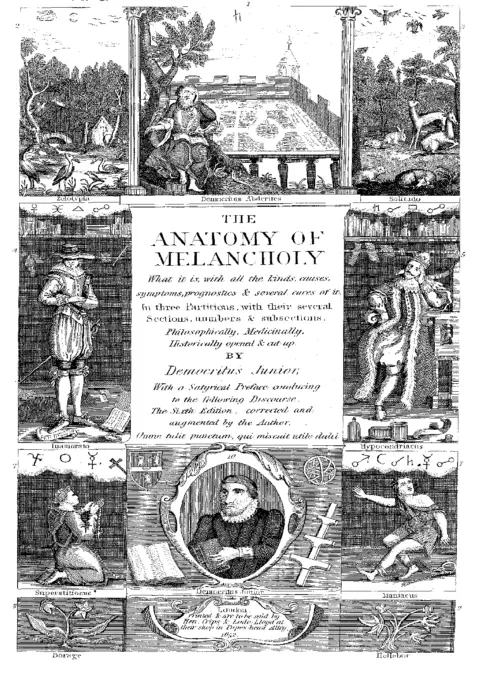
THE CLASSIC COLLECTION · 1617
"The Anatomy of Melancholy" by Robert Burton is a medical treatise first published in 1621. This massive work explores depression and its causes, symptoms, and cures, but ranges far beyond medicine into history, astronomy, geography, and literature. Written under the pseudonym Democritus Junior, Burton blends scientific analysis with humor and satire across over 500,000 words. Drawing from ancient authorities and medieval sources, he examines melancholy as both a passing mood and a serious ailment, creating a unique work that inspired generations of writers.
Introduction adapted from the source catalogue; source summaries may be automatically generated.
Free to read · English · 529,097 words · No account needed
MAKE TIME FOR A GOOD BOOK
On by default. Untick to stop anonymous reading totals. Each page counts after 10 seconds in view. How this works.
Anonymous counting is on unless you have switched it off.
he may sail as he will himself, and temper his estate at his pleasure, jovial days, splendour and magnificence, sweet music, dainty fare, the good things, and fat of the land, fine clothes, rich attires, soft beds, down pillows are at his command, all the world labours for him, thousands of artificers are his slaves to drudge for him, run, ride, and post for him: [2218]Divines (for Pythia Philippisat) lawyers, physicians, philosophers, scholars are his, wholly devote to his service. Every man seeks his [2219]acquaintance, his kindred, to match with him, though he be an oaf, a ninny, a monster, a goose-cap, uxorem ducat Danaen, [2220]when, and whom he will, hunc optant generum Rex et Regina—he is an excellent [2221]match for my son, my daughter, my niece, &c. Quicquid calcaverit hic, Rosa fiet, let him go whither he will, trumpets sound, bells ring, &c., all happiness attends him, every man is willing to entertain him, he sups in [2222]Apollo wheresoever he comes; what preparation is made for his [2223]entertainment? fish and fowl, spices and perfumes, all that sea and land affords. What cookery, masking, mirth to exhilarate his person? [2224]Da Trebio, pone ad Trebium, vis frater ab illia Ilibus?———
What dish will your good worship eat of?
[2225]———dulcia poma,
Et quoscunque feret cultus tibi fundus honores,
Ante Larem, gustet venerabilior Lare dives.
Sweet apples, and whate'er thy fields afford,
Before thy Gods be serv'd, let serve thy Lord.
What sport will your honour have? hawking, hunting, fishing, fowling, bulls, bears, cards, dice, cocks, players, tumblers, fiddlers, jesters, &c., they are at your good worship's command. Fair houses, gardens, orchards, terraces, galleries, cabinets, pleasant walks, delightsome places, they are at hand: [2226]in aureis lac, vinum in argenteis, adolescentulae ad nutum speciosae, wine, wenches, &c. a Turkish paradise, a heaven upon earth. Though he be a silly soft fellow, and scarce have common sense, yet if he be borne to fortunes (as I have said) [2227]jure haereditario sapere jubetur, he must have honour and office in his course: [2228]Nemo nisi dives honore dignus (Ambros. offic. 21.) none so worthy as himself: he shall have it, atque esto quicquid Servius aut Labeo. Get money enough and command [2229]kingdoms, provinces, armies, hearts, hands, and affections; thou shalt have popes, patriarchs to be thy chaplains and parasites: thou shalt have (Tamerlane-like) kings to draw thy coach, queens to be thy laundresses, emperors thy footstools, build more towns and cities than great Alexander, Babel towers, pyramids and Mausolean tombs, &c. command heaven and earth, and tell the world it is thy vassal, auro emitur diadema, argento caelum panditur, denarius philosophum conducit, nummus jus cogit, obolus literatum pascit, metallum sanitatem conciliat, aes amicos conglutinat.[2230]And therefore not without good cause, John de Medicis, that rich Florentine, when he lay upon his death-bed, calling his sons, Cosmo and Laurence, before him, amongst other sober sayings, repeated this, animo quieto digredior, quod vos sanos et divites post me relinquam, It doth me good to think yet, though I be dying, that I shall leave you, my children, sound and rich: for wealth sways all. It is not with us, as amongst those Lacedaemonian senators of Lycurgus in Plutarch, He preferred that deserved best, was most virtuous and worthy of the place, [2231]not swiftness, or strength, or wealth, or friends carried it in those days: but inter optimos optimus, inter temperantes temperantissimus, the most temperate and best. We have no aristocracies but in contemplation, all oligarchies, wherein a few rich men domineer, do what they list, and are privileged by their greatness. [2232]They may freely trespass, and do as they please, no man dare accuse them, no not so much as mutter against them, there is no notice taken of it, they may securely do it, live after their own laws, and for their money get pardons, indulgences, redeem their souls from purgatory and hell itself,—clausum possidet arca Jovem. Let them be epicures, or atheists, libertines, Machiavellians, (as they often are) [2233]Et quamvis perjuris erit, sine gente, cruentus, they may go to heaven through the eye of a needle, if they will themselves, they may be canonised for saints, they shall be [2234]honourably interred in Mausolean tombs, commended by poets, registered in histories, have temples and statues erected to their names,—e manibus illis—nascentur violae.—If he be bountiful in his life, and liberal at his death, he shall have one to swear, as he did by Claudius the Emperor in Tacitus, he saw his soul go to heaven, and be miserably lamented at his funeral. Ambubalarum collegia, &c. Trimalcionis topanta in Petronius recta in caelum abiit, went right to heaven: a, base quean, [2235]thou wouldst have scorned once in thy misery to have a penny from her; and why? modio nummos metiit, she measured her money by the bushel. These prerogatives do not usually belong to rich men, but to such as are most part seeming rich, let him have but a good [2236]outside, he carries it, and shall be adored for a god, as [2237]Cyrus was amongst the Persians, ob splendidum apparatum, for his gay attires; now most men are esteemed according to their clothes. In our gullish times, whom you peradventure in modesty would give place to, as being deceived by his habit, and presuming him some great worshipful man, believe it, if you shall examine his estate, he will likely be proved a serving man of no great note, my lady's tailor, his lordship's barber, or some such gull, a Fastidius Brisk, Sir Petronel Flash, a mere outside. Only this respect is given him, that wheresoever he comes, he may call for what he will, and take place by reason of his outward habit. But on the contrary, if he be poor, Prov. xv. 15, all his days are miserable, he is under hatches, dejected, rejected and forsaken, poor in purse, poor in spirit; [2238]prout res nobis fluit, ita et animus se habet; [2239]money gives life and soul. Though he be honest, wise, learned, well-deserving, noble by birth, and of excellent good parts; yet in that he is poor, unlikely to rise, come to honour, office, or good means, he is contemned, neglected, frustra sapit, inter literas esurit, amicus molestus. [2240]If he speak, what babbler is this? Ecclus, his nobility without wealth, is [2241]projecta vilior alga, and he not esteemed: nos viles pulli nati infelicibus ovis, if once poor, we are metamorphosed in an instant, base slaves, villains, and vile drudges; [2242]for to be poor, is to be a knave, a fool, a wretch, a wicked, an odious fellow, a common eyesore, say poor and say all; they are born to labour, to misery, to carry burdens like juments, pistum stercus comedere with Ulysses' companions, and as Chremilus objected in Aristophanes, [2243] salem lingere, lick salt, to empty jakes, fay channels, [2244]carry out dirt and dunghills, sweep chimneys, rub horse-heels, &c. I say nothing of Turks, galley-slaves, which are bought [2245]and sold like juments, or those African Negroes, or poor [2246]Indian drudges, qui indies hinc inde deferendis oneribus occumbunt, nam quod apud nos boves et asini vehunt, trahunt, &c. [2247]Id omne misellis Indis, they are ugly to behold, and though erst spruce, now rusty and squalid, because poor, [2248]immundas fortunas aquum est squalorem sequi, it is ordinarily so. [2249]Others eat to live, but they live to drudge, [2250]servilis et misera gens nihil recusare audet, a servile generation, that dare refuse no task.—[2251]Heus tu Dromo, cape hoc flabellum, ventulum hinc facito dum lavamus, sirrah blow wind upon us while we wash, and bid your fellow get him up betimes in the morning, be it fair or foul, he shall run fifty miles afoot tomorrow, to carry me a letter to my mistress, Socia ad pistrinam, Socia shall tarry at home and grind malt all day long, Tristan thresh. Thus are they commanded, being indeed some of them as so many footstools for rich men to tread on, blocks for them to get on horseback, or as [2252]walls for them to piss on. They are commonly such people, rude, silly, superstitious idiots, nasty, unclean, lousy, poor, dejected, slavishly humble: and as [2253]Leo Afer observes of the commonalty of Africa, natura viliores sunt, nec apud suos duces majore in precio quam si canes essent: [2254]base by nature, and no more esteemed than dogs, miseram, laboriosam, calamitosam vitam agunt, et inopem, infelicem, rudiores asinis, ut e brutis plane natos dicas: no learning, no knowledge, no civility, scarce common, sense, nought but barbarism amongst them, belluino more vivunt, neque calceos gestant, neque vestes, like rogues and vagabonds, they go barefooted and barelegged, the soles of their feet being as hard as horse-hoofs, as [2255]Radzivilus observed at Damietta in Egypt, leading a laborious, miserable, wretched, unhappy life, [2256]like beasts and juments, if not worse: (for a [2257]Spaniard in Incatan, sold three Indian boys for a cheese, and a hundred Negro slaves for a horse) their discourse is scurrility, their summum bonum, a pot of ale. There is not any slavery which these villains will not undergo, inter illos plerique latrinas evacuant, alii culinariam curant, alii stabularios agunt, urinatores et id genus similia exercent, &c. like those people that dwell in the [2258]Alps, chimney-sweepers, jakes-farmers, dirt-daubers, vagrant rogues, they labour hard some, and yet cannot get clothes to put on, or bread to eat. For what can filthy poverty give else, but [2259]beggary, fulsome nastiness, squalor, contempt, drudgery, labour, ugliness, hunger and thirst; pediculorum, et pulicum numerum? as [2260] he well followed it in Aristophanes, fleas and lice, pro pallio vestem laceram, et pro pulvinari lapidem bene magnum ad caput, rags for his raiment, and a stone for his pillow, pro cathedra, ruptae caput urnae, he sits in a broken pitcher, or on a block for a chair, et malvae, ramos pro panibus comedit, he drinks water, and lives on wort leaves, pulse, like a hog, or scraps like a dog, ut nunc nobis vita afficitur, quis non putabit insaniam esse, infelicitatemque? as Chremilus concludes his speech, as we poor men live nowadays, who will not take our life to be [2261] infelicity, misery, and madness? If they be of little better condition than those base villains, hunger-starved beggars, wandering rogues, those ordinary slaves, and day-labouring drudges; yet they are commonly so preyed upon by [2262] polling officers for breaking the laws, by their tyrannising landlords, so flayed and fleeced by perpetual [2263]exactions, that though they do drudge, fare hard, and starve their genius, they cannot live in [2264]some countries; but what they have is instantly taken from them, the very care they take to live, to be drudges, to maintain their poor families, their trouble and anxiety takes away their sleep, Sirac. xxxi. 1, it makes them weary of their lives: when they have taken all pains, done their utmost and honest endeavours, if they be cast behind by sickness, or overtaken with years, no man pities them, hard-hearted and merciless, uncharitable as they are, they leave them so distressed, to beg, steal, murmur, and [2265] rebel, or else starve. The feeling and fear of this misery compelled those old Romans, whom Menenius Agrippa pacified, to resist their governors: outlaws, and rebels in most places, to take up seditious arms, and in all ages hath caused uproars, murmurings, seditions, rebellions, thefts, murders, mutinies, jars and contentions in every commonwealth: grudging, repining, complaining, discontent in each private family, because they want means to live according to their callings, bring up their children, it breaks their hearts, they cannot do as they would. No greater misery than for a lord to have a knight's living, a gentleman a yeoman's, not to be able to live as his birth and place require. Poverty and want are generally corrosives to all kinds of men, especially to such as have been in good and flourishing estate, are suddenly distressed, [2266]nobly born, liberally brought up, and, by some disaster and casualty miserably dejected. For the rest, as they have base fortunes, so have they base minds correspondent, like beetles, e stercore orti, e stercore victus, in stercore delicium, as they were obscurely born and bred, so they delight in obscenity; they are not thoroughly touched with it. Angustas animas angusto in pectore versant. [2267]Yet, that which is no small cause of their torments, if once they come to be in distress, they are forsaken of their fellows, most part neglected, and left unto themselves; as poor [2268]Terence in Rome was by Scipio, Laelius, and Furius, his great and noble friends. Nil Publius Scipio profuit, nil ei Laelius, nil Furius, Tres per idem tempus qui agitabant nobiles facillime, Horum ille opera ne domum quident habuit conductitiam.[2269]
Your reading position is saved on this browser. Take it to another device with a library code. Reading pages adapt to text, rather than matching a printed edition.
BEHIND THE BOOK
This eBook is for the use of anyone anywhere in the United States and most other parts of the world at no cost and with almost no restrictions whatsoever. You may copy it, give it away or re-use it under the terms of the Project Gutenberg License included with this eBook or online at www.gutenberg.org. If you are not located in the United States, you will have to check the laws of the country where you are located before using this eBook. Read the source licence.
The original source file, including credits and licence, is retained by this library. Request an original-format copy at no charge. Please include the book title and Project Gutenberg identifier #10800.
KEEP YOUR CURIOSITY GOING
David Patterson (Spirit) Hatch
Coulson Kernahan

Ralph Waldo Emerson
Frances Wright

Edwin Abbott Abbott

Joseph Droz