THE CLASSIC COLLECTION✦An outlaw’s diary: the CommuneCLASSIC FREE BOOKS
An outlaw’s diary: the Commune
Cécile Tormay
THE CLASSIC COLLECTION · 1888
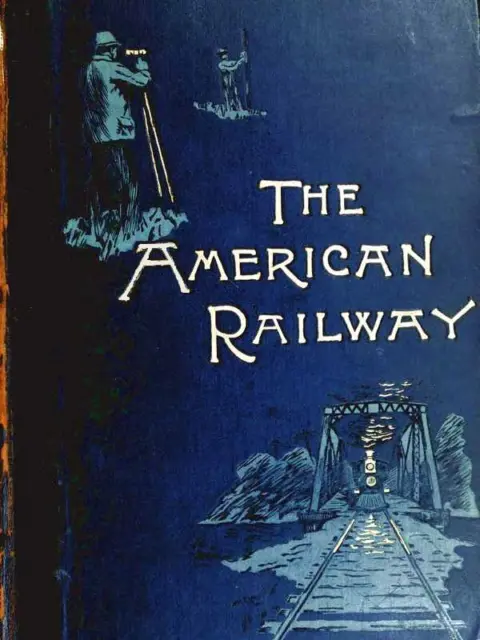
"The American Railway: Its Construction, Development, Management, and Appliances" by Thomas Curtis Clarke and co-authors is a historical account written in the late 19th century. This comprehensive work examines the evolution of railways in the United States, detailing the engineering innovations, construction techniques, and management practices that have shaped the railway system. It serves as a valuable resource for understanding the significance of railroads in American industry and society. At the start of the book, the authors trace the origins and development of railroads, starting from ancient Roman tramways to the revolutionary introduction of the steam locomotive in the early 19th century. They highlight key American inventions, such as the swiveling truck and equalizing beams, which enabled greater adaptability in railway construction and operation compared to European models. The opening also emphasizes the importance of surveying and engineering in establishing efficient rail lines, detailing the rigorous processes involved in building railways that would support an ever-growing transportation network, which fundamentally altered the landscape of America.
Introduction adapted from the source catalogue; source summaries may be automatically generated.
Free to read · English · 129,034 words · No account needed
MAKE TIME FOR A GOOD BOOK
On by default. Untick to stop anonymous reading totals. Each page counts after 10 seconds in view. How this works.
Anonymous counting is on unless you have switched it off.
The passenger runner's greatest concern is to "make time." Some trains are scheduled so that the engineman must keep his locomotive up to its very highest efficiency over every furlong of its journey in order to arrive at his destination on time. A little carelessness in firing, in letting cold water into the boiler irregularly, or in slackening more than is necessary where the right to the track is in doubt for a few rods; these and a score of similar circumstances may make five minutes' delay in the arrival at the terminus and necessitate an embarrassing interview with the trainmaster. A trip on a crowded line may involve watching for danger-signals every quarter of a mile and the maintenance of such high speed that they must be obeyed the instant they are espied in order to avoid the possibility of collision.[34]
The passenger runner finds himself now and then with a disabled engine on his hands, and two or three hundred passengers standing around apparently ready to eat him up if he does not remedy the difficulty in short order. Often in such cases he is in doubt himself whether the repairs necessary to enable his engine to proceed will occupy fifteen minutes or an hour. This, with the knotty question of where the nearest relief engine is, causes the brow to knit and the sweat to start, and to the young runner proves an experience which he long remembers.
Stories of fast running are common but unreliable; and when truthful, important considerations are often omitted. There are so many elements to be considered, that usually the verdict can be justly rendered only after a careful comparison with previous records. Most regular runs include a number of stops, and are subject to numerous slackenings of the speed, thus dimming the lustre of the record of the trip as a whole. Frequently, quick runs which have been reported as noteworthy have had favoring circumstances not told of. The most remarkable single run on record was that of Jarrett & Palmer's special train chartered to carry their theatrical company from New York to San Francisco (Jersey City to Oakland), June 1-4, 1876, which is well known to all Americans. Perhaps the fastest long run ever made in this country was that of a special train over the West Shore Railroad from East Buffalo to Frankfort, N. Y., two hundred and one miles, on July 9, 1885, which ran this distance in four hours, including several stops. This train ran thirty-six miles in thirty minutes, and ran many single miles in forty-three seconds each. An engine with two cars ran over the Canada Southern Division of the Michigan Central from St. Clair Junction to Windsor, Ont., on November 16, 1886, a distance of one hundred and seven miles, in ninety-seven minutes; and this included two or three stops. The average rate of speed was about sixty-nine miles an hour, and in places it rose to seventy-five and over. The engineers and their firemen, and all connected with the handling of the trains, certainly deserve credit for performances like these, and they receive it; but the supplying of the perfect machine, the smooth and safe roadway comparatively clear of other trains, and other conditions, is so manifestly beyond their control, while at the same time constituting such an important factor in the result, that praise should be given discriminatingly. An engineer who makes a specially quick trip feels proud of his engine, and of the honor of having been chosen for an important run, and he shares with the passengers the exhilaration produced by such a triumph of science and skill in annihilating space; but in the matter of credit to himself for experience and judgment, patience and forethought, he feels and knows that many a trip in his every-day service is worthy of greater recognition. Many a runner has to urge his engine, day after day, with a load twenty-five per cent. heavier than it was designed for, over track that is fit only for low speeds, at a rate which demands the most constant care. He must run fast enough over the better portions of the track to allow of slackening where prudence demands slackening. The tracks of many roads are rendered so uneven by the action of frost in winter that with an unskilful runner the passengers would be half-frightened by the unsteady motion of the cars. This condition is not common on the important trunk-lines, of course; but it does prevail on roads that carry a great many passengers, nevertheless; and engineers who guide trains over such difficult journeys, gently luring the passengers, with the aid of the excellent springs under the cars, into the belief that they are riding over a track of uniform smoothness, should not be forgotten in any estimate of the fraternity as a whole.
Your reading position is saved on this browser. Take it to another device with a library code. Reading pages adapt to text, rather than matching a printed edition.
BEHIND THE BOOK
This eBook is for the use of anyone anywhere in the United States and most other parts of the world at no cost and with almost no restrictions whatsoever. You may copy it, give it away or re-use it under the terms of the Project Gutenberg License included with this eBook or online at www.gutenberg.org. If you are not located in the United States, you will have to check the laws of the country where you are located before using this eBook. Read the source licence.
The original source file, including credits and licence, is retained by this library. Request an original-format copy at no charge. Please include the book title and Project Gutenberg identifier #54383.
KEEP YOUR CURIOSITY GOING
Cécile Tormay

Moritz Busch
John L. Ransom
Frances Wright
Cécile Tormay

Mabel Potter Daggett