THE CLASSIC COLLECTION✦An outlaw’s diary: the CommuneCLASSIC FREE BOOKS
An outlaw’s diary: the Commune
Cécile Tormay
THE CLASSIC COLLECTION · 1888
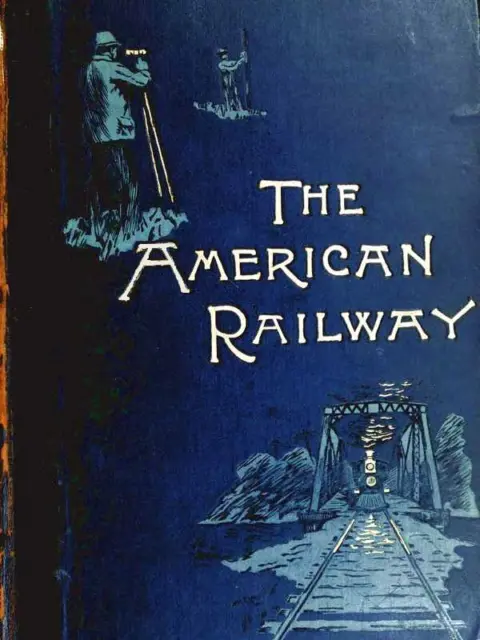
"The American Railway: Its Construction, Development, Management, and Appliances" by Thomas Curtis Clarke and co-authors is a historical account written in the late 19th century. This comprehensive work examines the evolution of railways in the United States, detailing the engineering innovations, construction techniques, and management practices that have shaped the railway system. It serves as a valuable resource for understanding the significance of railroads in American industry and society. At the start of the book, the authors trace the origins and development of railroads, starting from ancient Roman tramways to the revolutionary introduction of the steam locomotive in the early 19th century. They highlight key American inventions, such as the swiveling truck and equalizing beams, which enabled greater adaptability in railway construction and operation compared to European models. The opening also emphasizes the importance of surveying and engineering in establishing efficient rail lines, detailing the rigorous processes involved in building railways that would support an ever-growing transportation network, which fundamentally altered the landscape of America.
Introduction adapted from the source catalogue; source summaries may be automatically generated.
Free to read · English · 129,034 words · No account needed
MAKE TIME FOR A GOOD BOOK
On by default. Untick to stop anonymous reading totals. Each page counts after 10 seconds in view. How this works.
Anonymous counting is on unless you have switched it off.
Railways the Largest Single Interest in the United States--Some Impressive Statistics--Growth of a Complex Organization--Five Divisions of Necessary Work--Other Special Departments--Importance of the Operating Department--The Evil of Strikes--To be Remedied by Thorough Organization--Not the Ordinary Relation between Employer and Employee--Of what the Model Railway Service Should Consist--Temporary and Permanent Employees--Promotion from One Grade to the Other--Rights and Privileges of the Permanent Service--Employment during Good Behavior--Proposed Tribunal for Adjusting Differences and Enforcing Discipline--A Regular Advance in Pay for Faithful Service--A Fund for Hospital Service, Pensions, and Insurance--Railroad Educational Institutions--The Employer to Have a Voice in Management through a Council--A System of Representation.
In 1836--fifty years ago--there were but a little more than 1,000 miles of railroad on the American continents, representing an outlay of some $35,000,000, and controlled by a score or so of corporations. There are now (1886) about 135,000 miles in the United States alone, capitalized at over eight thousand millions of dollars.
The railroad interest is thus the largest single interest in the country. Probably 600,000 men are in its employ as wage-earners. It is safe to say that over two millions of human beings are directly dependent upon it for their daily support. The Union Pacific, as a single and by no means the largest member of this system, controls 5,150 miles of road, represented by stock and bonds to the amount of $275,000,000. More than 15,000 names are borne upon its pay-rolls. Its yearly income has exceeded $29,000,000, and in 1885 was $26,000,000. Large as these aggregates sound, there are other corporations which far exceed the Union Pacific both in income and in capitalization, and not a few exceed it in mileage. The Pennsylvania, for instance, either owns or directly controls 7,300 miles of road. It is represented by a capitalization of $670,000,000; its annual income is $93,000,000; it carries 75,000 names on its pay-rolls.
This has been the outgrowth of a single half-century. The vast and intricate organization implied in the management of such an interest had, as it were, to be improvised. The original companies were small and simple affairs. Some retired man of business held, as a rule, the position of president; while another man, generally a civil engineer, and as such supposed to be more or less acquainted with the practical working of railroads, acted as superintendent. The superintendent, in point of fact, attended to everything. He was the head of the commercial department; the head of the operating department; the head of the construction department; and the head of the mechanical department. But there is a limit to what any single man can do; and so, as the organization developed, it became necessary to relieve the railroad superintendent of many of his duties. Accordingly, the working management naturally subdivided itself into separate departments, at the head of which men were placed who had been trained all their lives to do the particular work required in each department. In the same way, the employees of the company--the wage-earners, as they are called--originally few in number, held toward the company relations similar to those which the employees in factories, shops, or on farms, held to those who employed them. In other words, there was in the railroad system no organized service. As the employees increased until they were numbered by hundreds, better organization became a necessity. The community was absolutely dependent upon its railroad service for continued existence, for the running of trains is to the modern body politic very much what the circulation of blood is to the human being. An organized system, therefore, had to grow up. This fact was not recognized at first; and, indeed, is only imperfectly recognized yet. Still the fact was there; and inasmuch as it was there and was not recognized, trouble ensued. No rationally organized railroad service--that is, no service in which the employer and employed occupy definite relations toward each other, recognized by each, and by the body politic--no such service exists. Approaches to it only have been made. A discussion, therefore, of the form that such a service would naturally take if it were organized, cannot be otherwise than timely.
Your reading position is saved on this browser. Take it to another device with a library code. Reading pages adapt to text, rather than matching a printed edition.
BEHIND THE BOOK
This eBook is for the use of anyone anywhere in the United States and most other parts of the world at no cost and with almost no restrictions whatsoever. You may copy it, give it away or re-use it under the terms of the Project Gutenberg License included with this eBook or online at www.gutenberg.org. If you are not located in the United States, you will have to check the laws of the country where you are located before using this eBook. Read the source licence.
The original source file, including credits and licence, is retained by this library. Request an original-format copy at no charge. Please include the book title and Project Gutenberg identifier #54383.
KEEP YOUR CURIOSITY GOING
Cécile Tormay

Moritz Busch
John L. Ransom
Frances Wright
Cécile Tormay

Mabel Potter Daggett