THE CLASSIC COLLECTION✦An outlaw’s diary: the CommuneCLASSIC FREE BOOKS
An outlaw’s diary: the Commune
Cécile Tormay
THE CLASSIC COLLECTION · 1888
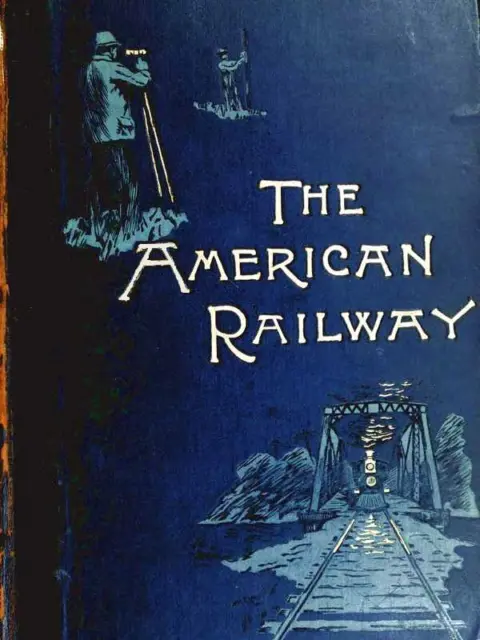
"The American Railway: Its Construction, Development, Management, and Appliances" by Thomas Curtis Clarke and co-authors is a historical account written in the late 19th century. This comprehensive work examines the evolution of railways in the United States, detailing the engineering innovations, construction techniques, and management practices that have shaped the railway system. It serves as a valuable resource for understanding the significance of railroads in American industry and society. At the start of the book, the authors trace the origins and development of railroads, starting from ancient Roman tramways to the revolutionary introduction of the steam locomotive in the early 19th century. They highlight key American inventions, such as the swiveling truck and equalizing beams, which enabled greater adaptability in railway construction and operation compared to European models. The opening also emphasizes the importance of surveying and engineering in establishing efficient rail lines, detailing the rigorous processes involved in building railways that would support an ever-growing transportation network, which fundamentally altered the landscape of America.
Introduction adapted from the source catalogue; source summaries may be automatically generated.
Free to read · English · 129,034 words · No account needed
MAKE TIME FOR A GOOD BOOK
On by default. Untick to stop anonymous reading totals. Each page counts after 10 seconds in view. How this works.
Anonymous counting is on unless you have switched it off.
The following statement of averages represents fairly what it costs to run a locomotive under ordinary conditions:
Averages.
Number of miles run to pint of oil 15.32 Number of miles run to ton of coal 46.17 Number of pounds of coal per mile run 48.62 Number of pints of oil per mile run 0.06
Cost in Cents per Mile Run.
Cents.
For oil, tallow, and waste 0.32
For fuel 7.42
For engineers 3.60
For firemen 1.79
For wipers and watchmen 1.25
For water supply 0.49
For supplies (miscellaneous) 0.10
For repairs 2.40
-----
Total 17.37
He will find that some engineers and firemen are more extravagant than others, and that some station agents and flagmen do not perform their respective duties with near so much regard for economy as others do under exactly similar circumstances. In such cases a report is made and a reminder from the Superintendent follows, calling attention to such carelessness. The result is apparent at the next monthly comparison.
Prompt payment of all supply bills helps to insure economy, and any company unable to make its payments promptly and regularly, suffers to a greater or less extent always; for a firm not able to know whether its accounts are to be settled in thirty or ninety days cannot afford to allow all the discounts which it otherwise might, and this may mean an extra expense every year of many thousands of dollars.
So far as the employees are concerned, it is for the best interests of the company to have a fixed time for the pay-day. They need their money and should get it regularly. Any road on which the men are paid at uncertain times may be subject to incalculable losses. It is apt to provoke dishonesty and carelessness. The road which is bankrupt and forced to pass its pay-day to some indefinite time is always hampered by some of the most inferior class of servants in the market. Except in some instances where special laws have been passed requiring railroad companies to meet their pay-rolls oftener, once each month is generally recognized as pay-time, and on large roads it would be simply out of the question for the pay-rolls to be made up correctly and the men paid off sooner. The paymaster is the wage-distributing medium, and by virtue of his generosity will command as much respect as the President of the road. No officer's face is more familiar than his, and surely no one connected with the institution is looked for with more eagerness by the hard-working employees. It is no easy task he has to perform, and the responsibility for the millions of dollars paid out in this way annually is very great. This responsibility, however, has been very much reduced on some roads, where wages are paid by checks entirely. Under some circumstances this system will not work satisfactorily, especially on a road running through a sparsely settled country. The employees may have to stand a good round discount to some store-keeper or tradesman in order to secure their money. The best and most satisfactory return for services can be nothing less than solid cash; it encourages better attention to business and relieves the men from possible annoyance and inconvenience. The Paymaster's car, which is virtually a moving bank or cashier's office, and arranged conveniently for the payment of money to the men as they pass through, is generally run "special," upon notice in advance to all foremen or heads of departments, either by telegraph or, as on some roads, by the display of special signal flags, which are carried on the front end of the locomotive of some regular train the day before the car is run over any division. In this way all men employed along the line of the road, whether at or between stations, are notified of the Paymaster's coming, and it does not usually require any other inducement than this to bring them all out. There is nothing that will prompt them to jump higher and run faster than the whistle of the pay-train as it comes around the curve to the station. Men have been known to forget their names, and do other foolish things under the excitement of drawing their month's pay. The fellow who said he could not write all his name when requested by the Paymaster to sign the pay-roll, but offered to write as much of it as he could, after some deliberation made a cross on the sheet with all the care and nicety he could muster. Others who could not write have been very slow to admit it, and have pleaded haste as an excuse for not doing so. So far as Italians are concerned (and what railroad service is now complete without its gang of Italian laborers?), they are usually designated by numbers, and in some cases their foremen have thought it well to name them after prominent statesmen or other public men, or possibly some of the head officials of the company. To run across twenty-five or thirty Daniel Websters on the same road is not surprising, and the President of the company himself is liable to have a half-dozen namesakes throughout the different divisions of his road. A cage of jabbering monkeys is not a more amusing spectacle than some gangs of Italian laborers receiving their month's pay.
Your reading position is saved on this browser. Take it to another device with a library code. Reading pages adapt to text, rather than matching a printed edition.
BEHIND THE BOOK
This eBook is for the use of anyone anywhere in the United States and most other parts of the world at no cost and with almost no restrictions whatsoever. You may copy it, give it away or re-use it under the terms of the Project Gutenberg License included with this eBook or online at www.gutenberg.org. If you are not located in the United States, you will have to check the laws of the country where you are located before using this eBook. Read the source licence.
The original source file, including credits and licence, is retained by this library. Request an original-format copy at no charge. Please include the book title and Project Gutenberg identifier #54383.
KEEP YOUR CURIOSITY GOING
Cécile Tormay

Moritz Busch
John L. Ransom
Frances Wright
Cécile Tormay

Mabel Potter Daggett