THE CLASSIC COLLECTION✦An outlaw’s diary: the CommuneCLASSIC FREE BOOKS
An outlaw’s diary: the Commune
Cécile Tormay
THE CLASSIC COLLECTION · 1845
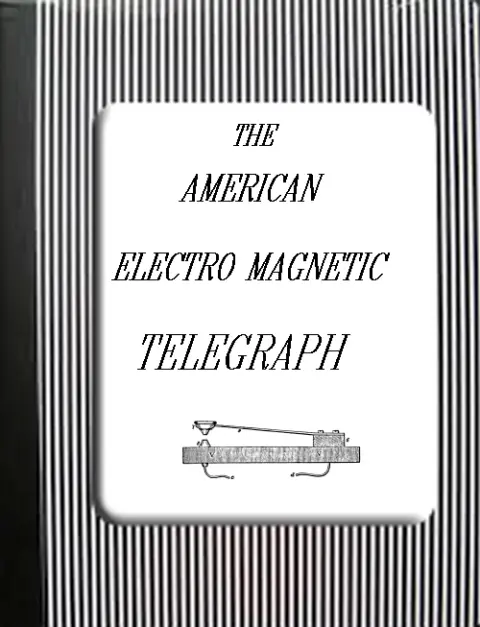
"The American Electro Magnetic Telegraph" by Alfred Vail is a scientific publication written in the mid-19th century. The work delves into the principles and workings of the electro magnetic telegraph, illustrating its significance in communication, especially in conjunction with the postal service. Vail aims to provide a thorough understanding of the telegraph's operation, highlighting American innovations and inventions in this field. The opening of the text outlines the intentions behind the work, detailing Vail’s commitment to present a comprehensive description of the American Electro Magnetic Telegraph. He notes the frequent inquiries he has received regarding its principles and operations and emphasizes the inclusion of various congressional reports on the subject. The introduction sets the stage for an exploration of the components such as the galvanic battery, the electro magnet, and the mechanisms involved in transmitting messages, with the goal of demonstrating the effectiveness of the American telegraph system compared to its European counterparts.
Introduction adapted from the source catalogue; source summaries may be automatically generated.
Free to read · English · 78,242 words · No account needed
MAKE TIME FOR A GOOD BOOK
On by default. Untick to stop anonymous reading totals. Each page counts after 10 seconds in view. How this works.
Anonymous counting is on unless you have switched it off.
3d. By making x = 0, we find y to be infinite and negative. Now, these are the properties of the logarithmic curve, which furnish an explanation of the case in hand. Assuming that the x’s represent the quantities of electricity, and the y’s the lengths of the wires, we perceive at once, that those parts of the curve which we have to consider, lie wholly in the fourth quadrant, where the abscissas are positive and the ordinates negative. When, therefore, the battery current passes without the intervention of any obstructing wire, its value is equal to unity. But, as successive lengths of wire are continually added, the quantities of electricity passing, undergo a diminution, at first rapid, and then more and more slow. And it is not until the wire becomes infinitely long that it ceases to conduct at all; for the ordinate y, when x = 0, is an asymptote to the curve. In point of practice, therefore, when a certain limit is reached, the diminution of the intensity of the forces becomes very small, whilst the increase in the lengths of the wire is vastly great. It is, therefore, possible to conceive a wire to be a million times as long as another, and yet, the two shall transmit quantities of electricity not perceptibly different, when measured by a delicate galvanometer. But, under these circumstances, if the long wire be coiled, so as to act as a multiplier, its influence on the needle will be inexpressibly greater than the one so much shorter than it. Further, from this we gather that for telegraphic despatches, with a battery of given electromotoric power, when a certain distance is reached, the diminution of effect for an increased distance becomes inappreciable.
This useful instrument, the invention of which is based upon Oersted’s discovery of the deflection of the magnetic needle, by the action of conducting wires conveying galvanic currents, seems to have furnished to most of the inventors of telegraphs, the main spring of communication. It was a very natural suggestion, as being the most convenient and ready mode of obtaining the required motion, by making and breaking the galvanic circuit. Thus Steinheil, Wheatstone and Bain have availed themselves of this one idea to effect that part of the telegraphic operation which may be called the galvanic, in contradistinction to the mechanical parts, which last have varied considerably with different operators. The construction and operation of the galvanometer may be understood by reference to the figures 27, 28, 29. A A, fig. 28, are two long coils of covered copper wire, a side view of which is shown in fig. 27. These coils are connected with the binding screws, L L, attached to the frame, or box, holding the coils. Two coils are used for the convenience of allowing the pivot sustaining the magnetic needle to pass between them; one coil might be used, by leaving room enough between the wires for a socket for the pivot, but the arrangement, represented, is the most readily constructed. A side view of the instrument, figure 27, shows the arrangement of the needles, two of them being generally used to increase the operation of deflection, and to neutralize the influence of the earth’s magnetism. The pair of needles is usually denominated, an astatic needle, or a needle without directive power; as the current traversing a conducting wire gives different directions to needles placed above and below the wire, the action upon the two needles thus placed is combined, by arranging their poles in opposite directions. When the current is in the direction indicated by the arrows in figure 27, the north pole of the needle, within the coil, is carried in a direction from you, as you face the drawing, and the north pole, without the coil, in a contrary direction. The operation upon the south pole is the reverse. Changing the direction of the galvanic current, reverses the motions. It is usual to apply the force of torsion, or of a hair spring, or of the superior weight of one extremity of the needle, to act against the deflective force of the current, and to attach a graduated scale to the instrument, fixing it between the uppermost needle and the coils as in figure 29. Instead of deflecting the needle, the coils themselves may be deflected, as in the galvanoscope of Prof. Page, invented in January, 1837, and described by him in the 33d vol. of Silliman’s Journal, page 376. The object of this contrivance was to enable him to use powerful magnets and lighter coils. This modification of the galvanoscope, Mr. Bain has preferred as the means of operating his telegraph.
Your reading position is saved on this browser. Take it to another device with a library code. Reading pages adapt to text, rather than matching a printed edition.
BEHIND THE BOOK
This eBook is for the use of anyone anywhere in the United States and most other parts of the world at no cost and with almost no restrictions whatsoever. You may copy it, give it away or re-use it under the terms of the Project Gutenberg License included with this eBook or online at www.gutenberg.org. If you are not located in the United States, you will have to check the laws of the country where you are located before using this eBook. Read the source licence.
The original source file, including credits and licence, is retained by this library. Request an original-format copy at no charge. Please include the book title and Project Gutenberg identifier #61533.
KEEP YOUR CURIOSITY GOING
Cécile Tormay

Moritz Busch
John L. Ransom
Frances Wright
Cécile Tormay

Mabel Potter Daggett