The Spirit of Japanese Art
Yoné Noguchi
THE CLASSIC COLLECTION · 1901
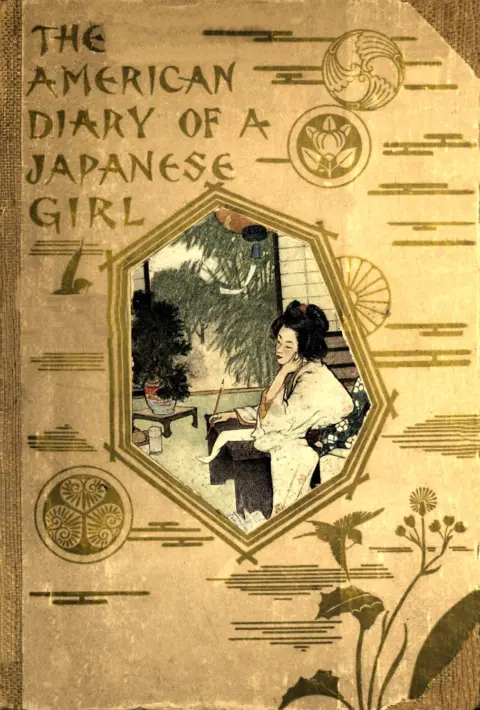
"The American Diary of a Japanese Girl" by Yoné Noguchi is a novel published in 1902. Marketed as the authentic diary of an 18-year-old Japanese visitor named "Miss Morning Glory," it chronicles her transcontinental journey across America with her uncle. From San Francisco's high society to Chicago and New York, she befriends Americans, experiments with various occupations, and offers satirical observations on American life and culture. The novel was actually written by male poet Yoné Noguchi, making it the first English-language novel published in the United States by a Japanese writer.
Introduction adapted from the source catalogue; source summaries may be automatically generated.
Free to read · English · 40,014 words · No account needed
MAKE TIME FOR A GOOD BOOK
On by default. Untick to stop anonymous reading totals. Each page counts after 10 seconds in view. How this works.
Anonymous counting is on unless you have switched it off.
I laughed when I fancied that I sat with my husband—where’s he in the world?—spreading a skilfully ironed linen cloth on the Spring grasses (what a gratifying white and green!), and I upset a teapot over the linen, while he ran after water;—then I picked all the buttercups and covered the dark red stain.
The minister makes a ridiculous show of himself in the dining-room.
His laughter draws the attention of every lady.
This morning he exclaimed: “Americans have no courtesy for strangers,
except meaning money.”
And he finished his speech with his boisterous “Ha, ha, ha!”
A pale impatient lady, like a trembling winter leaf, sitting at the table next to us, shrugged her shoulders and muttered, “Oh, my!”
I hoped I could invent any scheme to make him hasten to his post—Kara or Tenjiku, whatever place it be.
He is good-natured like a rubber stamp.
But I am sorry to say that he does not fit Amerikey.
I was relieved when he announced that his departure would occur
to-morrow.
My dignity was saved.
I cut a square piece of paper. I pencilled on it as follows:
To the Japanese Legation.
The City of Mexico.
Handle Carefully, Easily Broken.
I put it on the large palm of the minister. I warned him that he should never forget to pin it on his breast.
“Mean little thing you are!” he said.
And his great happy “Ha, ha, ha!” followed as usual.
Bye-bye!
The negroes are horrid. I scanned them on the first chance of my life.
What is the standard of beauty of their tribe, I am eager to be
informed!
I searched for “coon” in my dictionary. The explanation was
unsatisfactory.
The ever-so-kind Americans don’t consider them, I am certain, as “animals allied to the bear.”
Tell me what it means.
24th—Spittoon!
The American spittoon is famous, Uncle says.
From every corner in this nine-story hotel—think of its eight hundred and fifty-one rooms!—you are met by the greeting of the spittoon.
How many thousand are there?
It must be a tremendous task to keep them clean as they are.
I wonder why the proprietor doesn’t give the city the benefit of some of
them.
San Francisco ought to place spittoons along the sidewalk.
The ladies wear such a long gaudy skirt.
And it is quite a fashion of modern gents, it appears, to spit on the
pavements.
This Palace Hotel is a palace.
You drop into the toilet room, for instance.
You cannot help exclaiming: “Iya, haya, Japan is three centuries
behind!”
Everything presents to you a silent lecture of scientific modernism.
Your reading position is saved on this browser. Take it to another device with a library code. Reading pages adapt to text, rather than matching a printed edition.
Yoné Noguchi
BEHIND THE BOOK
This eBook is for the use of anyone anywhere in the United States and most other parts of the world at no cost and with almost no restrictions whatsoever. You may copy it, give it away or re-use it under the terms of the Project Gutenberg License included with this eBook or online at www.gutenberg.org. If you are not located in the United States, you will have to check the laws of the country where you are located before using this eBook. Read the source licence.
The original source file, including credits and licence, is retained by this library. Request an original-format copy at no charge. Please include the book title and Project Gutenberg identifier #63256.
KEEP YOUR CURIOSITY GOING
Coulson Kernahan

Maurice Baring
Frances Wright
Cécile Tormay

Frederic Jesup Stimson

W. H. P. (William Henry Pope) Jarvis