THE CLASSIC COLLECTION✦Hawthorne (English Men of Letters Series)CLASSIC FREE BOOKS
Hawthorne (English Men of Letters Series)
Henry James
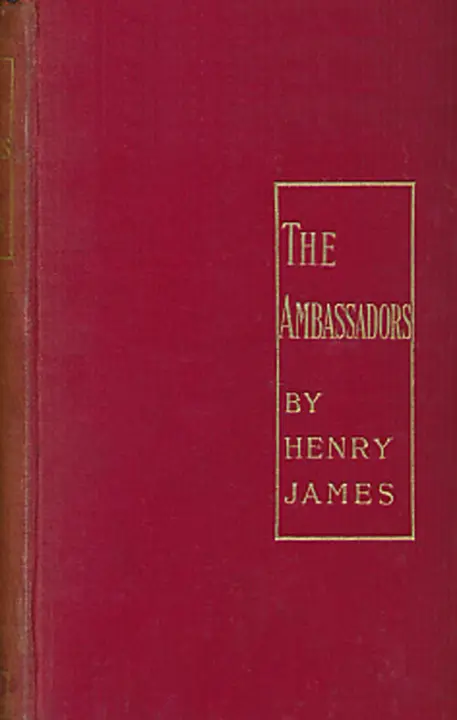
THE CLASSIC COLLECTION · 1903
"The Ambassadors" by Henry James is a novel written in the early 20th century. This work delves into themes of personal transformation and the search for meaning against the backdrop of Europe, particularly Paris, as seen through the eyes of its protagonist, Lambert Strether. He embarks on a journey that challenges his perceptions and ultimately forces him to confront his past and the choices he has made. The opening of "The Ambassadors" introduces us to Lambert Strether as he arrives in Chester, England, to reconnect with his friend Waymarsh. Initially relieved at having a moment of solitude, Strether reflects on the personal freedom he feels in Europe, contrasting it with his previous life in Woollett, Massachusetts. His encounter with Maria Gostrey—a woman he recognizes from a previous meeting—creates a dynamic where he feels both drawn to and apprehensive about the social interactions that await him. The narrative hints at Strether's complexity, revealing that he grapples with deeper emotions and a sense of detachment as he begins to navigate this new social landscape, all while reflecting on the nature of life and missed opportunities.
Introduction adapted from the source catalogue; source summaries may be automatically generated.
Free to read · English · 168,822 words · No account needed
MAKE TIME FOR A GOOD BOOK
On by default. Untick to stop anonymous reading totals. Each page counts after 10 seconds in view. How this works.
Anonymous counting is on unless you have switched it off.
“Oh,” Strether had to admit, “I couldn’t manage that. He’s thrown, as usual, on the world; the world which, after all, by his account—for he has prodigious adventures—seems very good to him. He fortunately—‘over here,’ as he says—finds the world everywhere; and his most prodigious adventure of all,” he went on, “has been of course of the last few days.”
Miss Gostrey, already knowing, instantly made the connexion. “He has seen Marie de Vionnet again?”
“He went, all by himself, the day after Chad’s party—didn’t I tell you?—to tea with her. By her invitation—all alone.”
“Quite like yourself!” Maria smiled.
“Oh but he’s more wonderful about her than I am!” And then as his friend showed how she could believe it, filling it out, fitting it on to old memories of the wonderful woman: “What I should have liked to manage would have been her going.”
“To Switzerland with the party?”
“For Jim—and for symmetry. If it had been workable moreover for a fortnight she’d have gone. She’s ready”—he followed up his renewed vision of her—“for anything.”
Miss Gostrey went with him a minute. “She’s too perfect!”
“She will, I think,” he pursued, “go to-night to the station.”
“To see him off?”
“With Chad—marvellously—as part of their general attention. And she does it”—it kept before him—“with a light, light grace, a free, free gaiety, that may well softly bewilder Mr. Pocock.”
It kept her so before him that his companion had after an instant a friendly comment. “As in short it has softly bewildered a saner man. Are you really in love with her?” Maria threw off.
“It’s of no importance I should know,” he replied. “It matters so little—has nothing to do, practically, with either of us.”
“All the same”—Maria continued to smile—“they go, the five, as I understand you, and you and Madame de Vionnet stay.”
“Oh and Chad.” To which Strether added: “And you.”
“Ah ‘me’!”—she gave a small impatient wail again, in which something of the unreconciled seemed suddenly to break out. “I don’t stay, it somehow seems to me, much to my advantage. In the presence of all you cause to pass before me I’ve a tremendous sense of privation.”
Strether hesitated. “But your privation, your keeping out of everything, has been—hasn’t it?—by your own choice.”
“Oh yes; it has been necessary—that is it has been better for you. What I mean is only that I seem to have ceased to serve you.”
Your reading position is saved on this browser. Take it to another device with a library code. Reading pages adapt to text, rather than matching a printed edition.
Henry James
Henry James
Henry James

Henry James
BEHIND THE BOOK
This eBook is for the use of anyone anywhere in the United States and most other parts of the world at no cost and with almost no restrictions whatsoever. You may copy it, give it away or re-use it under the terms of the Project Gutenberg License included with this eBook or online at www.gutenberg.org. If you are not located in the United States, you will have to check the laws of the country where you are located before using this eBook. Read the source licence.
The original source file, including credits and licence, is retained by this library. Request an original-format copy at no charge. Please include the book title and Project Gutenberg identifier #432.
KEEP YOUR CURIOSITY GOING
Coulson Kernahan

Maurice Baring
Frances Wright
Cécile Tormay

Frederic Jesup Stimson

W. H. P. (William Henry Pope) Jarvis