THE CLASSIC COLLECTION✦Hawthorne (English Men of Letters Series)CLASSIC FREE BOOKS
Hawthorne (English Men of Letters Series)
Henry James
THE CLASSIC COLLECTION · 1903
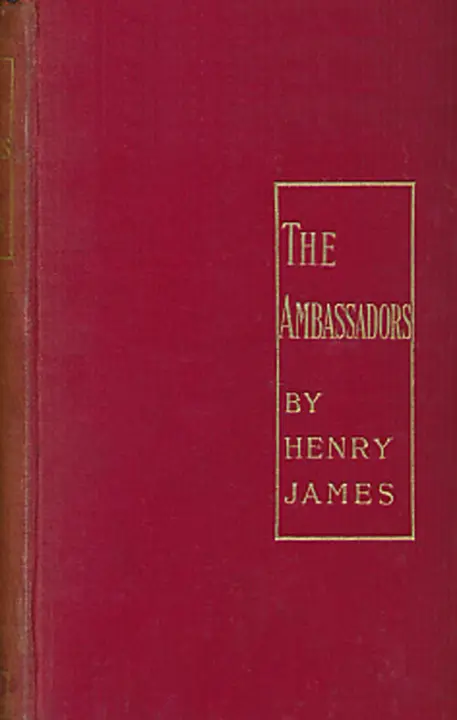
"The Ambassadors" by Henry James is a novel written in the early 20th century. This work delves into themes of personal transformation and the search for meaning against the backdrop of Europe, particularly Paris, as seen through the eyes of its protagonist, Lambert Strether. He embarks on a journey that challenges his perceptions and ultimately forces him to confront his past and the choices he has made. The opening of "The Ambassadors" introduces us to Lambert Strether as he arrives in Chester, England, to reconnect with his friend Waymarsh. Initially relieved at having a moment of solitude, Strether reflects on the personal freedom he feels in Europe, contrasting it with his previous life in Woollett, Massachusetts. His encounter with Maria Gostrey—a woman he recognizes from a previous meeting—creates a dynamic where he feels both drawn to and apprehensive about the social interactions that await him. The narrative hints at Strether's complexity, revealing that he grapples with deeper emotions and a sense of detachment as he begins to navigate this new social landscape, all while reflecting on the nature of life and missed opportunities.
Introduction adapted from the source catalogue; source summaries may be automatically generated.
Free to read · English · 168,822 words · No account needed
MAKE TIME FOR A GOOD BOOK
On by default. Untick to stop anonymous reading totals. Each page counts after 10 seconds in view. How this works.
Anonymous counting is on unless you have switched it off.
But he didn’t, it happened, know the Munsters well enough to give the case much of a lift; so that they were left together as if over the mere laid table of conversation. Her qualification of the mentioned connexion had rather removed than placed a dish, and there seemed nothing else to serve. Their attitude remained, none the less, that of not forsaking the board; and the effect of this in turn was to give them the appearance of having accepted each other with an absence of preliminaries practically complete. They moved along the hall together, and Strether’s companion threw off that the hotel had the advantage of a garden. He was aware by this time of his strange inconsequence: he had shirked the intimacies of the steamer and had muffled the shock of Waymarsh only to find himself forsaken, in this sudden case, both of avoidance and of caution. He passed, under this unsought protection and before he had so much as gone up to his room, into the garden of the hotel, and at the end of ten minutes had agreed to meet there again, as soon as he should have made himself tidy, the dispenser of such good assurances. He wanted to look at the town, and they would forthwith look together. It was almost as if she had been in possession and received him as a guest. Her acquaintance with the place presented her in a manner as a hostess, and Strether had a rueful glance for the lady in the glass cage. It was as if this personage had seen herself instantly superseded.
When in a quarter of an hour he came down, what his hostess saw, what she might have taken in with a vision kindly adjusted, was the lean, the slightly loose figure of a man of the middle height and something more perhaps than the middle age—a man of five-and-fifty, whose most immediate signs were a marked bloodless brownness of face, a thick dark moustache, of characteristically American cut, growing strong and falling low, a head of hair still abundant but irregularly streaked with grey, and a nose of bold free prominence, the even line, the high finish, as it might have been called, of which, had a certain effect of mitigation. A perpetual pair of glasses astride of this fine ridge, and a line, unusually deep and drawn, the prolonged pen-stroke of time, accompanying the curve of the moustache from nostril to chin, did something to complete the facial furniture that an attentive observer would have seen catalogued, on the spot, in the vision of the other party to Strether’s appointment. She waited for him in the garden, the other party, drawing on a pair of singularly fresh soft and elastic light gloves and presenting herself with a superficial readiness which, as he approached her over the small smooth lawn and in the watery English sunshine, he might, with his rougher preparation, have marked as the model for such an occasion. She had, this lady, a perfect plain propriety, an expensive subdued suitability, that her companion was not free to analyse, but that struck him, so that his consciousness of it was instantly acute, as a quality quite new to him. Before reaching her he stopped on the grass and went through the form of feeling for something, possibly forgotten, in the light overcoat he carried on his arm; yet the essence of the act was no more than the impulse to gain time. Nothing could have been odder than Strether’s sense of himself as at that moment launched in something of which the sense would be quite disconnected from the sense of his past and which was literally beginning there and then. It had begun in fact already upstairs and before the dressing glass that struck him as blocking further, so strangely, the dimness of the window of his dull bedroom; begun with a sharper survey of the elements of Appearance than he had for a long time been moved to make. He had during those moments felt these elements to be not so much to his hand as he should have liked, and then had fallen back on the thought that they were precisely a matter as to which help was supposed to come from what he was about to do. He was about to go up to London, so that hat and necktie might wait. What had come as straight to him as a ball in a well-played game—and caught moreover not less neatly—was just the air, in the person of his friend, of having seen and chosen, the air of achieved possession of those vague qualities and quantities that collectively figured to him as the advantage snatched from lucky chances. Without pomp or circumstance, certainly, as her original address to him, equally with his own response, had been, he would have sketched to himself his impression of her as: “Well, she’s more thoroughly civilized—!” If “More thoroughly than whom?” would not have been for him a sequel to this remark, that was just by reason of his deep consciousness of the bearing of his comparison.
Your reading position is saved on this browser. Take it to another device with a library code. Reading pages adapt to text, rather than matching a printed edition.
Henry James
Henry James
Henry James

Henry James
BEHIND THE BOOK
This eBook is for the use of anyone anywhere in the United States and most other parts of the world at no cost and with almost no restrictions whatsoever. You may copy it, give it away or re-use it under the terms of the Project Gutenberg License included with this eBook or online at www.gutenberg.org. If you are not located in the United States, you will have to check the laws of the country where you are located before using this eBook. Read the source licence.
The original source file, including credits and licence, is retained by this library. Request an original-format copy at no charge. Please include the book title and Project Gutenberg identifier #432.
KEEP YOUR CURIOSITY GOING
Coulson Kernahan

Maurice Baring
Frances Wright
Cécile Tormay

Frederic Jesup Stimson

W. H. P. (William Henry Pope) Jarvis