THE CLASSIC COLLECTION✦Hawthorne (English Men of Letters Series)CLASSIC FREE BOOKS
Hawthorne (English Men of Letters Series)
Henry James
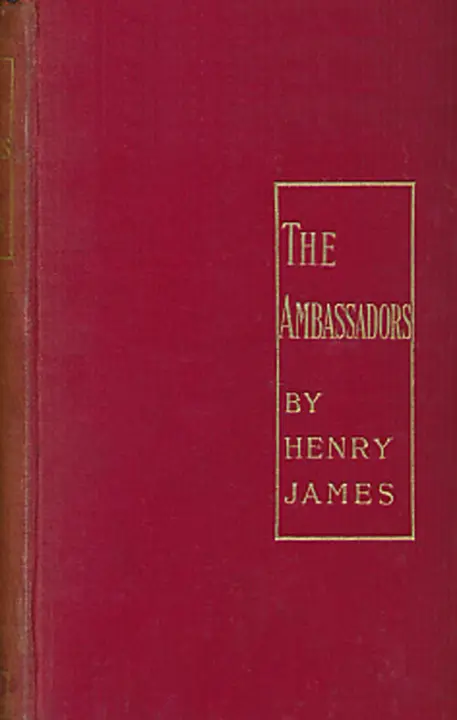
THE CLASSIC COLLECTION · 1903
"The Ambassadors" by Henry James is a novel written in the early 20th century. This work delves into themes of personal transformation and the search for meaning against the backdrop of Europe, particularly Paris, as seen through the eyes of its protagonist, Lambert Strether. He embarks on a journey that challenges his perceptions and ultimately forces him to confront his past and the choices he has made. The opening of "The Ambassadors" introduces us to Lambert Strether as he arrives in Chester, England, to reconnect with his friend Waymarsh. Initially relieved at having a moment of solitude, Strether reflects on the personal freedom he feels in Europe, contrasting it with his previous life in Woollett, Massachusetts. His encounter with Maria Gostrey—a woman he recognizes from a previous meeting—creates a dynamic where he feels both drawn to and apprehensive about the social interactions that await him. The narrative hints at Strether's complexity, revealing that he grapples with deeper emotions and a sense of detachment as he begins to navigate this new social landscape, all while reflecting on the nature of life and missed opportunities.
Introduction adapted from the source catalogue; source summaries may be automatically generated.
Free to read · English · 168,822 words · No account needed
MAKE TIME FOR A GOOD BOOK
On by default. Untick to stop anonymous reading totals. Each page counts after 10 seconds in view. How this works.
Anonymous counting is on unless you have switched it off.
The place itself was a great impression—a small pavilion, clear-faced and sequestered, an effect of polished parquet, of fine white panel and spare sallow gilt, of decoration delicate and rare, in the heart of the Faubourg Saint-Germain and on the edge of a cluster of gardens attached to old noble houses. Far back from streets and unsuspected by crowds, reached by a long passage and a quiet court, it was as striking to the unprepared mind, he immediately saw, as a treasure dug up; giving him too, more than anything yet, the note of the range of the immeasurable town and sweeping away, as by a last brave brush, his usual landmarks and terms. It was in the garden, a spacious cherished remnant, out of which a dozen persons had already passed, that Chad’s host presently met them while the tall bird-haunted trees, all of a twitter with the spring and the weather, and the high party-walls, on the other side of which grave hôtels stood off for privacy, spoke of survival, transmission, association, a strong indifferent persistent order. The day was so soft that the little party had practically adjourned to the open air but the open air was in such conditions all a chamber of state. Strether had presently the sense of a great convent, a convent of missions, famous for he scarce knew what, a nursery of young priests, of scattered shade, of straight alleys and chapel-bells, that spread its mass in one quarter; he had the sense of names in the air, of ghosts at the windows, of signs and tokens, a whole range of expression, all about him, too thick for prompt discrimination.
This assault of images became for a moment, in the address of the distinguished sculptor, almost formidable: Gloriani showed him, in such perfect confidence, on Chad’s introduction of him, a fine worn handsome face, a face that was like an open letter in a foreign tongue. With his genius in his eyes, his manners on his lips, his long career behind him and his honours and rewards all round, the great artist, in the course of a single sustained look and a few words of delight at receiving him, affected our friend as a dazzling prodigy of type. Strether had seen in museums—in the Luxembourg as well as, more reverently, later on, in the New York of the billionaires—the work of his hand; knowing too that after an earlier time in his native Rome he had migrated, in mid-career, to Paris, where, with a personal lustre almost violent, he shone in a constellation: all of which was more than enough to crown him, for his guest, with the light, with the romance, of glory. Strether, in contact with that element as he had never yet so intimately been, had the consciousness of opening to it, for the happy instant, all the windows of his mind, of letting this rather grey interior drink in for once the sun of a clime not marked in his old geography. He was to remember again repeatedly the medal-like Italian face, in which every line was an artist’s own, in which time told only as tone and consecration; and he was to recall in especial, as the penetrating radiance, as the communication of the illustrious spirit itself, the manner in which, while they stood briefly, in welcome and response, face to face, he was held by the sculptor’s eyes. He wasn’t soon to forget them, was to think of them, all unconscious, unintending, preoccupied though they were, as the source of the deepest intellectual sounding to which he had ever been exposed. He was in fact quite to cherish his vision of it, to play with it in idle hours; only speaking of it to no one and quite aware he couldn’t have spoken without appearing to talk nonsense. Was what it had told him or what it had asked him the greater of the mysteries? Was it the most special flare, unequalled, supreme, of the æsthetic torch, lighting that wondrous world for ever, or was it above all the long straight shaft sunk by a personal acuteness that life had seasoned to steel? Nothing on earth could have been stranger and no one doubtless more surprised than the artist himself, but it was for all the world to Strether just then as if in the matter of his accepted duty he had positively been on trial. The deep human expertness in Gloriani’s charming smile—oh the terrible life behind it!—was flashed upon him as a test of his stuff.
Your reading position is saved on this browser. Take it to another device with a library code. Reading pages adapt to text, rather than matching a printed edition.
Henry James
Henry James
Henry James

Henry James
BEHIND THE BOOK
This eBook is for the use of anyone anywhere in the United States and most other parts of the world at no cost and with almost no restrictions whatsoever. You may copy it, give it away or re-use it under the terms of the Project Gutenberg License included with this eBook or online at www.gutenberg.org. If you are not located in the United States, you will have to check the laws of the country where you are located before using this eBook. Read the source licence.
The original source file, including credits and licence, is retained by this library. Request an original-format copy at no charge. Please include the book title and Project Gutenberg identifier #432.
KEEP YOUR CURIOSITY GOING
Coulson Kernahan

Maurice Baring
Frances Wright
Cécile Tormay

Frederic Jesup Stimson

W. H. P. (William Henry Pope) Jarvis