THE CLASSIC COLLECTION✦Hawthorne (English Men of Letters Series)CLASSIC FREE BOOKS
Hawthorne (English Men of Letters Series)
Henry James
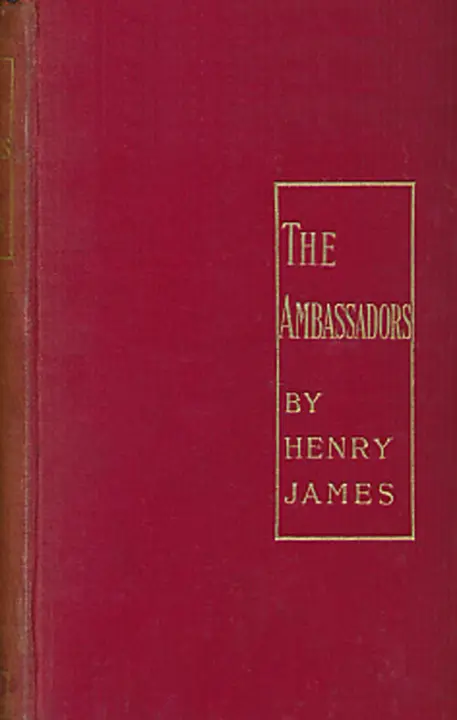
THE CLASSIC COLLECTION · 1903
"The Ambassadors" by Henry James is a novel written in the early 20th century. This work delves into themes of personal transformation and the search for meaning against the backdrop of Europe, particularly Paris, as seen through the eyes of its protagonist, Lambert Strether. He embarks on a journey that challenges his perceptions and ultimately forces him to confront his past and the choices he has made. The opening of "The Ambassadors" introduces us to Lambert Strether as he arrives in Chester, England, to reconnect with his friend Waymarsh. Initially relieved at having a moment of solitude, Strether reflects on the personal freedom he feels in Europe, contrasting it with his previous life in Woollett, Massachusetts. His encounter with Maria Gostrey—a woman he recognizes from a previous meeting—creates a dynamic where he feels both drawn to and apprehensive about the social interactions that await him. The narrative hints at Strether's complexity, revealing that he grapples with deeper emotions and a sense of detachment as he begins to navigate this new social landscape, all while reflecting on the nature of life and missed opportunities.
Introduction adapted from the source catalogue; source summaries may be automatically generated.
Free to read · English · 168,822 words · No account needed
MAKE TIME FOR A GOOD BOOK
On by default. Untick to stop anonymous reading totals. Each page counts after 10 seconds in view. How this works.
Anonymous counting is on unless you have switched it off.
The strolls over Paris to see something or call somewhere were accordingly inevitable and natural, and the late sessions in the wondrous troisième, the lovely home, when men dropped in and the picture composed more suggestively through the haze of tobacco, of music more or less good and of talk more or less polyglot, were on a principle not to be distinguished from that of the mornings and the afternoons. Nothing, Strether had to recognise as he leaned back and smoked, could well less resemble a scene of violence than even the liveliest of these occasions. They were occasions of discussion, none the less, and Strether had never in his life heard so many opinions on so many subjects. There were opinions at Woollett, but only on three or four. The differences were there to match; if they were doubtless deep, though few, they were quiet—they were, as might be said, almost as shy as if people had been ashamed of them. People showed little diffidence about such things, on the other hand, in the Boulevard Malesherbes, and were so far from being ashamed of them—or indeed of anything else—that they often seemed to have invented them to avert those agreements that destroy the taste of talk. No one had ever done that at Woollett, though Strether could remember times when he himself had been tempted to it without quite knowing why. He saw why at present—he had but wanted to promote intercourse.
These, however, were but parenthetic memories, and the turn taken by his affair on the whole was positively that if his nerves were on the stretch it was because he missed violence. When he asked himself if none would then, in connexion with it, ever come at all, he might almost have passed as wondering how to provoke it. It would be too absurd if such a vision as that should have to be invoked for relief; it was already marked enough as absurd that he should actually have begun with flutters and dignities on the score of a single accepted meal. What sort of a brute had he expected Chad to be, anyway?—Strether had occasion to make the enquiry but was careful to make it in private. He could himself, comparatively recent as it was—it was truly but the fact of a few days since—focus his primal crudity; but he would on the approach of an observer, as if handling an illicit possession, have slipped the reminiscence out of sight. There were echoes of it still in Mrs. Newsome’s letters, and there were moments when these echoes made him exclaim on her want of tact. He blushed of course, at once, still more for the explanation than for the ground of it: it came to him in time to save his manners that she couldn’t at the best become tactful as quickly as he. Her tact had to reckon with the Atlantic Ocean, the General Post-Office and the extravagant curve of the globe. Chad had one day offered tea at the Boulevard Malesherbes to a chosen few, a group again including the unobscured Miss Barrace; and Strether had on coming out walked away with the acquaintance whom in his letters to Mrs. Newsome he always spoke of as the little artist-man. He had had full occasion to mention him as the other party, so oddly, to the only close personal alliance observation had as yet detected in Chad’s existence. Little Bilham’s way this afternoon was not Strether’s, but he had none the less kindly come with him, and it was somehow a part of his kindness that as it had sadly begun to rain they suddenly found themselves seated for conversation at a café in which they had taken refuge. He had passed no more crowded hour in Chad’s society than the one just ended; he had talked with Miss Barrace, who had reproached him with not having come to see her, and he had above all hit on a happy thought for causing Waymarsh’s tension to relax. Something might possibly be extracted for the latter from the idea of his success with that lady, whose quick apprehension of what might amuse her had given Strether a free hand. What had she meant if not to ask whether she couldn’t help him with his splendid encumbrance, and mightn’t the sacred rage at any rate be kept a little in abeyance by thus creating for his comrade’s mind even in a world of irrelevance the possibility of a relation? What was it but a relation to be regarded as so decorative and, in especial, on the strength of it, to be whirled away, amid flounces and feathers, in a coupé lined, by what Strether could make out, with dark blue brocade? He himself had never been whirled away—never at least in a coupé and behind a footman; he had driven with Miss Gostrey in cabs, with Mrs. Pocock, a few times, in an open buggy, with Mrs. Newsome in a four-seated cart and, occasionally up at the mountains, on a buckboard; but his friend’s actual adventure transcended his personal experience. He now showed his companion soon enough indeed how inadequate, as a general monitor, this last queer quantity could once more feel itself.
Your reading position is saved on this browser. Take it to another device with a library code. Reading pages adapt to text, rather than matching a printed edition.
Henry James
Henry James
Henry James

Henry James
BEHIND THE BOOK
This eBook is for the use of anyone anywhere in the United States and most other parts of the world at no cost and with almost no restrictions whatsoever. You may copy it, give it away or re-use it under the terms of the Project Gutenberg License included with this eBook or online at www.gutenberg.org. If you are not located in the United States, you will have to check the laws of the country where you are located before using this eBook. Read the source licence.
The original source file, including credits and licence, is retained by this library. Request an original-format copy at no charge. Please include the book title and Project Gutenberg identifier #432.
KEEP YOUR CURIOSITY GOING
Coulson Kernahan

Maurice Baring
Frances Wright
Cécile Tormay

Frederic Jesup Stimson

W. H. P. (William Henry Pope) Jarvis