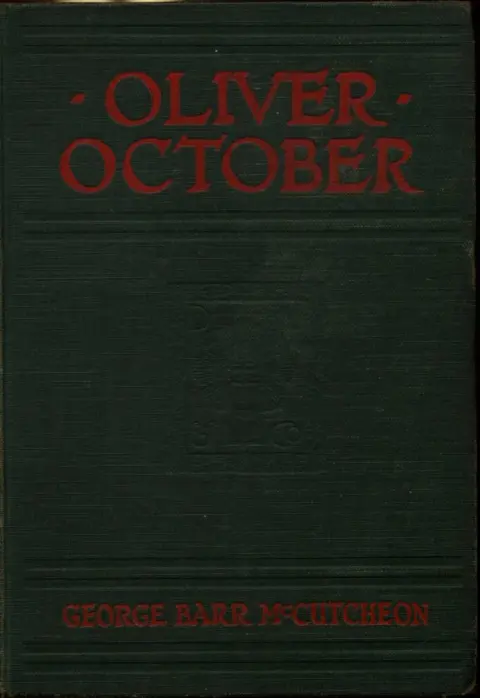
Oliver October
George Barr McCutcheon
THE CLASSIC COLLECTION · 1909
"The Alternative" by George Barr McCutcheon is a novel written in the early 20th century. The story centers around Bosworth Van Pycke, a young man from a distinguished but financially struggling family, who finds himself navigating the complex social circles of New York City. As he attempts to define what it means to be a gentleman in a world where wealth and titles often dictate social standing, the narrative unfolds to explore themes of class, ambition, and the expectations placed upon him by both his father and society. At the start of the novel, we are introduced to a cold, blustery night in New York City, where two elderly gentlemen converse in a club about the weather and the dynamic of their society. Bosworth, the son of Mr. Van Pycke, arrives at the club, serving as a character caught between family expectations and his desire for autonomy. The opening delves into Bosworth's lack of direction and the pressure to marry into wealth as a means of securing his future, setting the stage for the conflicts and comedic misunderstandings that arise from social expectations. Notably, the interaction between Bosworth and his father highlights the generational divide and the absurdities of high society, foreshadowing the humorous and chaotic scenarios to come as Bosworth contemplates marriage amid the blizzard.
Introduction adapted from the source catalogue; source summaries may be automatically generated.
Free to read · English · 29,880 words · No account needed
MAKE TIME FOR A GOOD BOOK
On by default. Untick to stop anonymous reading totals. Each page counts after 10 seconds in view. How this works.
Anonymous counting is on unless you have switched it off.
"I don't know what Laura's game is, but, by Jove, it's ripping, I'll say that for it," said Bosworth, his face beaming. "How many of them are there?" He counted. "Fourteen. Seven spiketails and seven directoires. Great!"
The two gentlemen withdrew to the upper end of the room, to better the effect. From the dining-room, four rooms away, came the more distinct sounds of laughter and conversation.
"There is a real party out there," said Bosworth, rubbing his chin contemplatively. "I wonder what's up?"
Mr. Van Pycke sat down and twirled his thin mustache, first one side and then the other, murmuring "By Jove!" over and over again in a most perplexed way. Bosworth stood, with his chin between finger and thumb, thoughtfully viewing the inanimate group. For several minutes his face indicated the most penetrating contemplation of the exhibit down the room. He was still a trifle dizzy, but in no danger of losing his attitude of sober reflection.
There were blond ladies and brunettes, old ladies and young ones, and some who were neither; all beautifully, elaborately gowned in the latest models from Paris. Their starry glass eyes gazed into space with the same innocuous stare that baffles all attempts to divert it through plate-glass windows. Some were sitting, some were standing. Gentlemen in evening clothes, with monocles or opera hats--mostly plebeian persons, from Eighth Avenue, you'd say--stood vaguely but stanchly in juxtaposition to ladies who paid no heed to them, but who, however, were not unique in their abstraction. Fuzzy-mustached gentlemen were they, with pink cheeks and iron-clad shoulders. They stared intently but not attentively at the chandeliers or the wall-paper, unwinking gallants who seemed only conscious of their clothes.
The effect was startling, even grewsome. For five minutes Bosworth surveyed the waxy, over-dressed group in profound silence, cudgeling his brain for a key to the puzzling exhibition.
"For the life of me," he said at last, "I can't understand it."
"I understand it perfectly," said his father, still somewhat dismayed by the steady gaze of the last pair of blue eyes he had encountered. "Mrs. Scoville is ordering some new gowns, and the--er--modistes have sent up samples. Perfectly clear to me."
"I suppose she's ordering a few suits of men's garments--garments is what they say in the clothing stores--to lend variety to her wardrobe," said Bosworth, dryly.
Mr. Van Pycke coughed indulgently. "Bosworth, you shouldn't take so many
cocktails before--"
"Yes, father," interrupted Bosworth, humbly. "I quite agree with you. For a while I thought it might be the cocktails, but now that you see them, too, I am very much relieved."
"I am very sorry to see a son of mine--"
Your reading position is saved on this browser. Take it to another device with a library code. Reading pages adapt to text, rather than matching a printed edition.
George Barr McCutcheon
George Barr McCutcheon
George Barr McCutcheon
George Barr McCutcheon
BEHIND THE BOOK
This eBook is for the use of anyone anywhere in the United States and most other parts of the world at no cost and with almost no restrictions whatsoever. You may copy it, give it away or re-use it under the terms of the Project Gutenberg License included with this eBook or online at www.gutenberg.org. If you are not located in the United States, you will have to check the laws of the country where you are located before using this eBook. Read the source licence.
The original source file, including credits and licence, is retained by this library. Request an original-format copy at no charge. Please include the book title and Project Gutenberg identifier #43071.
KEEP YOUR CURIOSITY GOING
Coulson Kernahan

Maurice Baring
Frances Wright
Cécile Tormay

Frederic Jesup Stimson

W. H. P. (William Henry Pope) Jarvis