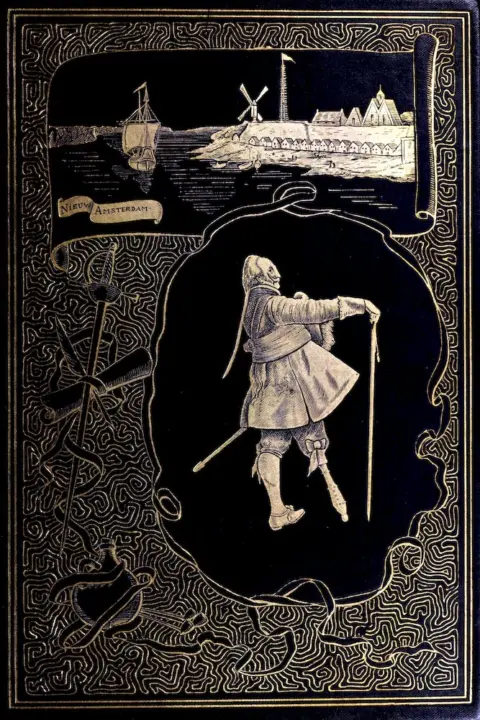
Knickerbocker’s history of New York, vol. 2 (of 2)
Washington Irving
THE CLASSIC COLLECTION · 1800
"The Alhambra" by Washington Irving is a collection of essays and tales written in the early 19th century. The work reflects Irving's deep affection for the Alhambra, a stunning Moorish palace in Granada, Spain, capturing the beauty of its architecture, gardens, and rich history through personal observations and enchanting folklore. Though there are no conventional protagonists, Irving himself emerges as a central figure, as he recounts his journey and experiences within this culturally rich setting. At the start of the narrative, Irving sets the stage for his travels in Spain, describing the rugged and majestic landscape that surrounds the Alhambra. He introduces readers to his companion from the Russian Embassy as they embark on their expedition from Seville to Granada. The opening sections present vivid descriptions of the Spanish scenery, the solitary and resilient nature of the landscape, and the cultural customs that shape the experiences of the travelers. He vividly portrays the stark contrasts between the barren wilderness and lush valleys, the intriguing characters met along the journey, and the foreboding presence of banditti in the region. Through these observations, Irving lays the groundwork for a romantic exploration of the Alhambra and its legendary past, inviting readers into the tales and historical accounts that swirl around this iconic location.
Introduction adapted from the source catalogue; source summaries may be automatically generated.
Free to read · English · 109,130 words · No account needed
MAKE TIME FOR A GOOD BOOK
On by default. Untick to stop anonymous reading totals. Each page counts after 10 seconds in view. How this works.
Anonymous counting is on unless you have switched it off.
It was now completely dark; we were passing through the barranco, where stood the cross of the murdered muleteer, when I beheld a number of lights moving at a distance, and apparently advancing up the ravine. On nearer approach, they proved to be torches borne by a train of uncouth figures arrayed in black: it would have been a procession dreary enough at any time, but was peculiarly so in this wild and solitary place.
Mateo drew near, and told me, in a low voice, that it was a funeral train bearing a corpse to the burying-ground among the hills.
As the procession passed by, the lugubrious light of the torches, falling on the rugged features and funeral weeds of the attendants, had the most fantastic effect, but was perfectly ghastly, as it revealed the countenance of the corpse, which according to the Spanish custom, was borne uncovered on an open bier. I remained for some time gazing after the dreary train as it wound up the dark defile of the mountain. It put me in mind of the old story of a procession of demons bearing the body of a sinner up the crater of Stromboli.
"Ah! Señor," cried Mateo, "I could tell you a story of a procession once seen among these mountains, but then you'd laugh at me, and say it was one of the legacies of my grandfather the tailor."
"By no means, Mateo. There is nothing I relish more than a marvellous
tale."
"Well, Señor, it is about one of those very men we have been talking of, who gather snow on the Sierra Nevada.
"You must know, that a great many years since, in my grandfather's time, there was an old fellow, Tio Nicolo [Uncle Nicholas] by name, who had filled the panniers of his mule with snow and ice, and was returning down the mountain. Being very drowsy, he mounted upon the mule, and soon falling asleep, went with his head nodding and bobbing about from side to side, while his surefooted old mule stepped along the edge of precipices, and down steep and broken barrancos, just as safe and steady as if it had been on plain ground. At length Tio Nicolo awoke, and gazed about him, and rubbed his eyes--and, in good truth, he had reason. The moon shone almost as bright as day, and he saw the city below him, as plain as your hand, and shining with its white buildings, like a silver platter, in the moonshine; but, Lord! Señor, it was nothing like the city he had left a few hours before! Instead of the cathedral, with its great dome and turrets, and the churches with their spires, and the convents with their pinnacles, all surmounted with the blessed cross, he saw nothing but Moorish mosques, and minarets, and cupolas, all topped off with glittering crescents, such as you see on the Barbary flags. Well, Señor, as you may suppose, Tio Nicolo was mightily puzzled at all this, but while he was gazing down upon the city, a great army came marching up the mountains, winding along the ravines, sometimes in the moonshine, sometimes in the shade. As it drew nigh, he saw that there were horse and foot, all in Moorish armour. Tio Nicolo tried to scramble out of their way, but his old mule stood stock still, and refused to budge, trembling at the same time, like a leaf,--for dumb beasts, Señor, are just as much frightened at such things as human beings. Well, Señor, the hobgoblin army came marching by; there were men that seemed to blow trumpets, and others to beat drums and strike cymbals, yet never a sound did they make; they all moved on without the least noise, just as I have seen painted armies move across the stage in the theatre of Granada, and all looked as pale as death. At last, in the rear of the army, between two black Moorish horsemen, rode the Grand Inquisitor of Granada, on a mule as white as snow. Tio Nicolo wondered to see him in such company, for the Inquisitor was famous for his hatred of Moors, and, indeed, of all kinds of Infidels, Jews, and heretics, and used to hunt them out with fire and scourge. However, Tio Nicolo felt himself safe, now that there was a priest of such sanctity at hand. So making the sign of the cross, he called out for his benediction, when, hombre! he received a blow that sent him and his old mule over the edge of a steep bank, down which they rolled, head-over-heels, to the bottom! Tio Nicolo did not come to his senses until long after sunrise, when he found himself at the bottom of a deep ravine, his mule grazing beside him, and his panniers of snow completely melted. He crawled back to Granada sorely bruised and battered, but was glad to find the city looking as usual, with Christian churches and crosses. When he told the story of his night's adventure, every one laughed at him; some said he had dreamed it all, as he dozed on his mule; others thought it all a fabrication of his own; but what was strange, Señor, and made people afterwards think more seriously of the matter, was, that the Grand Inquisitor died within the year. I have often heard my grandfather, the tailor, say, that there was more meant by that hobgoblin army bearing off the resemblance of the priest, than folks dared to surmise."
Your reading position is saved on this browser. Take it to another device with a library code. Reading pages adapt to text, rather than matching a printed edition.
Washington Irving
William Irving & Washington Irving & James Kirke Paulding
Washington Irving
Washington Irving
BEHIND THE BOOK
This eBook is for the use of anyone anywhere in the United States and most other parts of the world at no cost and with almost no restrictions whatsoever. You may copy it, give it away or re-use it under the terms of the Project Gutenberg License included with this eBook or online at www.gutenberg.org. If you are not located in the United States, you will have to check the laws of the country where you are located before using this eBook. Read the source licence.
The original source file, including credits and licence, is retained by this library. Request an original-format copy at no charge. Please include the book title and Project Gutenberg identifier #49872.
KEEP YOUR CURIOSITY GOING
Wilfrid Scawen Blunt
Wilfrid Scawen Blunt

E. W. (Edgar Watson) Howe

David Patterson (Spirit) Hatch

David Patterson (Spirit) Hatch

David Patterson (Spirit) Hatch