THE CLASSIC COLLECTION✦Nigeria and its tin fieldsCLASSIC FREE BOOKS
Nigeria and its tin fields
Albert Frederick Calvert
THE CLASSIC COLLECTION · 1907
"The Alhambra" by Albert Frederick Calvert is a historical account written in the early 20th century. The work serves as a comprehensive exploration of the Alhambra, a palace and fortress complex in Granada, Spain, detailing its architectural significance and the historical context of the Arabian conquest of the Iberian Peninsula. The book aims to provide readers with an illustrated souvenir of the Alhambra, showcasing its artistic brilliance and the legacy of Moorish culture in Spain. The opening of "The Alhambra" sets the scene with a Spanish rhyme praising both Seville and Granada. It introduces the book's purpose, revealing the author's intention to create a succinct and visually appealing record of the Alhambra's history and artistry for tourists and enthusiasts alike. Calvert discusses his difficulties in sourcing high-quality illustrations, ultimately relying on both his own photography and contributions from various artists and historians. He emphasizes the merging of visual beauty and historical depth, capturing the allure and enchantment of the Alhambra as a premier symbol of Moorish architecture and culture.
Introduction adapted from the source catalogue; source summaries may be automatically generated.
Free to read · English · 41,614 words · No account needed
MAKE TIME FOR A GOOD BOOK
On by default. Untick to stop anonymous reading totals. Each page counts after 10 seconds in view. How this works.
Anonymous counting is on unless you have switched it off.
a most beautiful Mosaic dado, as perfect as when originally executed, and which seems to be imperishable. It is formed of baked clay, squeezed into moulds of the different figures, glazed on the surface, and bevelled slightly on the edge. Thus, when necessary, the Mosaics were not only easily withdrawn from the moulds, but, when united, they formed a key for the mortar. In this particular recess, doubtless, was the throne of
the Moorish kings, as indicated both by the inscriptions on the walls, and the extraordinary care bestowed upon the decoration of the recess.
The Mosaic dados present a great variety in their patterns, the
combinations being endless.
“The colours of blue, red, and gold are still to be seen on the capital of the column of the centre window of the Hall, but no traces of gold, or any colour, have been discovered
on the shaft. The same thing occurs in the Court of the Fish-pond and the Court of the Lions, but, in each case, the harmony of the colouring appears to require that they should be gilt. It is probable that in the restorations which the Palace underwent during the residence of the Spanish kings, it was found much more easy to remove the gold from the columns, exposing the white marble, than to incur the expense of re-
gilding.” Such is the opinion of the famous decorative artist, Owen Jones; but the fondness of the Oriental for the spotless purity of marble, and the transparency of alabaster, so oft expressed in the inscriptions, forbids its acceptance.
In the several alcoves, or divans, which surround the Hall, the walls are covered with plaster ornaments in relief, presenting the greatest variety; the patterns in each divan being different.
Beneath this Golden Saloon is a network of dungeon-like passages, by which, it is said, Sultáns escaped in treasonable revolts, when angry scimitars were glittering in the fountain-courts, or when the incensed populace were tossing their threatening spears in the humming city below. Here is also a prison-cell sort of room, with whispering holes at each end, which
Philip the Second built to amuse the wretched child, Don Carlos. Also a vaulted cellar, where some rude sculpture has been immured by the prudish monks.
The exquisite façade of this Court is much disfigured by a modern gallery. From the portions which remain, however, the general design may be traced with tolerable certainty.
The inscriptions are few and unimportant, consisting, for the most part, of the constantly-recurring motto: “There is no Conqueror but God,” and some verses from the Koran.
Your reading position is saved on this browser. Take it to another device with a library code. Reading pages adapt to text, rather than matching a printed edition.
Albert Frederick Calvert
Albert Frederick Calvert
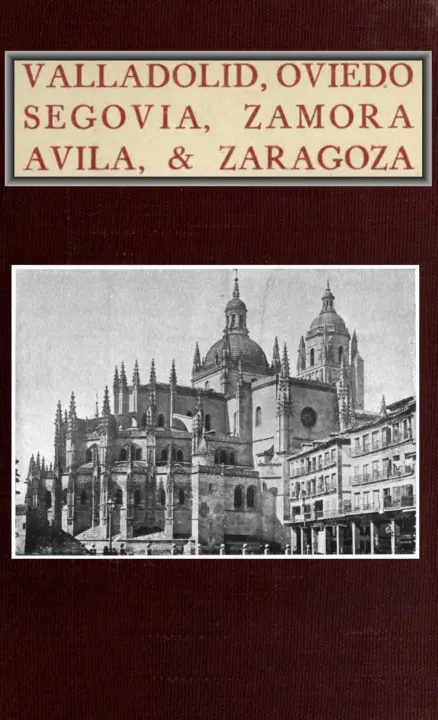
Albert Frederick Calvert

Albert Frederick Calvert
BEHIND THE BOOK
This eBook is for the use of anyone anywhere in the United States and most other parts of the world at no cost and with almost no restrictions whatsoever. You may copy it, give it away or re-use it under the terms of the Project Gutenberg License included with this eBook or online at www.gutenberg.org. If you are not located in the United States, you will have to check the laws of the country where you are located before using this eBook. Read the source licence.
The original source file, including credits and licence, is retained by this library. Request an original-format copy at no charge. Please include the book title and Project Gutenberg identifier #64822.
KEEP YOUR CURIOSITY GOING
Cécile Tormay

Moritz Busch
John L. Ransom
Frances Wright
Cécile Tormay

Mabel Potter Daggett