
Letters from Switzerland
Samuel Irenæus Prime
THE CLASSIC COLLECTION · 1873
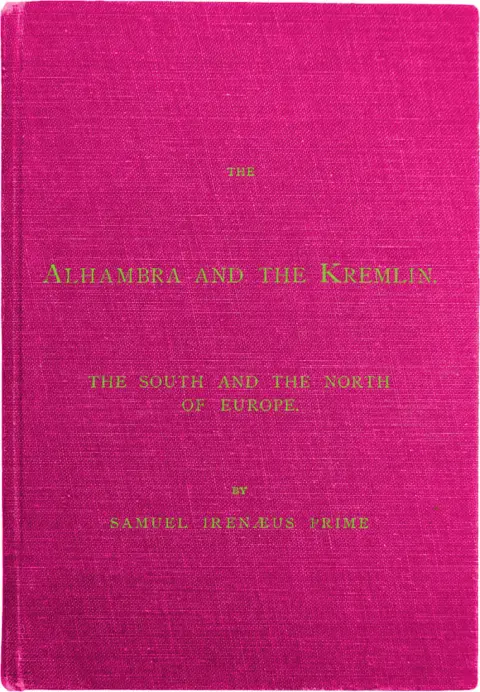
"The Alhambra and the Kremlin: The South and the North of Europe" by Samuel Irenæus Prime is a travel narrative written in the late 19th century. This work presents a comparative exploration of the cultural and historical contexts of two iconic structures: the Alhambra in Spain, representing Southern Europe, and the Kremlin in Russia, symbolizing the North. The narrative aims to provide readers with a vivid portrayal of life in these regions, emphasizing the distinct characteristics and legacies left by their historical inhabitants. At the start of the narrative, Prime settles into an inn near the Alhambra, reflecting on the storied history and enduring beauty of the Moorish palace. He remarks on its romanticized descriptions and aims to provide an authentic account of Spanish life. His observations extend to the cultural richness of Granada, evoking imagery of the Sierra Nevada mountains and the local agriculture that persists despite modern advancements. He contrasts past glories with the current state of Spain, emphasizing a sense of nostalgia for the cultural vibrancy once present under Moorish rule. As he narrates his experiences, it sets the stage for deeper explorations of both the Alhambra and other significant locations in both Spain and Scandinavia, promising insights into their histories and contemporary identities.
Introduction adapted from the source catalogue; source summaries may be automatically generated.
Free to read · English · 149,423 words · No account needed
MAKE TIME FOR A GOOD BOOK
On by default. Untick to stop anonymous reading totals. Each page counts after 10 seconds in view. How this works.
Anonymous counting is on unless you have switched it off.
“These men” she said; “but I ought to say, you men, are so squeamish; you faint at the sight of a little blood; what would you do in a fight, a real battle with bullets and brains flying all about you and men bleeding to death by hundreds, if you can’t bear to see a bull cut down or a horse ripped up. Why, I saw a horse run all about the bull-ring with his entrails trailing on the ground, and a bull with his hamstrings cut, and making splendid fight on his knees. You must go and see it; now there’s my husband, poor fellow, he ought not to go to such places, it doesn’t agree with him!”
“Well, I would rather have you describe a fight,” said I, “than to go and see it. I have no particular taste for blood, but any thing would be agreeable that you would undertake to describe.”
“Thank you. You have seen the ring; every city in Spain has its bull-ring: a circular theatre, open to the sky, with seats rising from the arena in the centre. The seats on the east and southerly quarters are covered to protect the grandees, while the multitude sitting in the sun hold fans before their faces or take it as it comes. This ring will seat some fifteen to twenty thousand people, and a gayer, grander sight it is rare to see, than these bright-colored, dressy people; the women are the most beautiful in the world; they are far handsomer than American women, you know they are, don’t you?”
“Perhaps so, present company excepted, and one or two others: but pray go on,—I am more anxious to hear of bulls than women.”
“A blast of trumpets sounds the hour for the spectacle to begin, and the eager shout of the multitude shows their impatience to see the fun. A great show precedes, the magistrates riding in with a troop to give something like dignity to the occasion, and when they have swept around the circle and retired, the spectators sit in breathless silence. Two mounted men, called picadors, ride in, each with a long spear at rest, and take their position, some fifty feet in front of the gateway through which the beasts are to enter. All things being ready, and the breathless throng thirsting for the fray, the huge door unfolds, and a fierce bull dashes into the arena. The multitude greet him with a shout of ecstasy. He makes straight upon the picadors, if he is a bull of spirit. There’s a great difference in the animals; some of them go scouring all around the ring, head down and tail up, pursued by the picador; but a real bull of Navarre—they are the fiercest and pluckiest—pitches right ahead for the first enemy he sees. The horseman levels his lance to meet the tremendous monster as he comes; sometimes catches him on the shoulder, and the blood spouts from the wound. But he does not stop for trifles. It takes more than a scratch to stop a good bull; he rushes on and sometimes buries the iron deeper in his flesh, or tosses it off, and catching the horse on his horns, hoists him and his rider into the air, and as they come down in a heap, he drives on to meet other antagonists lying in wait, and ready to do him mischief. The very last time I was there, it was this sight that made my husband sick; the horse scrambled up, and actually went trotting around the ring, when there was more of him outside than in, he was so terribly ripped open by that one lunge of those splendid horns. I was in hopes that the bull would beat the whole of them; now he met the men on foot, with red cloaks on their arms, which they shake to attract the excited gentleman’s attention. He sees them and bears down gallantly upon them like a Monitor or a Miantonomoh, and the wily chulos, or cloakers, leap dexterously to one side, and sometimes they jump over the barriers among the spectators, where they have been followed by the raging bull himself. This is not often, however. He has still another set of fighters to drive out of the ring. These are the banderilleros, who throw fiery darts into the bull’s neck; these darts are provided with a powder squib which explodes when it strikes in the flesh, and puts his majesty into a horrid rage: by this time, the bull, hunted by all these foes, charging upon one and speared by another, is becoming exhausted, or the spectators are wearied with the sameness of the fight, and want a new victim. The matador, or chief butcher, then enters the field in a full court dress, with a scarlet robe in one hand and a sharp stiletto in the other. He brandishes the red skirt to draw the bull on, and as he comes he aims a stab at his neck, and, if he is a master at his work, takes him in the right spot, and the huge fellow falls dead at his victor’s feet. Once I saw the matador miss his aim, the bull wheeled suddenly, one horn took him in the side, and he went over the head of the bull and came down a mangled corpse. Then a shout went up as if to shake the skies. I felt badly myself, but these Spanish people seemed to relish it amazingly, and I suppose they get used to it. But the bull generally gets the worst of it. When he has had the finishing stroke, a team of mules is driven in, the dead beast is hitched on by a hook and chain and drawn out rapidly, and the ring is clear for another fight. All this has not taken half an hour, and a similar scene is repeated until four, five, or six bulls, and often as many horses, are killed.
Your reading position is saved on this browser. Take it to another device with a library code. Reading pages adapt to text, rather than matching a printed edition.
Samuel Irenæus Prime
BEHIND THE BOOK
This eBook is for the use of anyone anywhere in the United States and most other parts of the world at no cost and with almost no restrictions whatsoever. You may copy it, give it away or re-use it under the terms of the Project Gutenberg License included with this eBook or online at www.gutenberg.org. If you are not located in the United States, you will have to check the laws of the country where you are located before using this eBook. Read the source licence.
The original source file, including credits and licence, is retained by this library. Request an original-format copy at no charge. Please include the book title and Project Gutenberg identifier #65004.
KEEP YOUR CURIOSITY GOING
Wilfrid Scawen Blunt
Wilfrid Scawen Blunt

E. W. (Edgar Watson) Howe
Cécile Tormay

Moritz Busch
John L. Ransom