THE CLASSIC COLLECTION✦The WesternersCLASSIC FREE BOOKS
The Westerners
Stewart Edward White
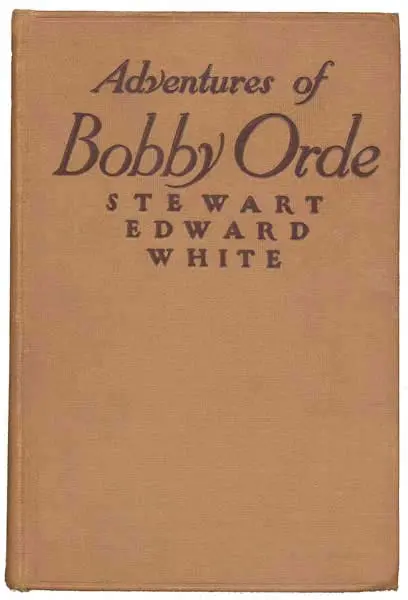
THE CLASSIC COLLECTION · 1911
"The Adventures of Bobby Orde" by Stewart Edward White is a novel written in the early 20th century. This coming-of-age story follows a young boy named Bobby Orde as he navigates childhood adventures, friendships, and the complexities of growing up amidst the backdrop of river life and logging activities. The narrative is rich with details of early 20th-century life, showcasing Bobby’s innocent curiosity and the imaginative world he inhabits. At the start of the book, Bobby Orde is introduced as a vibrant, inquisitive boy, enchanted by the workings of the river and the lumber industry where his father works. His journey begins when he explores his father’s office and the nearby lumber yards, revealing his fascination with the equipment and the bustling life that surrounds him. Bobby’s adventures take him to the booms where logs are collected and sorted, where he experiences the thrill of the water and nature’s wonders. He is accompanied by his dog, Duke, and later befriends a charming girl named Celia, setting the stage for explorations that blur the lines between play, discovery, and early emotional experiences. These formative encounters hint at the deeper themes of friendship and childlike wonder that will unfold throughout the story.
Introduction adapted from the source catalogue; source summaries may be automatically generated.
Free to read · English · 65,104 words · No account needed
MAKE TIME FOR A GOOD BOOK
On by default. Untick to stop anonymous reading totals. Each page counts after 10 seconds in view. How this works.
Anonymous counting is on unless you have switched it off.
Mr. Daggett took the box without replying; and, opening it, tested with his finger the quality and colour of what it had contained.
"I guess so," said he.
He led the way to one of the shelves and opened a can as big as a
bucket. Bobby gasped.
"My!" he cried; "will you ever use all that?"
Mr. Daggett nodded, and, dipping a broad-bladed knife, brought up, on merely its point, enough to fill Bobby's tin box.
"How much is it?" asked Bobby.
"Let's see, you're Jack Orde's little boy, aren't you?" asked Daggett.
"Yes, sir."
"Well, that's all right, then. It's nothing."
"Oh, thank you!" cried Bobby, overwhelmed. The man nodded his massive head. "Please," ventured Bobby, hesitating, "please, would you mind if I stay a little while and watch?"
"'Course not," assured Mr. Daggett. "Stay as long as you want."
He returned to his table and forgot the little boy. An hour later he looked up. Bobby was still there standing in the middle of the floor, staring with all his might. Mr. Daggett pulled together his great frame and arose.
"Have you a printing press?" he asked Bobby.
"Yes, sir," replied Bobby--"it's only a little one--to print two lines,"
he added.
"Do you like printing?"
"Oh!" burst out Bobby enthusiastically, "it's more fun than anything!"
"I'd like to see some of your work," said Mr. Daggett a flash of amusement flickering in his deep eyes.
Bobby felt in his pocket and gravely presented a card.
"Mr. Robert Orde.
Job Printer."
"Why," said Mr. Daggett, surprised, "this is pretty well done. I didn't know you could make ready so well on those little presses."
"What's 'make ready'?" asked Bobby.
"Why, regulating the impression so that all the letters are printed
evenly."
"They didn't for a long time," sighed Bobby. "I had lots of trouble."
"How did you make it go?" asked Mr. Daggett, interested.
Bobby explained the pasting of the slips of paper.
"Who taught you that?" asked Mr. Daggett sharply.
"Nobody; I just thought of it."
Two hours later, when the noon whistles blew, Bobby said good-bye to his friend after a most interesting morning. Mr. Daggett had showed him everything. He explained how in the type-cases the capital letters occupied little compartments all alike and at the top, but how the small letters were arranged arbitrarily in various-sized compartments.
"You see," said he, "we use the e oftenest, so that is the largest and is right in the middle. And here is the a near it, but a little smaller. A man has to learn where they are."
Your reading position is saved on this browser. Take it to another device with a library code. Reading pages adapt to text, rather than matching a printed edition.
Stewart Edward White
Stewart Edward White
Stewart Edward White
Stewart Edward White
BEHIND THE BOOK
This eBook is for the use of anyone anywhere in the United States and most other parts of the world at no cost and with almost no restrictions whatsoever. You may copy it, give it away or re-use it under the terms of the Project Gutenberg License included with this eBook or online at www.gutenberg.org. If you are not located in the United States, you will have to check the laws of the country where you are located before using this eBook. Read the source licence.
The original source file, including credits and licence, is retained by this library. Request an original-format copy at no charge. Please include the book title and Project Gutenberg identifier #25506.
KEEP YOUR CURIOSITY GOING
Coulson Kernahan

Maurice Baring
Frances Wright
Cécile Tormay

Frederic Jesup Stimson

W. H. P. (William Henry Pope) Jarvis