An Ambitious Woman: A Novel
Edgar Fawcett
THE CLASSIC COLLECTION · 1883
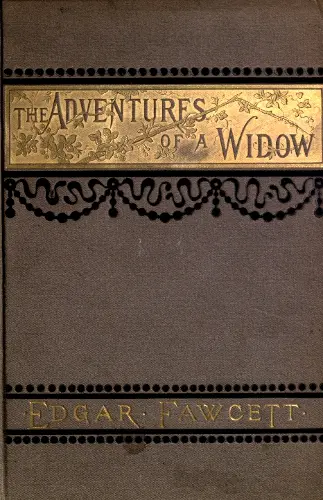
"The Adventures of a Widow: A Novel" by Edgar Fawcett is a fiction narrative likely written in the late 19th century. The story's central focus revolves around Pauline Van Corlear, a young woman navigating the complexities of society after marrying a significantly older gentleman, Mr. Hamilton Varick. As she transitions from girlhood to widowhood, the narrative seemingly explores themes of independence, societal expectations, and personal transformation. The opening of the novel sets the stage in New York, describing the shifting character of Bond Street, once a bastion of old-world gentility now beset by commercialism. Mr. Varick, a wealthy man returned from Paris, marries eighteen-year-old Pauline, who feels the weight of societal pressure to secure her future through marriage. In the initial chapters, we see Pauline’s internal conflict as she reconciles her ambitions with the constraints imposed by her social world, setting up a storyline rich in both character development and commentary on the era's societal norms. Her early interactions, especially with her cousin Courtlandt and her husband Varick, hint at her struggles with personal desires versus societal expectations.
Introduction adapted from the source catalogue; source summaries may be automatically generated.
Free to read · English · 67,822 words · No account needed
MAKE TIME FOR A GOOD BOOK
On by default. Untick to stop anonymous reading totals. Each page counts after 10 seconds in view. How this works.
Anonymous counting is on unless you have switched it off.
"Oh, but they are so different!" exclaimed the fat Miss Upton. "One is the work of Gawd, to delight man, and the other is--oh, dear! the other is--well, it's only a mere dead body! None of the great poets have ever written in that dreadful style, Mr. Trevor. Of course, I know that Mr. Corson has done some powerful work, but is it right to give people the shudders and horrors, as he does? Why not have sunshine in poetry, instead of gloom and misery?"
"Sunshine is commonplace," said Arthur Trevor.
"Very," said Mr. Corson.
"Sunshine means hope," declared Leander Prawle. "It means evolution,
development, progress."
"Art is art!" cried Trevor. "Sing of what you please, so long as your technique is good, so long as you have the right chic, the right facon, the right way of putting things!"
"True," said Corson. "I write of skulls and corpses because you can get new effects out of them. They haven't been done to death, like faith, and philanthropy, and freedom. Optimism is so tiresome, nowadays. All the Greeks are dead. Notre Dame stands intact, but the Parthenon is a ruin."
Leander Prawle shivered. "You can make clever rhymes about charnel-houses," he said, "but that is not poetry. You can deplore the allurements of women with green eyes and stony hearts, but you degrade womanhood while you do so. You"--
"Are you not bored?" whispered Kindelon, in his mellow Irish brogue to Pauline, as he just then stole to her side. "If so, let us walk away together."
Pauline slipped her hand into his proffered arm. "I was not bored," she said, as they moved off, "but I was just beginning to be. Are there nothing but belligerent poets here to-night?"
"Oh, you will find other sorts of people."
"But, who are these three wranglers, Mr. Trevor, Mr. Prawle, and Mr.
Corson?"
Kindelon laughed. "They are fanatics," he said. "Each one believes
himself a Milton in ability."
"Are they successful?"
"They send poems (with stamps inclosed) to the magazines, and have them rejected. They make believe to despise the magazines, but secretly they would give worlds to see their names in print. Heaven knows, the magazines print rubbish enough. But they are sensible in rejecting Arthur Trevor's poems, which are something in this style--I quote from memory:--
"'The hot, fierce tiger-lily madly yearns
To kill with passionate poison the wild moth
That reels in drunken ecstasy above
Its gorgeous bosom....'
"Or in rejecting that bald-pated posing Corson's trash, which runs like
this:--
Your reading position is saved on this browser. Take it to another device with a library code. Reading pages adapt to text, rather than matching a printed edition.
Edgar Fawcett
Frank R. Stockton & Edgar Fawcett & Franklin Fyles & Anna Katharine Green & Henry Harland & Ingersoll Lockwood & Joaquin Miller & Kirk Munroe & Brainard Gardner Smith & Maurice Thompson & A. C. (Andrew Carpenter) Wheeler
Edgar Fawcett
BEHIND THE BOOK
This eBook is for the use of anyone anywhere in the United States and most other parts of the world at no cost and with almost no restrictions whatsoever. You may copy it, give it away or re-use it under the terms of the Project Gutenberg License included with this eBook or online at www.gutenberg.org. If you are not located in the United States, you will have to check the laws of the country where you are located before using this eBook. Read the source licence.
The original source file, including credits and licence, is retained by this library. Request an original-format copy at no charge. Please include the book title and Project Gutenberg identifier #37185.
KEEP YOUR CURIOSITY GOING
Coulson Kernahan

Maurice Baring
Frances Wright
Cécile Tormay

Frederic Jesup Stimson

W. H. P. (William Henry Pope) Jarvis