An Ambitious Woman: A Novel
Edgar Fawcett
THE CLASSIC COLLECTION · 1883
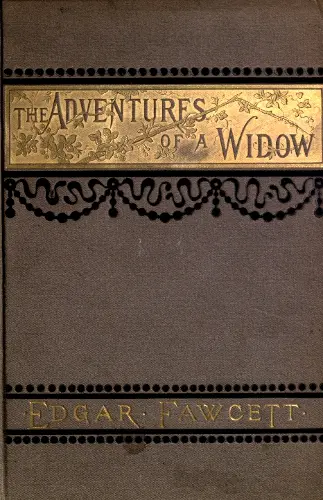
"The Adventures of a Widow: A Novel" by Edgar Fawcett is a fiction narrative likely written in the late 19th century. The story's central focus revolves around Pauline Van Corlear, a young woman navigating the complexities of society after marrying a significantly older gentleman, Mr. Hamilton Varick. As she transitions from girlhood to widowhood, the narrative seemingly explores themes of independence, societal expectations, and personal transformation. The opening of the novel sets the stage in New York, describing the shifting character of Bond Street, once a bastion of old-world gentility now beset by commercialism. Mr. Varick, a wealthy man returned from Paris, marries eighteen-year-old Pauline, who feels the weight of societal pressure to secure her future through marriage. In the initial chapters, we see Pauline’s internal conflict as she reconciles her ambitions with the constraints imposed by her social world, setting up a storyline rich in both character development and commentary on the era's societal norms. Her early interactions, especially with her cousin Courtlandt and her husband Varick, hint at her struggles with personal desires versus societal expectations.
Introduction adapted from the source catalogue; source summaries may be automatically generated.
Free to read · English · 67,822 words · No account needed
MAKE TIME FOR A GOOD BOOK
On by default. Untick to stop anonymous reading totals. Each page counts after 10 seconds in view. How this works.
Anonymous counting is on unless you have switched it off.
Pauline gave an irritated sigh. As she did so the door of Mrs. Dares's house was opened by a spruce-looking young negress, and they both passed into the little limited hall beyond. Tapestries of tasteful design were looped back from the small doors which gave upon the hall. Their blended stuffs of different colors produced a novel effect, wholly disproportioned to the real worth of the fabrics themselves. The deft skill of Mrs. Dares's younger daughter was responsible, not alone for these, but for other equally happy embellishments throughout this delightful miniature dwelling. In every chamber there was to be found some pretty decorative stratagem whereby a maximum of graceful and even brilliant ornamentation had been won from a minimum of pecuniary expense. Pauline's eye had swept too many costly objects of upholstery not to recognize that a slender purse had here gone with a keen artistic sense. The true instinct of beauty seemed never to err, and its constant accompaniment of simplicity in the way of actual material lent it a new charm. Screen, rug, panelling, mantel-cover, tidy, and chair-cushion took for her a quick value because of their being wrought through no luxurious means. It was so easy to buy all these things in velvet, in silk, in choice woods; it was so hard, so rare, to be able to plan them all from less pretentious resources. Before she had been five minutes in Mrs. Dares's abode, Pauline found herself affected by the mingled attractiveness and modesty of its details, as we are allured by the tints, contours, and even perfumes of certain wildflowers which glow only the more sweetly because of their contrast with cultured blooms.
Mrs. Dares herself had a look not unlike that of some timid little wildflower. She was short of stature and very fragile; Kindelon's past accounts of her incessant accomplishments took the hue of fable as Pauline gazed upon her. She was extremely pale, with large, warm, dark eyes set in a face of cameo-like delicacy. Her dress hung in folds about her slight person, as if there had been some pitying motive in the looseness of its fit. But she wore it with an air of her own. It was a timid air, and yet it was one of ease and repose. The intelligence and earnestness of her clear-cut face gave her an undeniable dignity; you soon became sure that she was wholly unassuming, but you as soon realized that this trait of diffidence had no weakness in mind or character for its cause. It seemed, in truth, to correspond with her bodily frailty, and to make her individualism more complete while none the less emphatic. The personality that pushes itself upon our heed does not always make us notice it the quickest. Mrs. Dares never pushed herself upon anybody's heed, yet she was seldom unnoticed. Her voice rarely passed beyond a musical semitone, and yet you rarely failed to catch each word it uttered. Pauline not only caught each word, as her new hostess now stood and addressed her, leaving for the time all other guests who were crowding the rather meagre apartments, but she tacitly decided, as well, that there was an elegance and purity in the expressions used by this notable little lady which some of the grander-mannered dames whom she had intimately known might have copied with profit. One peculiarity about Mrs. Dares, however, was not slow to strike her: the pale, delicate face never smiled. Not that it was melancholy or even uncheerful, but simply serious. Mrs. Dares had no sense of humor. She could sometimes say a witty thing that bit hard and sharp, but she was without any power to wear that lazier mental fatigue-dress from which some of the most vigorous minds have been unable, before hers, to win the least relaxation. This was probably the true reason why her small drawing-room often contained guests whose eccentricity of garb or deportment would otherwise have excluded them from her civilities. She could not enjoy the foibles of her fellow-creatures; she was too perpetually busy in taking a grave view of their sterner and more rational traits. She found something in nearly everybody that interested her, and it always interested her because it was human, solemn, important--a part, so to speak, of the great struggle, the great development, the great problem. This may, after all, be no real explanation of why she never smiled; for a smile, as we know, can hold the sadness of tears in its gleam, just as a drop of morning dew will hold the moisture of the autumn rainfall. But the absence of all mirthful trace on her gentle lips accorded, nevertheless, with the inherent sobriety of her nature, and they who got to know her well would unconsciously assign for both a common origin.
Your reading position is saved on this browser. Take it to another device with a library code. Reading pages adapt to text, rather than matching a printed edition.
Edgar Fawcett
Frank R. Stockton & Edgar Fawcett & Franklin Fyles & Anna Katharine Green & Henry Harland & Ingersoll Lockwood & Joaquin Miller & Kirk Munroe & Brainard Gardner Smith & Maurice Thompson & A. C. (Andrew Carpenter) Wheeler
Edgar Fawcett
BEHIND THE BOOK
This eBook is for the use of anyone anywhere in the United States and most other parts of the world at no cost and with almost no restrictions whatsoever. You may copy it, give it away or re-use it under the terms of the Project Gutenberg License included with this eBook or online at www.gutenberg.org. If you are not located in the United States, you will have to check the laws of the country where you are located before using this eBook. Read the source licence.
The original source file, including credits and licence, is retained by this library. Request an original-format copy at no charge. Please include the book title and Project Gutenberg identifier #37185.
KEEP YOUR CURIOSITY GOING
Coulson Kernahan

Maurice Baring
Frances Wright
Cécile Tormay

Frederic Jesup Stimson

W. H. P. (William Henry Pope) Jarvis