An Ambitious Woman: A Novel
Edgar Fawcett
THE CLASSIC COLLECTION · 1883
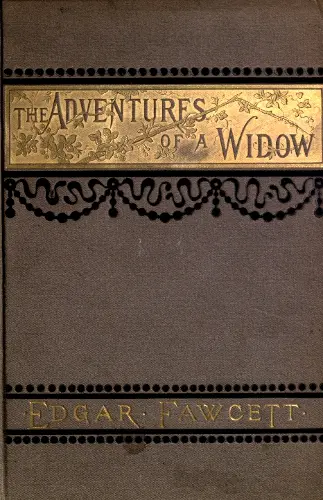
"The Adventures of a Widow: A Novel" by Edgar Fawcett is a fiction narrative likely written in the late 19th century. The story's central focus revolves around Pauline Van Corlear, a young woman navigating the complexities of society after marrying a significantly older gentleman, Mr. Hamilton Varick. As she transitions from girlhood to widowhood, the narrative seemingly explores themes of independence, societal expectations, and personal transformation. The opening of the novel sets the stage in New York, describing the shifting character of Bond Street, once a bastion of old-world gentility now beset by commercialism. Mr. Varick, a wealthy man returned from Paris, marries eighteen-year-old Pauline, who feels the weight of societal pressure to secure her future through marriage. In the initial chapters, we see Pauline’s internal conflict as she reconciles her ambitions with the constraints imposed by her social world, setting up a storyline rich in both character development and commentary on the era's societal norms. Her early interactions, especially with her cousin Courtlandt and her husband Varick, hint at her struggles with personal desires versus societal expectations.
Introduction adapted from the source catalogue; source summaries may be automatically generated.
Free to read · English · 67,822 words · No account needed
MAKE TIME FOR A GOOD BOOK
On by default. Untick to stop anonymous reading totals. Each page counts after 10 seconds in view. How this works.
Anonymous counting is on unless you have switched it off.
"It is stronger than ever," Pauline asseverated. She folded her hands in her lap and tried to look excessively firm and resolute. She was always particularly handsome when she tried to look thus; she was just slender and feminine enough in type to make the assumption of strength, of determination, especially becoming.
"Ah, very well," replied Kindelon, with one of his richly expressive smiles. "Then I have a proposition to make you. It concerns an immediate course of action on your part. Have you ever heard of Mrs. Hagar Williamson Dares?"
Pauline burst into a laugh. "No. It sounds more like an affirmation than a name--'Mrs. Hagar Williamson Dares.' One feels like saying, 'Does she?' Don't think me irredeemably trifling, and please continue. Please tell me, I mean, what remarkable things has this remarkably-named lady done?"
"Nothing."
Pauline's face, full of a pleased anticipation, fell. "Nothing! How
tiresome!"
"I mean nothing remarkable," Kindelon went on, "in the luminously intellectual sense. And yet she is a very extraordinary woman. At twenty-five she was divorced from her husband."
Pauline shook her head troubledly. "That does not sound at all
promising."
"He was a dissolute wretch. The courts easily granted her a release from him. At this time she was almost penniless. The question, as she had two little children, naturally arose: 'How are we three to live?' She had been reared in a New England home; her dead father had been a man of extensive learning, and at one time the principal of a successful school. Hagar had always had 'a taste for writing,' as we call it. She began by doing criticisms for a New York journal of rather scholarly tendency, whose editor had combined pity for her almost starving condition with appreciation of her undoubted talents. But the prices that the poor struggling young mother received were necessarily very meagre. She became practical. She asked herself if there was no other way of earning money by her pen. She soon discovered a way; it did not require her to know about Diderot and Strauss and Spinoza, with all of whose writings (and with many classics more of equal fame) she was finely familiar; it simply required that she should lay aside every vestige of literary pride and write practically. Good Heavens! what a word that word 'practical' is in literature! You must tell the people how to bake a pie, to cure a headache, to bleach a shirt, to speak the truth, to clean silverware, to make a proposal of marriage. Mrs. Dares did it in country letters, in city letters, in newspaper editorials, in anonymous fine-print columns, in the back parts of fashion and household magazines--and she does it still. For a number of years past she has superintended a periodical of the popular sort, which I dare say you have never heard of. The amount of work that she accomplishes is enormous. A strong man would stagger under it, but this frail woman (you'll think her frail when you see her) bears it with wondrous endurance. Her life has been a terrible failure, looked at from one point of view--for it is scarcely exaggeration to say that had she not been handicapped by poverty in the beginning she might have swayed and charmed her generation with great books. But from another point of view her life has been a sublime success; she has trampled all aspiration under foot, forsworn every impulse of honorable egotism, and toiled for the maintenance of a home, for the education of her two daughters. They are both grown up, now--girls who are themselves bread-winners like their mother, and bearing their yoke of labor as cheerfully, though not with the same splendid strength, as she. One is a school-teacher in a well-known kindergarten here, and one has become an artist of no contemptible ability. Meanwhile Mrs. Dares has not merely established a pleasant and refined household; she has caused to be diffused from it, as a social centre, the warm radiations of a sweet, wholesome hospitality. Like some of the high-born Fifth Avenue leaders of fashion, she has her 'evenings.' But they are of a totally different character. They are not 'select;' I don't claim that grace for them. And yet they are very interesting, very typical. Some shabby people meet there--shabby, I mean, in mental ways no less than in character and costume. But the prevailing element is of a higher order than they. Anyone whom Mrs. Dares believes to be an earnest worker in the field of letters will have no difficulty about gaining her favor. I think she would rather greet in her rooms some threadbare young poet who had published at his own expense a slim little volume of poems possessing distinct merit and having received the snubs of both critics and public, than welcome some rich and successful writer whose real claim upon recognition she honestly doubted. And for this reason she makes mistakes. I have no doubt she is aware of making them. When we search the highways and hedges for cases of deserving charity, we cannot but light upon at least an occasional impostor--to put the matter as optimistically as possible. And now let me tell you that if my mighty explanatory outburst has roused your desire to meet Mrs. Dares, the opportunity to do so lies well within your reach."
Your reading position is saved on this browser. Take it to another device with a library code. Reading pages adapt to text, rather than matching a printed edition.
Edgar Fawcett
Frank R. Stockton & Edgar Fawcett & Franklin Fyles & Anna Katharine Green & Henry Harland & Ingersoll Lockwood & Joaquin Miller & Kirk Munroe & Brainard Gardner Smith & Maurice Thompson & A. C. (Andrew Carpenter) Wheeler
Edgar Fawcett
BEHIND THE BOOK
This eBook is for the use of anyone anywhere in the United States and most other parts of the world at no cost and with almost no restrictions whatsoever. You may copy it, give it away or re-use it under the terms of the Project Gutenberg License included with this eBook or online at www.gutenberg.org. If you are not located in the United States, you will have to check the laws of the country where you are located before using this eBook. Read the source licence.
The original source file, including credits and licence, is retained by this library. Request an original-format copy at no charge. Please include the book title and Project Gutenberg identifier #37185.
KEEP YOUR CURIOSITY GOING
Coulson Kernahan

Maurice Baring
Frances Wright
Cécile Tormay

Frederic Jesup Stimson

W. H. P. (William Henry Pope) Jarvis