An Ambitious Woman: A Novel
Edgar Fawcett
THE CLASSIC COLLECTION · 1883
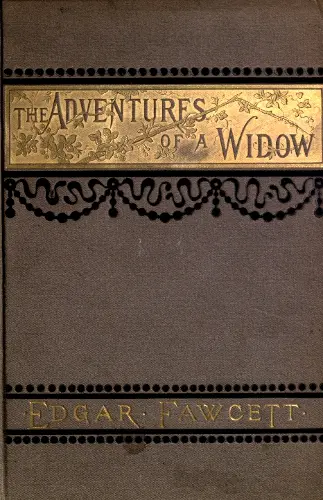
"The Adventures of a Widow: A Novel" by Edgar Fawcett is a fiction narrative likely written in the late 19th century. The story's central focus revolves around Pauline Van Corlear, a young woman navigating the complexities of society after marrying a significantly older gentleman, Mr. Hamilton Varick. As she transitions from girlhood to widowhood, the narrative seemingly explores themes of independence, societal expectations, and personal transformation. The opening of the novel sets the stage in New York, describing the shifting character of Bond Street, once a bastion of old-world gentility now beset by commercialism. Mr. Varick, a wealthy man returned from Paris, marries eighteen-year-old Pauline, who feels the weight of societal pressure to secure her future through marriage. In the initial chapters, we see Pauline’s internal conflict as she reconciles her ambitions with the constraints imposed by her social world, setting up a storyline rich in both character development and commentary on the era's societal norms. Her early interactions, especially with her cousin Courtlandt and her husband Varick, hint at her struggles with personal desires versus societal expectations.
Introduction adapted from the source catalogue; source summaries may be automatically generated.
Free to read · English · 67,822 words · No account needed
MAKE TIME FOR A GOOD BOOK
On by default. Untick to stop anonymous reading totals. Each page counts after 10 seconds in view. How this works.
Anonymous counting is on unless you have switched it off.
Mrs. Poughkeepsie lifted her brow in surprise. She almost lifted her august shoulders as well. "Then pray what are you, my dear?" she asked.
"Their hostess--and their equal," asserted Pauline. She spoke with momentary seriousness, but immediately afterward she chose to assume an air of careless raillery.
"Ah, Aunt Cynthia," she went on, "you don't know how you make me envy
you!"
"Envy me, Pauline?"
"Oh, yes; you have settled matters so absolutely. You have no misgivings, no distrusts. You are so magnificently secure."
"I don't understand," politely faltered Mrs. Poughkeepsie. She looked
inquiringly at Courtlandt.
"It is metaphysics," Courtlandt at once said. "They are a branch of study in which Pauline has made great progress." His face remained so completely placid and controlled that he might have been giving the number of a residence or recording the last quotation in stocks.
Sallie had become absorbed in staring here and there, just as her mother had been a brief while ago; Mrs. Poughkeepsie was at a little distance from her niece; Courtlandt stood close at Pauline's side, so that the latter could ask him, in an undertone full of curt, covert imperiousness,--
"Did you come here to say and do rude things?"
"I never say nor do rude things if I can help it," he answered, with a leaden stolidity in his own undertone.
"Why did they come?" continued Pauline, lowering her voice still more.
"You invited them, I believe. That is, at least, my impression."
"I mentioned the affair. I never imagined they would wish to come."
"You see that you were mistaken. If I had been you I wouldn't have given them the awful opportunity."
"What awful opportunity?" queried Pauline, furtively bristling.
"Of coming," said Courtlandt.
"My dear Pauline," here broke in Mrs. Poughkeepsie, "shall you not
present anybody to us?"
"Anyone whom you please to meet, Aunt," responded Pauline.
"But, my dear, we please to meet anyone. We have no preferences. How
can we have?"
"This is torment," thought poor Pauline. She glanced toward Courtlandt, but she might as well have appealed to one of her chairs. "What shall I do?" her thoughts sped fleetly on. "This woman and this girl would shock and repel whomever I should bring to them. It would be like introducing the North Pole and the South."
But her face revealed no sign of her perplexity. She quietly put her hand within Courtlandt's arm. "Come, Court," she said, with a very creditable counterfeit of gay sociality, "let us find a few devotees for Aunt Cynthia and Sallie."
"We shall find a good many," said Courtlandt, as they moved away. "Have
no fear of that."
Your reading position is saved on this browser. Take it to another device with a library code. Reading pages adapt to text, rather than matching a printed edition.
Edgar Fawcett
Frank R. Stockton & Edgar Fawcett & Franklin Fyles & Anna Katharine Green & Henry Harland & Ingersoll Lockwood & Joaquin Miller & Kirk Munroe & Brainard Gardner Smith & Maurice Thompson & A. C. (Andrew Carpenter) Wheeler
Edgar Fawcett
BEHIND THE BOOK
This eBook is for the use of anyone anywhere in the United States and most other parts of the world at no cost and with almost no restrictions whatsoever. You may copy it, give it away or re-use it under the terms of the Project Gutenberg License included with this eBook or online at www.gutenberg.org. If you are not located in the United States, you will have to check the laws of the country where you are located before using this eBook. Read the source licence.
The original source file, including credits and licence, is retained by this library. Request an original-format copy at no charge. Please include the book title and Project Gutenberg identifier #37185.
KEEP YOUR CURIOSITY GOING
Coulson Kernahan

Maurice Baring
Frances Wright
Cécile Tormay

Frederic Jesup Stimson

W. H. P. (William Henry Pope) Jarvis