THE CLASSIC COLLECTION✦A dead man’s diaryCLASSIC FREE BOOKS
A dead man’s diary
Coulson Kernahan
THE CLASSIC COLLECTION · 1812
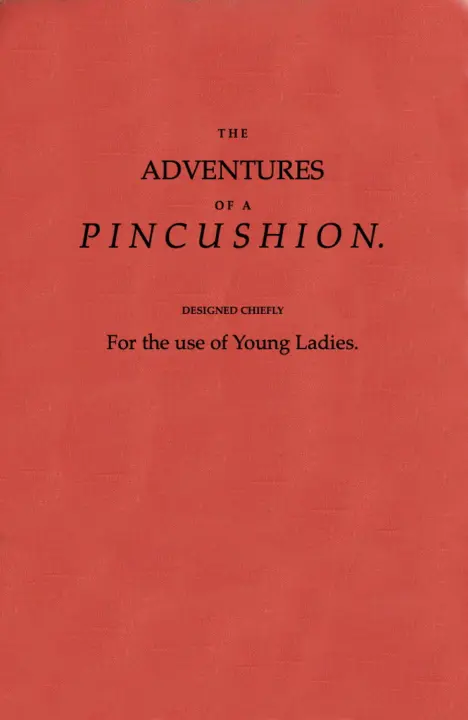
"The Adventures of a Pincushion, Designed Chiefly for the Use of Young Ladies" is a children's fictional narrative written in the late 18th or early 19th century. The story is crafted to entertain and instruct young readers, particularly young girls, offering moral lessons through the amusing events that befall a sentient pincushion. As such, it is a whimsical exploration of childhood experiences and domestic life. At the start of the story, we meet Mrs. Airy and her two daughters, Martha and Charlotte, who engage in sewing and sibling antics. Martha successfully completes a pincushion, setting the stage for the pincushion's adventures as it narrates its own experiences from a first-person perspective. The opening introduces themes of family relationships, responsibility, and proper behavior, especially for young girls, providing an engaging mix of lightheartedness and moral instruction that characterizes the book's approach to education through storytelling.
Introduction adapted from the source catalogue; source summaries may be automatically generated.
Free to read · English · 18,530 words · No account needed
MAKE TIME FOR A GOOD BOOK
On by default. Untick to stop anonymous reading totals. Each page counts after 10 seconds in view. How this works.
Anonymous counting is on unless you have switched it off.
“Presently, Madam.” But still she thought she would give it another twirl. “You shall not go if you have not finished your morning business!” “In a minute I will!” And so she simply idled away her time, without heeding her mamma’s admonition, till near an hour beyond her usual time of beginning. This put her into such a hurry to finish when she found it was so late, that she stitched some wristbands she was about, and which were intended for her grandpapa, so very badly, they were obliged to be undone; which made her so cross, that in pulling out the work, she broke the threads of the cloth, and entirely spoiled it. Charlotte was a very fair complexioned pretty girl; but you cannot imagine how ugly her ill-humour made her appear; nor how much more agreeable her sister looked, who was much browner, was pitted with the small pox, and a much plainer child. I surveyed them both as I lay on the table, where my Mistress had placed me to stick her pins as she took out of the shirt collar which she was putting on; Martha looked so placid and cheerful, and seemed to speak so kindly when she asked a question, that it made her really charming; while Charlotte, who had a very pretty mouth, and very regular features, stuck out her lips in a manner so unbecoming, and tossed about her head with such very illiberal jirks that she lost all natural advantages in her wilful ill-humour.
A person happening to call on Mrs. Airy, to speak about some particular business, she left the children to attend him; and Martha, who pitied her sister’s distress, and saw the impossibility of her finishing the task she was ordered to do, very kindly offered to assist her, without which, she never could have accomplished it. But their mamma at her return, immediately suspected the case to be as I have told you, and inquired what help Charlotte had received in her absence? They were both girls of too much honour to deny the truth, and in consequences of her frankly owning her sister’s kindness, Mrs. Airy, permitted her to retire; in order to prepare for the intended expedition; but alas! poor Charlotte, who indeed was not always so good as she ought to have been, was not to go that morning, although her mamma had consented to it. Betty, who came to put on her frock, was not very fond of her, for she was sometimes apt, when her mamma was not in the way, to speak very haughtily, and in a manner quite unbecoming a young lady. Unfortunately she forgot herself on the present occasion, and very rudely said, “You must come and dress me, and you must make haste, or I shall not be ready.” “Must I?” replied Betty, “That is if I please, Miss Charlotte, though you, forgot to put that in, and unless you speak in a prettier way, I will not help you at all.” “Then you may let it alone, for I will not ask you any otherwise,” and away she went, banging the door after her, to call her sister, who was ready and waiting for the coach in her mamma’s room. Martha ran directly, and began to pin her frock as she desired. But a new distress arose, for as she was too careless ever to retain any of my fellow-servants (commonly called a Pincushion) in her service, so she had not one pin to proceed with after three, which had stuck at one end of me, had been employed. Neither of them chose to apply to Betty, because they were sure from Charlotte’s ill-behaviour to be denied: and she would not permit her sister to ask her mamma, for fear of an inquiry which might not turn out to her credit. So, in short, they both traversed the room backwards and forwards, and were quite overjoyed when they found two, (one of which proved to be crooked) between the joining of the floor. Then they each returned and took me up repeatedly, and examined me over and over, though they were convinced I had been empty long ago. At last, a loud rap at the door announced Mrs. Gardner’s arrival. The ladies were called, and Martha obeyed, though with reluctance to leave her sister: and Charlotte, with conscious shame, and remorse for her past conduct, and heart-heaving sobs of disappointment, saw them drive away without her. I was left upon the table in the hurry of my mistress’s departure, and Charlotte took me up, and earnestly wished she had had a pincushion of her own: and so I should think would any one who had experienced the want of such a useful companion; though unless well furnished with pins, it is in itself but of little assistance, as—she had but too unfortunately found. The slatternly appearance, and real inconvenience, which many ladies suffer from neglecting to provide themselves with and retaining a few such necessary implements of female œconomy about them, is really inconceivable by any person accustomed to a proper degree of attention. Trifles are frequently regarded by the giddy and thoughtless as of no moment, when essentials are taken care of: but it is the repetition of trifles which constitutes the chief business of our existence. In other words, people form their opinion of a young lady from her personal appearance; and if, because she is at work, and in want of pins, and destitute of a Pincushion, she has quite undressed herself, and her cloaths are dropping off, she will be thought a negligent slattern; which, I suppose, is what no one would chuse to be esteemed: so, when children accustom themselves to loll their elbows, stoop their heads, stand upon one foot, bite their nails, or any other ungraceful actions, it makes them disagreeable, and the object of dislike to all their friends, and every one who is acquainted with them. And it is very foolish to imagine, that because they are not in company with strangers it does not signify; for ill-habits, when once they are acquired, are very difficult to leave off; and by being used to do an impolite action frequently, they will do it without recollecting the impropriety; when if they thought, perhaps, they would have on no account been guilty of it.
Your reading position is saved on this browser. Take it to another device with a library code. Reading pages adapt to text, rather than matching a printed edition.
BEHIND THE BOOK
This eBook is for the use of anyone anywhere in the United States and most other parts of the world at no cost and with almost no restrictions whatsoever. You may copy it, give it away or re-use it under the terms of the Project Gutenberg License included with this eBook or online at www.gutenberg.org. If you are not located in the United States, you will have to check the laws of the country where you are located before using this eBook. Read the source licence.
The original source file, including credits and licence, is retained by this library. Request an original-format copy at no charge. Please include the book title and Project Gutenberg identifier #63541.
KEEP YOUR CURIOSITY GOING
Coulson Kernahan

Maurice Baring
Frances Wright
Cécile Tormay

Frederic Jesup Stimson

W. H. P. (William Henry Pope) Jarvis