
The New Glutton or Epicure
Horace Fletcher
THE CLASSIC COLLECTION · 1898
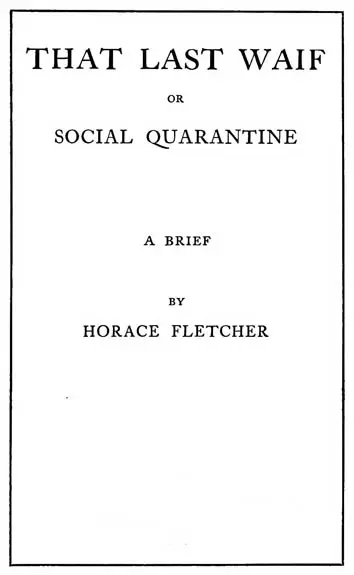
"That Last Waif; or, Social Quarantine" by Horace Fletcher is a social reform treatise written in the early 20th century. The work advocates for improved care and protection for neglected children, arguing that society must enact a "social quarantine" to shield these vulnerable individuals from harmful environments and influences. The author highlights the tragic fate of a young, neglected child he encounters, illustrating the pressing need for systemic change in how society treats its least fortunate members. At the start of the book, the narrative unfolds in the context of heightened patriotism during the Spanish-American War, juxtaposing the fervor for distant humanitarian efforts with the dire conditions faced by the neglected children in urban America. Fletcher shares a poignant encounter with a young boy, a "waif," who pleads for mercy from a policeman, revealing the harsh realities of life on the streets. This incident serves as a catalyst for Fletcher’s call to action, highlighting both the societal neglect faced by children and the potential for a comprehensive reform system that could redeem them and shape them into good citizens. Through his observations and arguments, Fletcher critiques the current societal norms and suggests that a collective, organized effort could address the root causes of neglect and crime, rather than merely treating their symptoms.
Introduction adapted from the source catalogue; source summaries may be automatically generated.
Free to read · English · 34,906 words · No account needed
MAKE TIME FOR A GOOD BOOK
On by default. Untick to stop anonymous reading totals. Each page counts after 10 seconds in view. How this works.
Anonymous counting is on unless you have switched it off.
And, on the other hand, what has man to do in the sphere of mother efficiency, in keeping with the demands of a rational division of labor, than to furnish the support required, and, in himself, show a worthy example of the potency of mother influence?
"In the great seaport city of Hamburg--of all sorts of cities the one likeliest to prove an omnium gatherum of the human refuse brought by ships from all over the world, I lived a whole week without seeing a beggar, a tramp, or a drunkard; and what is true of Germany is more true of Japan."--Julian Ralph.
During the preparation of this appeal for organized effort to establish Perfect Social Quarantine, the writer has enjoyed the advice and example of numerous workers in the field of child-saving and child-training, both in Chicago, where the incident which led to the appeal occurred, and in other sections of the country, representing various and extreme conditions of opportunity, need and experiment. Among them we wish especially to mention Mr. Hastings H. Hart, general secretary, National Conference of Charities and Correction, with headquarters at Chicago; Miss Julia G. Fox, director of the West Division Kindergarten, Chicago; Miss Eva B. Whitmore, general superintendent, and Miss Estelle Taylor, secretary, Chicago Free Kindergarten Association and Kindergarten Normal Department, Armour Institute of Technology, Chicago; Mr. Michel Heymann, superintendent, Jewish Orphan Asylum, New Orleans, La.; Mrs. Mollie E. Moore Davis, New Orleans; Miss Mary F. Ledyard, supervisor of Kindergartens, Los Angeles, Cal.; Colonel George McC. Derby, United States Engineer Corps, in charge of Lower Mississippi Levee District (now, August, 1898, at Santiago de Cuba), New Orleans; Mr. William S. Harbert, president Forward Movement, and Mrs. Harbert, Lake Geneva, Wis., and Evanston, Ill.; Rev. Dr. George W. Gray, in charge of the Forward Movement schools and charities, Chicago; Mr. Hugh K. Wagner, attorney-at-law, St. Louis, Mo.; Mr. and Mrs. Charles S. McCoy, actively interested in the rescue and cure of crippled waifs, Chicago; Mr. Myron M. Marsh, Chicago; the examples of the National Cash Register Company, Dayton, Ohio, and of the N. O. Nelson Manufacturing Company, St. Louis, Mo.; Miss Amalie Hofer, editor of Kindergarten Magazine, official organ of the Kindergarten Department of the National Education Association, Chicago; Mrs. Lucretia Williard Treat, Grand Rapids, Mich.; Colin A. Scott, Ph.D., professor of psychology and child-study, Cook County Normal School, Chicago; teachers of classes at Hull House, Chicago, whose Mæcenas, guardian and manager is Miss Jane Addams; Hon. William J. Van Patten, Burlington, Vt.; Mr. Clarence A. Hough, Indianapolis, Ind.; Mr. Clarence F. Low, president of the Charity Organization Society, New Orleans, La.; General Roeliff Brinkerhoff, Mansfield, Ohio; and Hon. C. C. Bonney, organizer and president of the Auxiliary Congress of the World's Columbian Exposition, in charge of the World's Parliament of Religions.
Your reading position is saved on this browser. Take it to another device with a library code. Reading pages adapt to text, rather than matching a printed edition.
Horace Fletcher

Horace Fletcher
Horace Fletcher
Horace Fletcher
BEHIND THE BOOK
This eBook is for the use of anyone anywhere in the United States and most other parts of the world at no cost and with almost no restrictions whatsoever. You may copy it, give it away or re-use it under the terms of the Project Gutenberg License included with this eBook or online at www.gutenberg.org. If you are not located in the United States, you will have to check the laws of the country where you are located before using this eBook. Read the source licence.
The original source file, including credits and licence, is retained by this library. Request an original-format copy at no charge. Please include the book title and Project Gutenberg identifier #44997.
KEEP YOUR CURIOSITY GOING
Cécile Tormay

Moritz Busch
John L. Ransom
Frances Wright
Cécile Tormay

Mabel Potter Daggett